
ADOPTING AL-HIKR LONG TERM LEASE FINANCING
FOR WAQF AND STATE LANDS IN MALAYSIA TO
PROVIDE AFFORDABLE PUBLIC HOUSING1
Adam Abdullah
Ahamed Kameel Mydin Meera
Abstract
This concept paper provides a practical, policy solution to deliver affordable public housing. By evaluating price-to-income ratios, it analyzes to what extent housing has become seriously unaffordable in Malaysia. We discuss how the federal government, state governments, state Islamic religious councils (SIRCs) as well as pension and investment institutions can participate, by examining affordable public housing based on an Ottoman long-term lease structure (al-Hikr) and subsequently adopted in the development of waqf land in Singapore and Malaysia. In Singapore, the Housing Development Board adopted the 99-year leasehold (al-Hikr) concept and now houses over 80% of its citizens into low-cost state-built housing. Accordingly, this study adopts case study, library research, documentary analysis and descriptive statistics relating to housing affordability and construction costs, to provide an Islamic social finance solution by adopting al-Hikr for waqf and state lands in Malaysia, to deliver affordable public housing to the bottom 40% (B40) of households by median income.
Keywords: public housing, al-hikr, waqf, Islamic social finance 1 Article received: August 2018; article accepted: September 2018
1.0 Introduction
This policy paper examines a new national public housing initiative for Malaysia involving the delivery of affordable low-cost housing under a long-term al-Hikr leasing structure and the efficient use of idle state or waqf land. We envisage the development of a pilot project comprising the construction of new township in one of the states, that would also involve a feasibility study relating to land allocation and location, detailed construction costs, design and lease-hold pricing, as a template for a national public housing plan. The research promotes a new national public housing board (PHB) that would construct, manage, maintain and deliver affordable public housing involving 99-year leasehold units, that would permit Employees Provident Fund (EPF) members to pay rental installments, life, medical, home-holder house-holder takaful, as well as Social Security Organization (SOSCO) payments, from member accounts. We should recall that one of the more successful public housing programmes is Singapore’s Housing Development Board (HDB), which was formed in 1960, one year after achieving self-governance. Singapore faced a significant housing shortage including unhygienic slums and squatter settlements. The HDB has been credited with resettling residents into low-cost state-built housing. In 1960 only 9% of residents lived in government apartments, however, within 10 years it had built a sufficient number of apartments which solved the housing shortage, and currently over 80% of Singaporeans live in HDB apartments2. The HDB involves the construction, management and maintenance of public housing apartments available to Singaporean citizens and permanent residents. In 1968, citizens were allowed to use their Central Provident Fund (CPF) pension to purchase and own the homes they were renting. The CPF involves a comprehensive social security system that funds the retirement, healthcare, housing, family protection and investment needs for Singaporean citizens and permanent residents 3. The CPF is a defined contribution (DC)
2 Housing and Development Board, Singapore (HDB), “History and Towns”, accessed on 19 June 2018, http://www.hdb.gov.sg/cs/infoweb/ about-us/history 3 Central Provident Fund (CPF), accessed on 19 June 2018, employment-based savings scheme with employers and employees contributing a mandated amount to the fund. In fact, the HDB involves the sale and purchase, as well as financing, of long-term leasehold flats. Indeed, the 99-year lease adopted by the HDB was derived from the Ottoman al-hikr long-term lease mode of financing that was historically used to develop waqf properties in Singapore4. The HDB and CPF are 100% reserve institutions, that allow members to finance the purchase of HDB flats from savings (equity), and if insufficient, then HDB will provide financing (debt at interest).
Meanwhile, the instability and injustice associated with the fiat monetary system has been well documented5. It not only causes asset price bubbles through speculative credit creation, but it also erodes real incomes and confiscates wealth through inflation. Specifically, the fundamental underlying issue associated with unaffordable housing involves credit creation and the mechanics of the modern banking system. Empirical research has established that the current fiat and banking system involves a medium of exchanged backed by debt6. The credit creation theory of banking confirms that all banks are not financial intermediaries and all money is created from lending by individual banks, thereby transferring wealth to the issuers of money 7. However, the Bank of International Settlements (BIS)
https://www.cpf.gov.sg/Members/AboutUs/about-us-info/cpf-overview 4 A. Abdullah and B. Saiti, “A Re-Examination of Musharakah Bonds and Waqf Development: The Case of Singapore”, Intellectual Discourse, Special Issue on Islamic Social Finance, Vol.24, No.3, (2016, Dec.), 548 5 A. K. M. Meera, The Theft of Nations. (Kuala Lumpur: Pelanduk, 2004); A. K. M. Meera and M. Larbani, “Ownership Effects of Fractional Reserve Banking: An Islamic Perspective”. Humanomics. Vol.25, No.2 (2009), 101-116 6 A. Abdullah, “Economic Security Requires Monetary and Price Stability: Analysis of Malaysian Macroeconomic and Credit Data”, Al-Shajarah, Special Issue on Islamic Banking & Finance, (2015, Dec.), 205-247. 7 R. Werner, “Can banks individually create money out of nothing? – The theories and empirical evidence”, International Review and Financial Analysis, 36, (2014), 1-19; M. McLeay, A. Radia and R. Thomas, “Money creation in a modern economy”, Quarterly Bulletin (1Q2014), BoE’s Monetary Analysis Directorate, accessed on 19 June 2018, http://www.bankofengland.co.uk/publications/Pages/quarterlybulletin/2014/ qb14q1.aspx; A. Abdullah, “Examining the Value of Money in America established the Basel Committee on Banking Supervision in 1974 “to enhance financial stability by improving the quality of banking supervision worldwide”8. Subsequently, international and national bank supervisory authorities have introduced related bank supervision, capital adequacy and stability measures 9. However, these authorities assume that conventional, or Islamic, banks are financial intermediaries, and in doing so, have not only misdiagnosed the underlying mechanism, but have failed to prevent any of the 425 instances of monetary, debt and financial crises since 1970 under the fiat standard10. Moreover, conventional and Islamic banks have been engaged in speculative credit creation, involving largely non-GDP financial and real estate transactions, rather than productive credit that would affect economic growth11.
Over the Long Term (1792-2009)”, International Journal for Economics and Finance. Vol.5, No.10, (2013, Oct.), 58-84; A. Abdullah, “Economic Security Requires Monetary and Price Stability: Analysis of Malaysian Macroeconomic and Credit Data”, (2015, Dec.); A. Abdullah, Money and the Real Economy: An Islamic Perspective, (Kuala Lumpur: IIUM Institute of Islamic Banking & Finance, 2018). 8 Bank for International Settlements (BIS), “The Basel Committee”, (2018), accessed on 19 June 2018, https://www.bis.org/bcbs/history.htm 9 Uniform Financial Institutions Rating System (UFIRS), CAMELS rating system, (1979, Nov. 11), accessed on 19 Jun 2018, https://www.fdic.gov/regulations/laws/rules/5000-900.html; European Central Bank (ECB), “Opinion of the European Central Bank on measures to strengthen bank stability” (2013, Dec. 9), accessed on 19 June 2018, https://www.ecb.europa.eu/ecb/legal/pdf/en_con_2013_67_f_sign.pdf; International Monetary Fund (IMF), “Macro-prudential Indicators of Financial System Soundness”, IMF Occasional Paper (OP) No.192, (2000, Apr.), accessed on 19 June 2018, https://www.imf.org/external/pubs/ft/ op/192/OP192.pdf; International Monetary Fund. (IMF), “Bank Stability Measures”, IMF Working Paper, WP/09/4, (2009, Jan.), accessed on 19 June 2018, https://www.imf.org/external/pubs/ft/wp/2009/wp0904.pdf; Islamic Financial Services Board (IFSB), “Prudential and Structural Islamic Financial Indicators (PSIFIs)”, (2018), accessed on 19 June 2018, https://www.ifsb.org/psifi_01.php 10 A. Abdullah, Money and the Real Economy: An Islamic Perspective, (2018). 11 R. Werner, “The Quantity Theory of Credit and Some of its Applications”, Centre for Banking, Finance and Sustainable Development, Southampton University, U.K., (2012, 30 Oct.), accessed on 19 June 2018, Absent of near term monetary and financial reform, this paper provides an alternative solution to provide affordable public housing over the long-term by adopting the Ottoman al-Hikr form of financing, historically used for the development of waqf properties. By scaling the implementation as a national public housing project, it would increase productive investment in the real economy, and provide a just and stable solution to the needy within the framework of Islamic social finance. Accordingly, this paper is organized into five sections. This first section provides a background to the study, section two provides a review of literature and section three discusses our methodology. Section four provides an analysis of housing affordability in Malaysia, whilst section five analyzes our proposed model and section six provides some concluding remarks and policy recommendations.
2.0 Literature Review
In this section, we review issues discussed in the literature concerning land ownership, contemporary and historical modes of finance for waqf development, focusing on Ottoman lease structures. We also summarize the Islamic normative theory of lawful profit and the efficiency of resource allocation, as a framework to ensure the validity of the long-term lease financing and highlight the importance of equity investment rather than debt finance in relation to economic growth. We also examine an Islamic monetary theory of value to understanding the impact of monetary policy and inflation on the real estate market.
2.1 Land Ownership and Modern Modes of Islamic Finance
In terms of waqf property, waqf (pl. awqaf), or habs (pl. ahbas) means to “stop”, “prevent”, or “restrain” by detaining or preserving, in the form of sadaqah (charity), the usufruct of property, for the https://www.postkeynesian.net/downloads/Werner/RW301012PPT.pdf; R. Werner, “Can banks individually create money out of nothing? – The theories and empirical evidence”, (2014); A. Turner, Between Debt and the Devil: Money, Credit and Fixing Global Finance, (Princeton and Oxford: Princeton University Press, 2016); A. Abdullah, Money and the Real Economy: An Islamic Perspective, (2018). purpose the property is dedicated, in the way of Allah (fi sabil Allah). Thus, a waqf involves a pious endowment of assets, irrevocably dedicated by its founder (waqif) to be administered (by a mutawalli) in perpetuity, in order to provide for the waqf beneficiaries (public and/or private). Accordingly, ownership is transferred from a private individual to Allah (s.w.t.). Given the inalienable characteristic of waqf land, there can be no change in land ownership once property has been endowed. In terms of state-owned land in Malaysia, most is typically classified as Tanah Melayu and any change in land classification would only be possible under exceptional circumstances.
Given certain classical, or even modern modes of investment and financing, would not be possible for waqf12 and may be very limited for state land, where there might be any required change in ownership, however temporary, in fulfillment of contractual terms and conditions. Indeed, in terms of waqf properties, given irrevocable ownership associated with waqf, modes of financing that involve the sale, transfer, or encumbrance (financial lien) of waqf-assets would therefore not be approved according to Sadique13. This includes the securitization of asset-based sukuk or conventional bonds. Scholars have approved muqaradah bonds for the development of Jordanian waqf property14 and do not carry a fixed dividend. Bond investors are considered co-investors as capital providers (rabb al-mal). Profits are considered provisional disbursements paid on account based on the evaluation of the assets of the venture and identifying the excess over investment capital (ras al-mal). The income from the venture attributable to the waqf (as the mudharib) is used to redeem the shares of the bond investors and through this process the project becomes solely owned by the waqf itself. Concern arises if this concept is extended into a musharakah mutanaqisah (MM), or declining partnership, where the waqf provides waqf-land and investors provide capital, implying an undivided ownership (musha)
12 M. A. Sadique, “Development of Dormant Waqf Properties: Application of Traditional and Contemporary Modes of Financing”, IIUM Law Journal 18(1), (2010), 75-102 13 Ibid, 101-102 14 Ibid, 97 of assets (in terms of land and capital) associated with musharakah. In this case, the waqf should contribute liquid capital from waqf income, or from non-waqf assets, towards the joint-venture15.
MM has been defined as “a form of partnership in which one of the partners promises to buy the equity share of the other partner gradually until the title to the equity is completely transferred to him”16. MM involves co-ownership partnership (sharikat al-mulk that features an ijarah contract as an independent contract. Meera argued that under MM, the “return to the financier is neither determined by the initial capital provided by the financier nor the duration of the contract which is usual under debt financing. The return is solely but determined by the rental alone as a percentage of the house price”17. Meera subsequently considered adjusting the rental to reflect current market conditions according to a rental or house price index18, and noticed that, “rental yields for all categories of houses are generally lower than BLR and average lending rate”19. Meera also pointed out that “once the market interest rate replaces the rental rate, of course, the MM would no longer be Islamic in character”20. Khan’s view echoed that of Meera, noticing that, in the case of the Islamic Bank of Britain, “the ‘rental rates’ are ‘benchmarked’ to commercial rates ‘such as LIBOR plus a further profit margin’ and so the rental amount will vary” 21. Indeed, in a case study and documentary analysis of MM in the U.S., Abdullah (2016, Oct.) established that practitioners were pricing their riskless modes of MM finance 15 Ibid, 98 16 Accounting and Auditing Organisation for Islamic Financial Institution (AAOIFI), Shari’a Standards, (Bahrain: AAOIFI, 2015), 346-347 17 A. K. M. Meera and D. Abdul Razak, “Islamic Home Financing through Musharakah Mutanaqisah and al-Bay’ Bithaman Ajil Contracts: A Comparative Analysis”. Review of Islamic Economics, 9 (2), (2005), 12 18 A. K. M. Meera and D. Abdul Razak, “Home Financing through Musharakah Mutanaqisah Contract: Some Practical Issues”, J.KAU: Islamic Econ., Vol.22, No.1, (2009), 5 19 Ibid, 19 20 A. K. M. Meera, “Critique of The Diminishing Balance Method of Islamic Home Financing”. ISRA International Journal of Islamic Finance, Vol.4 Issue 2, (2012), 12 21 F. Khan, “How ‘Islamic’ is Islamic Banking?” Journal of Economic Behavior & Organization, 76 (3), (2010), 815 according to the interest rate and similarly in Islamic banking products in Malaysia 22 . This was also echoed by El-Gamal: “examining the periodic payments, the customer will find that they look very much like a conventional mortgage schedule. Early on, a large portion of the payment is ‘rent’ (corresponding to ‘interest payment’ in conventional mortgage), and a small part is ‘buy-out’ (corresponding to the ‘principal payment’ in a conventional mortgage)”23. The only institution, which endeavours to adopt a genuine market rental based MM is the Ansar housing co-operative in Canada24.
In contrast to the muqadarah bonds mentioned above, and with regard to sukuk transactions that in reality operate as debt certificates, Abdullah and Saiti25 noticed that the musharakah bonds issued by the Islamic Religious Council of Singapore (MUIS) in 2001 and 2002, for the development of waqf properties at 11 Beach Road and Bencooolen Street, were invalidated on two counts. The first was that the sharikat al-‘aqd (contractual partnership) was structured in a way that guaranteed a coupon to the bond investors26, thereby voiding the 22 A. Abdullah, “Examining U.S. approvals of Islamic financing products and the Islamic theory of lawful profit”. International Journal of Islamic and Middle Eastern Finance and Management, Vol.9 (4), (2016, Oct.), 532-550 23 M. A. El Gamal, “A Basic Guide to Contemporary Islamic Banking and Finance”, Islamic Society of North America, (2000), 16, accessed on 22 June 2018, www.ruf.rice.edu/~elgamal/files/primer.pdf 24 Ansar Co-operative Housing Corp. Ltd, Canada, (2018), accessed on 23 June 2016, http://www.ansarhousing.com/ 25 A. Abdullah and B. Saiti, “A Re-Examination of Musharakah Bonds and Waqf Development: The Case of Singapore” (2016, Dec.) 26 Ibn Qudamah clarified that, “it is not permissible to guarantee for any partner a pre-specified number of dirhams. If one partner’s profit amount is specified in dirhams, or if a specified increment over his profit-share is pre-specified, the partnership is thus invalidated” (Ibn Qudamah, Al-Mughni, 5, 140 cited by M. T. Usmani, An Introduction to Islamic Finance, (New Delhi: Adam Publishers, 2012), 35-37; and “when a thing has become void (batil), all that follows from it is also (batil)” Majallah, The Mejelle: Being An English Translation of Majallah el-Ahkam-I-Adliya, And A Complete Code of Islamic Civil Law, enacted in Imperial Turkey between 1869 and 1876, trans. by C. R. Tyser, D .G. Demetriades and I. H. Effendi in 1901, (Petaling Jaya: The Other Press, 2001), no.52 partnership, and that the coupon itself reflected an interest rate. This was despite the fact that alternatives could have been considered. MUIS migrated the sale of low-yielding waqfs and consolidating the proceeds through migration (istibdal), and had created an “internal REIT”. The waqf-REIT could have been externalized allowing equity investors to commercially develop the land under a long-lease (al-hikr), possibly in combination with non-waqf assets, or liquid capital from waqf income27. This was similarly echoed by Hasan and Sulaiman28.
29 identified
istisna’ Sadique that (manufacturing or construction contract) can also be used for the commercial development of buildings, such as housing projects, on waqf-land. An order is placed with the developer to supply a defined item with specifications that have been fully described, against a mutually agreed fixed price. The developer would not have to be paid up-front, which is required for the validity of the bai’ as’salam contract, which in any case, historically was mainly used to develop agricultural land. Istisna’ is well suited for large capitally intensive projects, as payments can be staggered. Thus, a build, operate, transfer (BOT) approach would allow the manufacturer to recover the cost and projected revenue, from operating the project for a limited period, before transferring the whole operation to the waqf30. In the case of public housing, this would be suitable for a housing developer that would be paid, during and upon completion, of the housing development, where the ististna’ would reflect a construction contract.
For all of the above modes of finance, lawful Islamic real estate investments, imply ownership, risk and reward sharing, generating competitive market rates of return. They also imply new 27 A. Abdullah and B. Saiti, “A Re-Examination of Musharakah Bonds and Waqf Development: The Case of Singapore” (2016, Dec.), 557 28 A. Hasan and S. Sulaiman, “The Use of Islamic Real Estate Investment Trusts (i-REITS) as a Contemporary Instrument in Developing Waqf Assets: Potential Structural, Issues and Challenges”. Intellectual Discourse, Special Issue on Islamic Social Finance, (2016), 521-540 29 M. A. Sadique, “Development of Dormant Waqf Properties: Application of Traditional and Contemporary Modes of Financing”, (2010), 94 30 Ibid, 95 and re-sale transactions involving some capital as down payment. Moreover, properties must be efficiently managed and well maintained. In the case of public housing, none of these parameters may exist. In the next section we review literature on traditional Ottoman modes of financing that might provide suitable solutions.
2.2 Ottoman Modes of Waqf Financing
In terms of lease financing for waqf, we therefore should revisit some key issues relating to ijarah. AAOIFI states that, “the subject of a lease is its usufruct and not the asset”31, thus, ijarah involves the rental of a finished item. The Majallah also defines it more closely as “the sale (bai’) of a known benefit in return for its known equivalent”32. Hence, the price of the usage must have an equivalent counter-value (‘iwad). In this context, the Majallah viewed ijarah in terms an operational and not a financial lease, with the lessor accepting market risk, liability including ownership, and maintenance. AAOIFI does not permit an asset to be leased by the lessor to the lessee, and leased back to the lessor, wherein the rent or the period varies, as this would lead to ‘inah33. In the case of ijarah followed by a subsequent sale or transfer of the asset for a nominal sum (ijarah muntahia bittamleek, or ijarah wa iqtina), AAOIFI argues that this avoids ‘inah34 since sufficient time during the lease period has been observed which alters the physical and thus 31 AAOIFI, Shari’a Standards, (2015), 260 32 Majallah, no.405 33 AAOIFI, Shari’a Standards, (2015), 240 34 AAOIFI reflects the Middle Eastern attitude towards ‘inah (as distinct from Malaysia), although Ibn Taymiyya condemned both tawarruq and specifically ‘inah, such that a merchant whom, (1) purchases goods in order to consume them, which is halal, (2) purchases goods in order to trade with them, which is halal, (3) if the reason is not (1) or (2), then the reason must be that he does not have dirhams (money) so he purchases goods on credit (with increased dirhams) in order to subsequently sell them and take that price [i.e. the goods are bought with a higher credit price], then this is ‘inah which is haram. According to Islahi, this practice was prevalent in Medieval Europe under the name of mohatra, and also included a third party to disguise the circumvention of interest under the name of tawarruq, meaning to obtain silver (money) by trickery: A. A. Islahi, Economic Concepts of Ibn Taimiyah. (Markfield, Leicester: The Islamic Foundation, 1996), 134-136 economic characteristics of the asset35. Although, if the asset has been written down to zero, the lessor’s cost of insurance built into the rental, and ordinary maintenance paid directly by the lessee36, one might be tempted to ask where is the depreciation and market risk to the financier? And in the case of termination, if the lessee defaults in punctual payments, foreclosure and recovery of rentals from the security37 is no different to the risks associated with secured lending.
Nonetheless, traditional methods of financing waqfs during the Ottoman period involved long terms leases based on the ijarah contract. The hikr (meaning “exclusivity”) and ijaratayn (“dual lease”) were long-term leases designed to develop or reconstruct waqf properties38. Al-Hikr is alternatively referred to as ihitikar or istihkar39. Indeed, Abdul Karim40 stipulated that hikr had been historically and recently applied for refurbishing waqf in Singapore. It is also functionally equivalent to a 99-year lease41 used by the Housing Development Board (HDB) of Singapore for the sale and purchase of HDB apartments, except that the HDB does not permit estate distribution according to the rules of Islamic inheritance (fara’id), although it is still inheritable by a single nominee. Sadique42 explained that the hikr involved a large advanced rental payment equal to the market value of the empty waqf land, followed by nominal market rental payments over the period of a long-term 35 AAOIFI, Shari’a Standards, (2015), 250 36 Ibid, 244 37 Ibid, 246 38 S. Abdul Karim, Contemporary Shari’ah Structuring for the Development and Management of Waqf Assets in Singapore, Durham PhD Thesis, Durham University, (2010, Nov.), accessed on 19 June 2018 http://etheses.dur.ac.uk/778/, 41-42 39 M. A. Sadique, “Development of Dormant Waqf Properties: Application of Traditional and Contemporary Modes of Financing”, (2010), 80 40 S. Abdul Karim, “Contemporary Shari’a Compliance Structuring for the Development and Management of Waqf Assets in Singapore”. Kyoto Bulletin of Islamic Area Studies, 3-2, (2010, March), 150-151 41 M. Kahf, “Financing development of Awqaf Properties”. Paper presented for the Seminar on Awqaf and Economic Development, organized by IRTI, Kuala Lumpur, Malaysia, (1998, March, 2-4), 20 42 M. A. Sadique, “Development of Dormant Waqf Properties: Application of Traditional and Contemporary Modes of Financing”, (2010), 81-82 lease. Any development was performed by the lessee, such that, any structure erected by the lessee, with the permission of the mutawalli and with the right of using the property, belonged to the lessee. It could be sold by him to a third party and was inheritable 43. Historically, nominal rentals were also applied during the long-term lease period, although market rentals have been adopted in contemporary projects in Malaysia, Singapore and Indonesia44.
The ijaratayn was similar in nature to the hikr and emerged when large-scale fires resulted in the destruction of a number of waqf structures in Istanbul. The difference was that ijaratayn long-term lease involved two parts: the first was an advance rental that was sufficient to restore the damaged property, which was performed by the waqf. The second gave the right of the lessee to occupy the restored property under a long-term lease, involving a nominal periodic rental of the waqf land. The lease could be transferred to another and was inheritable45. Essentially, in the case of both the hikr and ijaratayn, the lessee achieved the right of long-term occupation that could be transferred and bequeathed, which on one hand deprived the waqf of exploiting the land through any better opportunities that might subsequently become available, but on the other hand, the liquidity gained could be invested in other more profitable ventures, or in maintaining and developing other waqf properties.
Finally, Kahf46 identified the mursad, which was a variation of the same format that permitted the lessee to construct on the waqf property. The amount spend by the lessee was not considered part of the rent, but an advance payment made by the lessee and remained a 43 Ibid, 80-81 44 M. I. Abdel Mohsin, H. Dafterdar, M. Cizakca, S. O. Alhabshi, S. H. Abul Razak, S. K. Sadr, T. Anwar and M. Obdaidullah, Financing the Development of Old Waqf Properties, Classical Principles and Innovative Practices around the World, (New York: Palgrave Macmillan, 2016), 240-241 45 M. A. Sadique, “Development of Dormant Waqf Properties: Application of Traditional and Contemporary Modes of Financing”, (2010), 81-83 46 M. Kahf, “Financing development of Awqaf Properties”. Paper presented for the Seminar on Awqaf and Economic Development, organized by IRTI, Kuala Lumpur, Malaysia, (1998, March, 2-4), 21 debt on the waqf that would be credited/set-off against the agreed periodical rental applicable after reconstruction47.
2.3 Islamic Normative Theory of Profit and Efficiency of Resource
Allocation An important Islamic legal maxim (al-qawaid al-fiqhiyyah) states that, “in contracts, attention is given to the objects and meaning, and not to the words and form”48. This allows us to evaluate financial transactions in terms of economic substance over legal form. This enhances the ability to block the legal means to an unlawful outcome (sadd al-dhara’i), thereby avoiding harm (al-darar) attributed to usury (riba), and upholding what is in the public interest (maslahah), in order to fulfill one of the objectives of the Shari’ah (maqasid al-Shari’ah), which is to protect wealth (hafiz al-mal). Accordingly, regarding the Islamic theory of lawful profit, Ibn al-`Arabi (d.1148) said, “Every increase which is without an equal counter-value (‘iwad) is riba”49, and the components of ‘iwad are, (1) risk (ghunm), (2) liability (daman), and (3) earnings (kasb). The necessary components of ‘iwad must be present for profit (ribh) to be lawful (halal), and if any of the components of ‘iwad are not present in a transaction then the income is unlawful (haram). In terms of risk (ghunm) it refers to market risk; earnings (kasb) implies to strive to earn or gain wealth, thus implying work and effort (amal); whereas, liability (daman) includes ownership (milkiyyah). The Majallah reaffirms this with a number of important maxims: “reward begets risk” (al-ghurm bi al-ghunm)50, “benefit begets liability” (al-kharaj bi al-daman)51, and “burden is proportional to benefit, and benefit is proportional to 47 M. A. Sadique, “Development of Dormant Waqf Properties: Application of Traditional and Contemporary Modes of Financing”, (2010), 82 48 Majallah, no.3 49 Ibn al-’Arabi, Ahkam al-Qu’ran, 1, 242 cited by Z. Haque, Riba: The Moral Economy of Usury, Interest and Profit, (Kuala Lumpur: S. Abdul Majeed & Co. for Ikraq, 1995), 10; also S. A. Rosly, “Iwad as a Requirement of Lawful Sale: A Critical Analysis”. IIUM Journal of Economics and Management, Vol. 9 No. 2, (2001), 193 50 Majallah, no.87 51 Ibid, no.85 burden”52. Therefore, in any Islamic transaction, including in a long-term lease, market risk must be present for the transaction to be valid. In terms of efficiency of resource allocation and absent of interest, investment can be carried out to the fullest potential53, since our study envisages a national public housing policy that will also increase investment (I) and real GDP (figure 1).
Figure 1: Aggregate Expenditure Model (AE = Y)
Ultimately, investment financed by debt at interest is less efficient that equity finance (from savings). Indeed, Keynes admitted that said that interest sets “a limit to the level of employment…[and]…holds back production”54, due to the reduced marginal efficiency of interest-based capital55.
2.4 Islamic Monetary Theory of Value and the Monetary Inflation
Abdullah56 (2016, Apr,) provided an important analysis on monetary policy with qualitative analysis of Islamic texts and a quantitative empirical investigation involving the store of value function of 52 Ibid, no.88 53 A. M. Sadeq, Economic Development in Islam, (Petaling Jaya: Pelanduk, 1990), 20 54 J. M. Keynes, The General Theory of Employment, Interest and Money. Originally published (1936), re-published (2007) for the Royal Economic Society, (Basingstoke: Palgrave Macmillan, 2007), 222, 235 55 Ibid, 222 56 A. Abdullah, “An Islamic Monetary Theory of Value and Equation of Exchange: Evidence from Egypt (696–1517)”, Humanomics, Vol.32, Issue 2, (2016, April), 121-150 money over the long term. He developed an Islamic monetary theory of value, where, “the value of money, as reflected in its rate of exchange with a fixed amount of precious metal, depreciates (or appreciates), due to an excessive increase (or decrease) in the supply of money in relation to demand, the effect of which is to increase (or decrease) the price level”57. He found that a high value currency ensured low and constant prices over the long term: a devaluation of money was the cause and an increase in prices was the effect, of a change in monetary policy. Inflation was thus a monetary phenomenon and indeed, the common denominator for all economic transactions is money. Therefore, the price of an asset is affected by the underlying value of money and may be expressed as the ratio of the demand and supply of that asset as the numerator, over the demand and supply of money as the denominator58. Abdullah’s findings are relevant, since we can express the nominal value of the price of housing over the long term as an index and adjust it with an index of the price of gold, in order to obtain real prices in terms of gold. In doing so, we can evaluate to what extent nominal residential house prices are affected by monetary policy. This would be an important contribution to understanding the housing market, since the primary focus of stakeholders (real estate lenders, investors, construction companies, property developers, property valuers and estate agents, as well as buyer and sellers of residential housing) largely involves investigation in to the supply and demand of housing only.
3.0 Methodology
According to Yin59, case study research is one of several forms of social science research, which would be the preferred method over other forms, including surveys or statistical modeling, in situations where the main research questions involve “how” or “why”; where a researcher has little or no control over behavioural events; and the focus of the study is a contemporary rather than purely historical 57 Ibid, 138 58 Ibid, 138 59 R. K. Yin, Case Study Research, (Thousand Oaks, California: Sage Publications, 2014), 2 phenomenon. In this study, we seek to clarify “why” affordable public housing is necessary in Malaysia and examine “how” public housing can be developed involving the al-Hikr long-term lease structure. The research has no influence on any of the behavioural events surrounding contemporary al-Hikr transactions that have been developed in Singapore and Malaysia.
Descriptive statistics were analyzed from a full population of secondary affordability and construction cost data derived from the Malaysian National Property Information Centre (NAPIC) 60, the Department of Statistics, (DoS) 61 and the Construction Industry Development Board (CIDB)62. In particular, the price-to-house ratio, or median multiple, as a function of the median all-house price divided by annual median income is presented to illustrate the housing affordability throughout Malaysia. Household debt and debt-to-GDP ratios were derived from a full population of secondary total credit to non-financial sector data obtained from the Bank for International Settlements (BIS)63. In order to evaluate the effect of monetary policy and inflation64, the Malaysian House Price Index (MHPI)65 was adjusted by a MYR price of gold index (PG) derived from a full population of annual secondary USD gold price data (p.m. fix) culled from the London Bullion Market Association (LBMA)66 60 National Property Information Centre (NAPIC), Malaysian House Price Index (MHPI), (2018), accessed on 19 June 2018, http://napic.jpph.gov. my/portal/web/guest/publication-new 61 Department of Statistics (DoS), Malaysia, “Report of Household Income and Basic Amenities Survey 2016”, published by Department of Statistics, Malaysia (2017, October 9), accessed on 22 June 2018, https://www.dosm. gov.my/v1/index.php?r=home/index&menu_id=b2ROaWpITmQ5NnAvMHVmRjR kZzlBQT09 62 Construction
Industry Development Board (CIDB), National Construction Cost Centre (NCCC), (2018), accessed on 19 June 2018), http://myn3c.cidb.gov.my/cidb_n3c/output/n3clist.php# 63 Bank for International Settlements (BIS), “Total Credit to the Non-Financial Sector”, (2018, June 5), accessed on 19 June 2018, https://www.bis.org/statistics/totcredit.htm 64 A. Abdullah, “Economic Security Requires Monetary and Price Stability: Analysis of Malaysian Macroeconomic and Credit Data”, (2015, Dec.) 65 National Property Information Centre (NAPIC), (2018) 66 London Bullion Market Association (LBMA) (2018), accessed on 19 and converted into MYR at prevailing exchange rates, which were obtained from the International Financial Statistics database of the International Monetary Fund (IMF)67. Nominal prices from the MHPI can be correlated to the PG, to show the relationship between a weakening value of money and current prices, and also compared to real prices expressed in gold to show what house prices would have been absent of monetary devaluation.
This study also adopted library research and document analysis, which involves a systematic procedure for reviewing or evaluating documents including both printed and electronic material 68 . It requires that material and data be examined and interpreted to gain meaning and understanding, in order to develop empirical knowledge69. The systematic evaluation of selected material in this study, also involved a review of prior literature, in relation to modern and traditional Ottoman modes of waqf financing, the Islamic normative theory of profit, the efficiency of resource allocation and the Islamic monetary theory of value, which in this case served to support the overall research70. Moreover, this study yields excerpts, quotations and selected passages that required discovery, selection, appraisal and clarification, which were organized through library research and also content analysis71 to identify contractual validity and market risk in the various financing structures. In terms of analytical generalization (including investment analysis) and external validity, we evaluated contemporary modes of Islamic finance including al-Hikr through the Islamic normative theory of profit.
June 2018, http://www.lbma.org.uk/ 67 International Monetary Fund (IMF), “International Financial Statistics”, (2018), accessed on 19 June 2018, http://data.imf.org/?sk=4C514D48- B6BA-49ED-8AB9-52B0C1A0179B 68 G. A. Bowen, “Document Analysis as a Qualitative Research Method”. Qualitative Research Journal, Vol.9 (2), (2009), 27 69 J. Corbin and A. Strauss, Basics of qualitative research: Techniques and procedures for developing grounded theory, 3/e, (Thousand Oaks, CA: Sage, 2008) 70 G. A. Bowen, “Document Analysis as a Qualitative Research Method”, (2009), 28 71 A. Labuschagne, “Qualitative research: Airy fairy or fundamental?” The Qualitative Report, 8(1), Article 7, (2003), accessed on 19 June 2018, http://www.nova.edu/ssss/QR/QR8-1/labuschagne.html
4.0 Malaysian Residential Housing Market and Affordability
4.1 Household Debt
According to latest data from the Bank for International Settlements (BIS), at 31st December 2017, Malaysia’s total debt (MYR 2.5 trillion) to GDP (MYR 1.35 trillion) ratio was 185.2%72.
Figure 2: Household Debt:GDP, Malaysia, 2006-2017
Government debt (MYR 0.69 trillion) represented a 50.8% debt:GDP ratio, whilst total corporate and household debt, or private debt (MYR 1.82 trillion) represented a 134.4% debt:GDP ratio. However, 50% of Malaysia’s private debt is household debt (MYR 0.91 trillion), whilst represents a household debt to GDP ratio of 67.2% (figure 2). Greece has a public debt crisis, but in Malaysia a private debt crisis is looming.
4.2 Nominal and Real House Prices and Inflation
According to NAPIC’s aggregate Malaysian House Price Index (MHPI), nominal Malaysian aggregate house prices, reflected in the all-house price index (figure 3), accelerated from 1988 to 1999, before steadily growing between 2000 to 2009, only to then resume a rapid increase from 2010 to 2017. Although the all-price index 72 Bank for International Settlements (BIS), “Total Credit to the Non-Financial Sector”, (2018, June 5) increased at a CAGR of 6.2% between 1988 and 2017, between 1988 and 1999 it grew at 6.9%, between 2000 and 2009 it grew at 3.1%, and between 2010 to 2017 it grew at 9.4%73.
Figure 3: Malaysian All-House Price Index (MHPI), 1988-2017
However, in figure 4 we present indices for nominal house prices (MHPI), the price of gold74 in MYR (PG) and real house price expressed in gold (real MHPI). The price of gold is an exchange rate between fiat money and a fixed amount of gold. The supply of fiat money is managed by monetary authorities, primarily through the interest rate, in order to target stable prices, as a function of monetary policy. This approach was empirically rejected by Abdullah (2015), involving a full population of gold, silver and commodity price data, in Malaysia under the fiat standard. By adopting an Islamic monetary theory of value, which under a fiat standard, meant that a decline the value of money (as reflected in a higher price of gold), as a result of 73 National Property Information Centre (NAPIC), Malaysian House Price Index (MHPI), (2018), accessed on 19 June 2018, http://napic.jpph. gov.my/portal/web/guest/publication-new 74 USD gold price data (p.m. fix) culled from the London Bullion Market Association (LBMA) (2018) and converted into MYR at prevailing exchange rates from International Monetary Fund (IMF), “International Financial Statistics”, (2018) an excessive increase in the supply of money (due to aggregate interest on deposits and loans) in relation to demand, the effect of which is an increase in prices. This reflects value, supply and demand, such that a decrease in the VM (the cause) would increase prices (the effect) and vice versa. In our findings, the correlation between nominal house prices (MHPI) and the MYR price of gold (PG) = 0.9, implying that a decline in the value of money (VM) is strongly related to higher property prices. Figure 4: Indices of Nominal and Real Malaysian House Prices and Gold, 1988-2017
In order to determine causality, when we correct the loss in the VM and adjust nominal house prices (MHPI) by the PG, we obtain real house prices expressed in terms of gold (Real MHPI), which are constant over the long term. The difference between nominal and real house prices is monetary inflation. This ought to encourage authorities to examine monetary and financial reform in order to address the underlying cause of real estate bubbles and unaffordable housing, which is speculative credit creation as a function of lending at the TVM by the banking system75.
75 A. Abdullah, “Economic Security Requires Monetary and Price Stability: Analysis of Malaysian Macroeconomic and Credit Data”, (2015, Dec.); A.
4.3 Residential Property Market
Meanwhile, the residential sector continues to dominate the Malaysian property market (figure 5). As of 2016, residential transactions represent 63% (MYR 65.6 billion) of total transactions (MYR 145.4 billion). Whilst the value of residential and total transactions has declined since 2014, residential transactions have on average represented about 64% of total transactions from 2014 to 201676 (figure 6). Figure 5: Value of Property Transactions by Type of Property, Malaysia, 2001-2016
Figure 6: Number and Value of Residential Transactions, Malaysia, 2001-2016
Abdullah, Money and the Real Economy: An Islamic Perspective, (2018), 33-41 76 National Property Information Centre (NAPIC), (2018).
The average value of residential properties in Malaysia (figure 7) increased from MYR 248,514 in 2012, to MYR 292,661 in 2013, to MYR 331,888 in 2014, decreasing slightly to MYR 311,357 in 2015, before increasing again to MYR 322,925 in 201677.
Figure 7: Average House Prices (MYR), Malaysia, 2001-2016
In terms of incomes, the bottom 40% (B40) of Malaysian households by income experienced a notable increase in the average monthly income of 6% per year between 2014 and 201678, but this was very low in absolute terms, since the monthly income for this group grew from MYR 2,537 to MYR 2,848, which is equivalent to a meagre average increase of about MYR 150 per year relative to the M40 and T20 income groups (table 1). BNM also noticed that the B40 were living below the median monthly household income of MYR 5,228 for Malaysia in 2016. In urban areas the problem has been further exacerbated, for example, the median income in Kuala Lumpur was MYR 9,073 in 2016. Indeed, BNM developed a living wage, which ranged from MYR 2,700 for a single adult, MYR 4,500 for a couple without children and MYR 6,500 for a couple with two children.
77 Ibid 78 Department of Statistics (DoS), Malaysia, “Report of Household Income and Basic Amenities Survey 2016”, (2017, October 9) Their findings discovered that 27% of households in Kuala Lumpur were living below the living wage and 70% consisted of just one employed household member79.
| B40 | M40 | T20 | |
|---|---|---|---|
| 2014 | 2,537 | 5,662 | 14,305 |
| 2016 | 2,848 | 6,502 | 16,088 |
| CAGR | 6.0% 80 | 7.2% | 6.0% |
| Source: DoS (2017) | |||
| This study measures housing affordability in Malaysia, based | |||
| on available data from DoS | 81 , NAPIC | 82 , BNM (Ling & Almeida) | 83 |
| and KRI 84 , by adopting the price-to-income ratio, or the | |||
| median-multiple, which is defined as the ratio of median house price | |||
| to median household income, and was initially developed by the | |||
| United Nations Centre for Human Settlement (UNCHS) and the | |||
| World Bank in order to assess housing affordability | 85 . The median | ||
| multiple assumes that, | ceteris paribus | , as housing prices become |
This study measures housing affordability in Malaysia, based on available data from DoS81, NAPIC82, BNM (Ling & Almeida)83 and KRI 84 , by adopting the price-to-income ratio, or the median-multiple, which is defined as the ratio of median house price to median household income, and was initially developed by the United Nations Centre for Human Settlement (UNCHS) and the World Bank in order to assess housing affordability85. The median multiple assumes that, ceteris paribus, as housing prices become higher relative to incomes, a smaller proportion of households can afford to purchase houses. Subsequent empirical research conducted 79 E. Chong and F. A. Khong, “The Living Wage: Beyond Making Ends Meet”, BNM Annual Report, (2017), 93-94, accessed on 22 June 2018 http://www.bnm.gov.my/index.php?ch=en_publication&pg=en_ar&ac=40& en 80 Department of Statistics (DoS), Malaysia, “Report of Household Income and Basic Amenities Survey 2016”, (2017, October 9) 81 Ibid 82 National Property Information Centre (NAPIC), (2018). 83 C. S. Ling and S. J. Almeida “Demystifying the Affordable Housing Issue in Malaysia”, BNM Annual Report, (2016), 90-98, accessed 19.6.18, http://www.bnm.gov.my/index.php?ch=en_publication&pg=en_ar&ac=38& en 84 Khazanah Research Institute (KRI), “Making Housing Affordable: Developers or Government to Play a Bigger Role?” published by KRI (2018, February 8), accessed on 22 June 2018, http://www.krinstitute. org/assets/contentMS/img/template/editor/20180208_WUF_KRI_MHA.pdf 85 Khazanah Research Institute (KRI) “Making Housing Affordable”, (2015, Aug.), accessed on 22 June 2018, http://www.krinstitute.org/ Publications-@-Making_Housing_Affordable.aspx by the UNCHS and World Bank and adapted in the Demographia International Housing Affordability Survey86, found that globally, affordability in housing meant three times the price-to-income ratio87. Demographia rated affordability according to various categories (table 2).
| Housing Affordability Ratings | Median Multiple | |
|---|---|---|
| Severely Unaffordable Seriously Unaffordable Moderately Unaffordable Affordable 88 Source: Demographia (2018) | 5.1 and over 4.1 to 5.0 3.1 to 4.0 3.0 and under | |
| During the 1970s, the ratio of average housing value to | ||
| average household income ranged from 4.6 to 5.2. However, in the | ||
| 1980s, the ratio rose by nearly 40% to a peak of 6.9 in 1982 before | ||
| dropping back to a level just above 6.0 in 1985 and 1986 | 89 . These | |
| calculations were based on average house prices and household | ||
| incomes rather than median values, and thus would have exaggerated | ||
| the ratios. Nonetheless, Malaysia’s property bubble burst in the | ||
| mid/late 1980s, followed by economic recession and increased | ||
| unemployment. |
During the 1970s, the ratio of average housing value to average household income ranged from 4.6 to 5.2. However, in the 1980s, the ratio rose by nearly 40% to a peak of 6.9 in 1982 before dropping back to a level just above 6.0 in 1985 and 198689. These calculations were based on average house prices and household incomes rather than median values, and thus would have exaggerated the ratios. Nonetheless, Malaysia’s property bubble burst in the mid/late 1980s, followed by economic recession and increased unemployment.
More recently (table 3, figures 8 and 9), the median multiple for Malaysia has persistently exceeded 4.0, ranging from moderately to seriously unaffordable (4.0 to 4.4) over 10 years between 2002 and 86 Demographia, “14th Annual Demographia International Housing Affordability Survey 2018”, (2018), accessed on 22 June 2018, http://demographia.com/ 87 Khazanah Research Institute (KRI) “Making Housing Affordable”, (2015, Aug.), 12-13 88 Demographia, “14th Annual Demographia International Housing Affordability Survey 2018”, (2018) 89 World Bank, “Malaysia – The housing sector: getting the incentives right”, (1989), 34-35, accessed on 22 June 2018, http://documents. worldbank.org/curated/en/543731468088461688/Malaysia-The-housing-sec tor-getting-the-incentives-right 2012, but the trend has rapidly escalated from moderately to seriously unaffordable (4.0 to 5.0) over the four years between 2012 and 2016, which in reality, now boarders on being severely unaffordable90. Indeed, for the 14 years between 2002 and 2016, the CAGR for the median income increased by 6.9% and the CAGR for the median house price increased by 8.5%. For the 10 years from 2002 to 2012, the CAGR for the median income and median house price was 5.9% and 5.8%, respectively, such that incomes roughly rose in tandem with house prices. However, over the 4 years between 2012 and 2016, the CAGR for the median income and median house price was 9.6% and 15.6%, respectively.
| Annual Median | Median House | Median Multiple | |
|---|---|---|---|
| Income | Price | Affordability | |
| 2002 | 24,588 | 100,000 | 4.07 |
| 2004 | 26,532 | 115,001 | 4.33 |
| 2007 | 30,624 | 135,000 | 4.41 |
| 2009 | 34,092 | 149,000 | 4.37 |
| 2012 | 43,512 | 175,000 | 4.02 |
| 2014 | 55,020 | 242,000 | 4.4 |
| 2016 | 62,736 91 | 313,000 | 5.0 |
| Sources: DoS, NAPIC, KRI (2018) |
90 C. S. Ling and S. J. Almeida “Demystifying the Affordable Housing Issue in Malaysia”, (2016); Demographia, “14th Annual Demographia International Housing Affordability Survey 2018”, (2018) 91 Department of Statistics (DoS), Malaysia, “Report of Household Income and Basic Amenities Survey 2016”, (2017, October 9); National Property Information Centre (NAPIC), (2018); Khazanah Research Institute (KRI), “Making Housing Affordable: Developers or Government to Play a Bigger Role?” (2018, February 8).
Figure 8: Malaysian Median Income and House Prices (MYR)
Figure 9: Malaysian Median Income and House Prices (MYR)
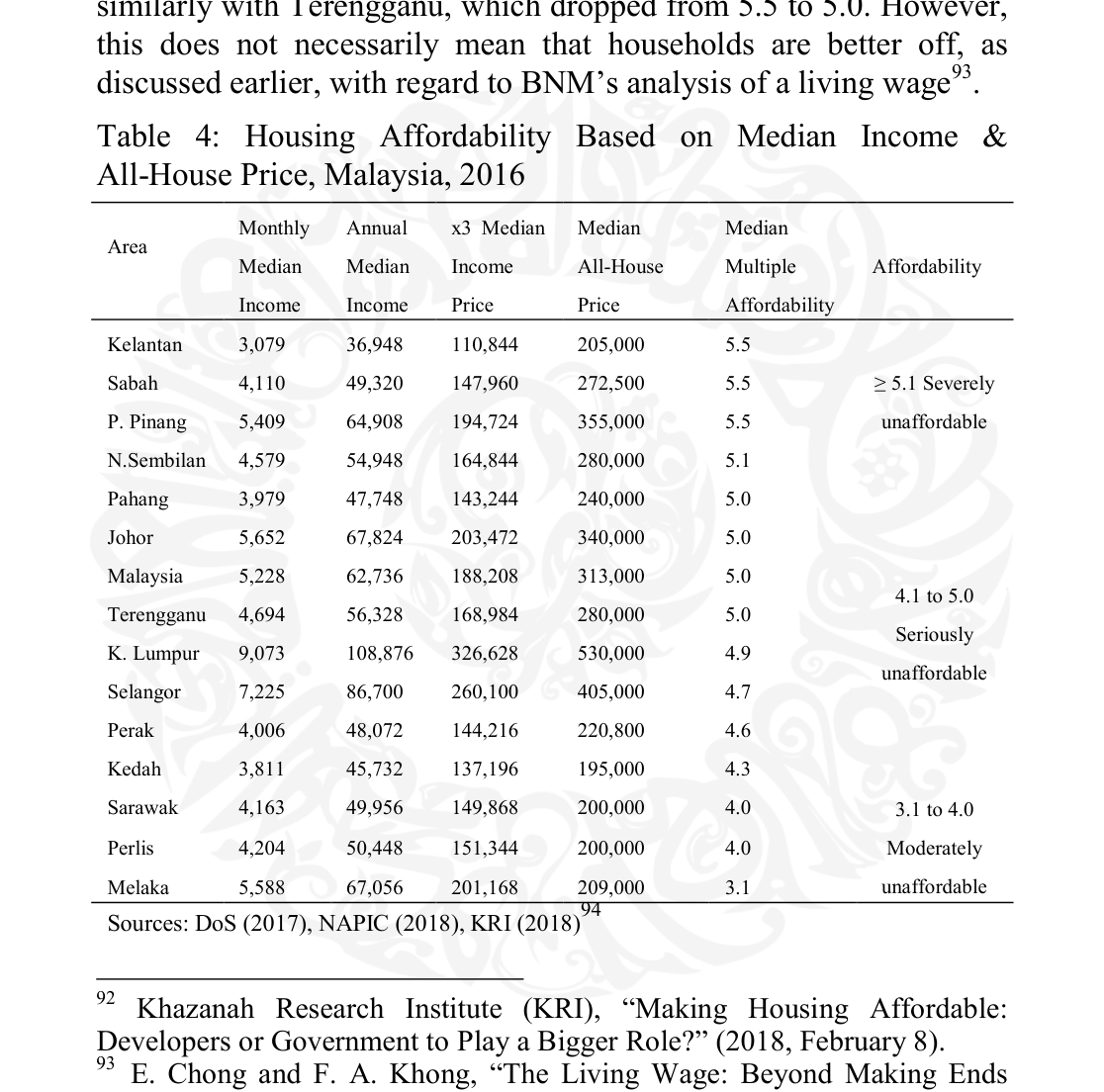
As we may further observe in table 4, the median all-house price in the Malaysian residential housing market, exceeds three times the median annual household income as a threshold for affordability. In 2014, the only state that was affordable was Melaka, with a median multiple of 3.0, but as of 2016 data, Melaka joins Sarawak and Perlis as moderately unaffordable states, and no state in Malaysia is deemed affordable. Those states that are now severely unaffordable are due to a lack of new launches below MYR All-House Price, Malaysia, 2016 Monthly Annual x3 Median Area
Income Income Price Kelantan 3,079 36,948 110,844 Sabah 4,110 49,320 147,960 P. Pinang 5,409 64,908 194,724 N.Sembilan 4,579 54,948 164,844 Pahang 3,979 47,748 143,244 Johor 5,652 67,824 203,472 Malaysia 5,228 62,736 188,208 Terengganu 4,694 56,328 168,984 K. Lumpur 9,073 108,876 326,628 Selangor 7,225 86,700 260,100 Perak 4,006 48,072 144,216 Kedah 3,811 45,732 137,196 Sarawak 4,163 49,956 149,868 Perlis 4,204 50,448 151,344 Melaka 5,588 67,056 201,168 en
272,500 5.5 ≥ 5.1 Severely
4.5 House Prices and Cost of Construction
On the other hand, in a profit maximizing business, housing developers have been unable to pass on the fact that throughout Malaysia (figures 10 to 14), construction costs actually declined in 2013, and have largely remained flat in recent years, whilst house prices continue to escalate. The building cost index95, reflects data changes in prices relating to building materials, labour rates as well as machinery rental rates and changes to equipment costs. Figure 10: Indices for All-House Price and Building Cost, K.Lumpur, Selangor, N.Sembilan, Melaka, 2008-2016 (2008=100)
Information Centre (NAPIC), (2018); Khazanah Research Institute (KRI), “Making Housing Affordable: Developers or Government to Play a Bigger Role?” (2018, February 8). 95 Building cost index from Construction Industry Development Board (CIDB), National Construction Cost Centre (NCCC), (2018) Figure 11: Indices for All-House Price and Building Cost, P.Pinang, Kedah, Perlis, 2008-2016 (2008=100)
Figure 12: Indices for All-House Price and Builfing Cost, Terengganu, Kelantan, 2008-2016 (2008=100) Figure 13: Indices for All-House Price and Builfing Cost, Sabah, Sarawak, 2008-2016 (2008=100)
Figure 14: Indices for All-House Price and Building Cost, Malaysia, 2008-2016 (2008=100)
We argue that as the value of money (VM) declines, due to the excessive money supply growing at aggregate interest, in relation to demand, the effect of which is higher prices96. In a cost minimizing business, developers have been hiring cheap foreign labour in order to cater for higher interest payments, but inevitably, the headline nominal all-house price index will increase, as bank direct their lending and credit creation to speculative non-GDP financial and real estate transactions97, as mentioned earlier. If this is the case, we would be able to structure and alternative solution that effectively passes on the savings in low construction costs, whilst avoiding the financial charges associated with debt finance. Accordingly, given our earlier literature review, we now turn to an historical Ottoman long-term lease financing solution (al-Hikr) to provide an affordable public housing solution.
5.0 Adoption of al-Hikr for Public Housing
5.1 Al-Hikr and Istisna’ Models
The framework for our al-Hikr model assumes that the trustee (lessor) of waqf or state land, enters into a long-term ground lease for 99-years with a new public housing board (lessee), where the lease agreement includes a reversionary clause, such that the land and the ownership of any buildings constructed on the land, will revert to the lessor at the end of the lease. This may involve some substitution (istibdal) for waqf properties in order to generate more income98, but 96 A. Abdullah, “Economic Security Requires Monetary and Price Stability: Analysis of Malaysian Macroeconomic and Credit Data”, (2015, Dec.) 97 A. Abdullah, Money and the Real Economy: An Islamic Perspective, (2018), 33-34 98 In fact, an “internal REITs” could be formed, such that small uneconomic waqf properties can be sold and substituted (istibdal) to form part of a new consolidated larger waqf property, in order to provide more income for the beneficiaries: c.f. A. Abdullah and B. Saiti, “A Re-Examination of Musharakah Bonds and Waqf Development: The Case of Singapore” (2016, Dec.) and A. Hasan and S. Sulaiman, “The Use of Islamic Real Estate Investment Trusts (i-REITS) as a Contemporary Instrument in Developing Waqf Assets: Potential Structural, Issues and Challenges” (2016). Alternatively, the cash raised could be utilized for renovating/developing other waqf properties: c.f. M. I. Abdel Mohsin, et al, Financing the Development of Old Waqf Properties, Classical Principles and Innovative Practices around the World, (2016), 239 in all cases, it would involve a long-term ground lease (al-Hikr) between the trustee of the land as the lessor, and a construction contract (istisna’) between the lessee and a third-party developer. Whilst this land may be idle, there are still beneficiaries and so market rates of return could apply. However, the annual income from rental earned would have to take into account that the proposed model involves providing low-cost state housing to those whose median or living wage is insufficient the cover the cost of housing under market terms and conditions.
The modus operandi of the long term “exclusivity” (al-Hikr) ground lease between the stakeholders, involving State Islamic Religious Councils (SRICs), State Development Corporations (SDCs), respective trustees (acting as managers for waqf or state land) and a new Public Housing Board (PHB) is presented in figure 15.
Figure 15: Long Term “Exclusivity” (al-Hikr) Ground Lease 99 M. I. Abdel Mohsin, et al, Financing the Development of Old Waqf 1. The respective Islamic Relgious Authority (SRIC) or State Development Corporation (SDC) authorizes the trustee as manager of waqf or state land to enter into a 99-year “exclusivity” (al-Hikr) ground lease with the lessee, a new Public Housing Board (PHB).
2. The al-Hikr, or exclusive right, is sold for an up-front rental payment equal to the nominal value of the land.
3. The lessee benefits from the usufruct of the land and pays an agreed nominal rent (as per historical practice) for the land over the period of the lease to the lessor. There is no change in classification of the ownership of the underlying land, although the lessee owns the building(s) constructed on it.
4. After the period of the lease ends, the land and the building(s)
constructed on it by the lessee, revert to the trustee (lessor).
The PHB can be a state or federal owned entity responsible for the leasing, managing and maintaining of low-cost state housing for onward sale or rental to Malaysian citizens. Sales would comprise of leasehold residential home sales to B40 citizens, while rentals would comprise of rental of shop-lots (convenience stores, clinics, pharmacies, kindergartens and so on) so that income earned would off-set the obligations of the lessee (PHB) associated with maintaining the leasehold property in general. In terms of the construction contract (istisna’), it is envisaged that the PHB would contract with a third-party developer, such as the Public Works Department of Malaysia100, to construct the low-cost housing as a turnkey project, such that individual units can be sold or leased immediately upon completion. In Islam, no caveat emptor exists in the case of negligence or poor workmanship by the construction company, so that a warranty period would apply post-delivery of the units to PHB and in turn, to the residential buyers and commercial shop-lot tenants. A government-linked developer would keep construction and subsequent maintenance costs low. The modus Properties, Classical Principles and Innovative Practices around the World, (2016), 240 100 JKR, Public Works Department (Jabatan Kerja Raya) Malaysia, (2018), accessed on 19 June 2018, https://www.jkr.gov.my/en operandi of the construction contract (istisna’) is presented in figure 16.
Figure 16: Construction Contract (Istisna’)
Source: adapted from Abdel Mohsin et al (2016)101 1. The lessor enters in to an istisna’ agreement with a developer to construct/develop waqf or state land, paying either a lump sum or through installments.
2. On completion, the developer delivers the developed property to the lessee.
5.2 Investment and Affordability Analysis
As mentioned earlier, the PHB will rent shop-lots on commercial terms, but sell residential leaseholds on the basis of what the needy can afford. Therefore, our model is based on affordability, such that the investment analysis must establish whether the inputs of affordable incomes, justify the investment in land and construction. We assume that our target group involves the B40 category with a median household monthly income of MYR 2,848 in 2016102. We also assume that this group may only be able to afford 20% of the median income towards the cost of housing, or approximately MYR 570 per month. According to data from JUMB and Arcadis 103 property consultants, constructions costs in selected Malaysia cities are presented in table 5. The construction costs comprise building 101 M. I. Abdel Mohsin, et al, Financing the Development of Old Waqf Properties, Classical Principles and Innovative Practices around the World, (2016), 241 102 Department of Statistics (DoS), Malaysia, “Report of Household Income and Basic Amenities Survey 2016”, (2017, October 9) 103 JUMB and Arcadis, “JUBM and Arcadis Construction Cost Handbook”, Malaysia, (2017), accessed on 22 June 2018, https://www.arcadis.com/ en/asia/our-perspectives/research-and-publications/arcadis-construction-cost -handbook/ costs (including preliminaries) and services (including mechanical, electrical, hydraulic, fire and lifts), as applicable.
From the perspective of the lessor (PHB), the up-front rental to the land trustees and the construction costs paid to the developers, are effectively the investment in the leasehold project. We assume the rental income generated from the commercial shop-lots will cover the cost of any operating expenses and maintenance. Therefore, the leaseholds that are sold should be pegged to affordability rather than indexed to a forward rental or house price index. Since, the beneficiaries of waqf land can be the public (waqf khayri) and the owners of state land are also the public, Al-Ghazali identified (in the Ihya Ulum al-Din) that it is incumbent upon a Muslim government to provide basic necessities of food, clothing and shelter104, so that the citizens are able to perform their ibadah to Allah (s.w.t.). On this basis, the cost of land would be sourced at a nominal value. Table 5: Construction Costs, Selected Malaysian Cities (MYR / sqft)
| Type of | Kuala | Johor | Kota | Floor size |
|---|---|---|---|---|
| Penang | Kuching Average | |||
| Property | Lumpur | Baru | Kinabalu | 1,000 sqft |
| Low cost | 59.5 | 64.6 55.0 | 58.1 71.5 | 61.72 61,725 |
| housing | ||||
| Low cost flats | ||||
| (low rise, less | 84.5 | 89.7 74.4 | 72.0 93.4 | 82.80 82,795 |
| than 6 levels) | ||||
| Low cost flats | ||||
| (high rise, less | 109.2 | 97.1 92.1 | 82.7 106.4 | 97.47 97,474 |
| than 15 levels) | 105 | |||
| Source: adapted from JUMB and Arcadis (2018) | ||||
| The JUMB and Arcadis data implies the average cost of | ||||
| construction, in terms of the cost of building and services, is MYR | ||||
| 61,725 for a single storey (3 room) terrace unit, with a floor area of | ||||
| S. M. Ghazanfar, |
Low cost flats (low rise, less 84.5 89.7 74.4 72.0 93.4 82.80 82,795 than 6 levels) Low cost flats (high rise, less 109.2 97.1 92.1 82.7 106.4 97.47 97,474 than 15 levels) Source: adapted from JUMB and Arcadis (2018)105
The JUMB and Arcadis data implies the average cost of construction, in terms of the cost of building and services, is MYR 61,725 for a single storey (3 room) terrace unit, with a floor area of 104 S. M. Ghazanfar, Medieval Islamic Economic Thought, (London: Routledge, 2003), 31 105 JUMB and Arcadis, “JUBM and Arcadis Construction Cost Handbook”, Malaysia, (2017), 16-24 1,000 sqft (92.9 sqm106). In our discussions with practitioners107, this figure in reality might be too low, and instead, we have assumed MYR 75,000 (with any contingencies expensed out). We may include 10% of the total development costs (DC) for local development costs in order to obtain the Development Order (DO) building permit. We may also include a 15% profit margin in the DC to the developer. We also assume that the up-front nominal value of the land area apportioned to this unit is MYR 500 per lot, which along with the DC would comprise the initial investment cost and be incorporated into the market price. The annual nominal rental payments to the Lessor are also assumed to be MYR 500 per annum (or MYR 10,000 over a period of 20 years) and would be deducted from cash flow. Finally, we also include a suitable profit margin to PHB of 20% of the market price (MP), given its responsibility to source land, organize the construction, pay for advertising and consultancy as well as manage and maintain all the units to be sold as public housing. Accordingly, the total cost breakdown is presented in table 6, revealing an initial investment of MYR 100,500 and a market price (MP) of MYR 125,625. Table 6: Low-Cost Housing Development Costs, Kuala Lumpur
| Development Costs | MYR |
|---|---|
| Construction costs | 75,000 |
| Local Development Costs (10% of DC) | 10,000 |
| Profit to Developer (15% of DC) | 15,000 |
| Development Costs (DC) | 100,000 |
| Up-front Rental to Lessor | 500 |
| Initial Investment | 100,500 |
| Profit to PHB (20% of MP) | 25,125 |
| Market Price (MP) | 125,625 |
| B40 | Lessor Rental | |
|---|---|---|
| Year | Installments | NCF Payback Payments |
| 0 | (100,500) | |
| 1 | 6,840 | (500) 6,340 (94,160 |
| 2 | 6,840 | (500) 6,340 (87,820) |
| 3 | 6,840 | (500) 6,340 (81,480) |
| 4 | 6,840 | (500) 6,340 (75,140) |
| 5 | 6,840 | (500) 6,340 (68,800) |
| 6 | 6,840 | (500) 6,340 (62,460) |
| 7 | 6,840 | (500) 6,340 (56,120) |
| 8 | 6,840 | (500) 6,340 (49,780) |
| 9 | 6,840 | (500) 6,340 (43,440) |
| 10 | 6,840 | (500) 6,340 (37,100) |
| 11 | 6,840 | (500) 6,340 (30,760) |
| 12 | 6,840 | (500) 6,340 (24,420) |
| 13 | 6,840 | (500) 6,340 (18,080) |
| 14 | 6,840 | (500) 6,340 (11,740) |
| 15 | 6,840 | (500) 6,340 (5,400) |
| 16 | 6,840 | (500) 6,340 940 |
| 17 | 6,840 | (500) 6,340 7,280 |
| 18 | 6,840 | (500) 6,340 13,620 |
| 19 | 6,840 | (500) 6,340 19,960 |
| 20 | 5,665 | (500) 5,165 25,125 |
| Total | 135,625 | (10,000) 125,625 |
| IRR | 2.2% | |
| Figure 17: Shareholders of PHB (Lessee) |
106 Conversion factor 1.0 sqm = 10.7639 sqft: 1,000 sqft / 10.7639 = 92.9 sqm. 107 The authors wish to express their gratitude for development cost advice and inputs from Thriven Global Bhd.
With regard to PHB’s profit margin, murabaha has been widely adopted by many Islamic banks and referred to as “cost-plus financing” and approved by AAOIFI (2015). However, such practices involve Islamic banks operating like “riskless principles” according to American regulators when murabaha products were introduced in to the United States108. According to Al-Zuhayli109, goods can be sold at a price either at a loss (wadi’a), at break-even (tawliya), can be sold in full or in part (‘ishrak), at a disclosed profit (murabaha), or simply sold at a price without disclosure of the original cost (musawama) and are known as trust sales. Thus, murabaha originally meant the disclosed profit of a price that was subject to market risk and certainly did not involve a pre-fixed or pre-determined risk-free “mark-up” at the time value of money (rate of interest). PHB may control the supply and thereby influence the market price, given its foreknowledge of the demand from B40 applications, but only a market price will be mutually agreed once the units are available for sale. Indeed, we may assume that a B40 buyer may be unable to provide a down payment and neither would PHB accept a binding promise (wa’ad) or booking payment.
Since, B40 median monthly income is MYR 2,848, therefore annual income is MYR 34,176, and by dividing the PHB market price (MP) of MYR 125,625 by the B40 annual income, we obtain 3.7 times, which indicates that this is moderately unaffordable to the B40. However, the PHB and the buyer could mutually agree an unambiguous deferred payment (bai’ mu’ajjal) in monthly installments of MYR 570110 per month, which represents 20% of B40 median income of MYR 2,848, over a period of 20 years.
The installments would not be calculated according to any constant rate return amortization schedule involving an interest rate, or even be benchmarked to an interest rate. Instead, the installments 108 A. Abdullah, “Examining U.S. approvals of Islamic financing products and the Islamic theory of lawful profit”, (2016, Oct.) 109 W. Al-Zuhayli, Islamic Jurisprudence and Its Proofs. 2 Vols. (Damascus: Dar al-Fikr, 2003), Vol.1, 353-354 110 Actual figure is MYR 569.60 at 20% of median income (MYR 2,848), which we have rounded to MYR 570. are pegged to affordability. Hence, this is more affordable than the 1/3rd of monthly income for installments typically adopted as a rule-of-thumb guide by banks. Furthermore, MYR 570, as 20% of B40 median income, represents a figure that is less than the combined, employer (13%) and employee (11%), EPF contributions of MYR 683 on a monthly wage between MYR 2,820.01 and MYR 2,840 111 . Hence, the installments (and any other takaful contributions) could in reality be paid out of the B40’s EPF account, rather than from monthly income, thereby actually increasing disposable income, as well as provide affordable housing for the needy.
The net cash flow, IRR and payback are presented in table 7 for the sale of a new unit between PHB and a B40 buyer, assuming a market price (MP) of MYR 125,625. The development and up-front rental are capitalized and treated as an initial investment of MYR 100,500, such that the investment payback is 15.9 years112. The net cash flow over 20 years (MYR 125,625) reflects B40 installments (MYR 135,625) less nominal rental payments (MYR 10,000). The net annual cash flow of MYR 6,340 reflects an annual income yield of about 6.3%113, even though the internal rate of return (IRR) is low (table 7) over 20 years, but in reality, the IRR could be higher over a 99-year lease period.
The income yield income is interesting, as this would encourage government linked investment companies (GLICs), such as Khazanah, Lembaga Tabung Haji (LTH), KWAP (government pension fund) and EPF (national pension fund) to become equity investors (figure 17), since they on average provide yields of about 6% to their members.
111 Employees Provident Fund (EPF), Contribution Rates, (2018), accessed on 22 June 2018, http://www.kwsp.gov.my/portal/en/web/kwsp/member/ member-responsibility/contribution/contribution-rate 112 Initial investment MYR 100,500 / net cash flow of MYR 6,340 = 15.9 years. 113 Rental income of MYR 6,340 / initial investment of MYR 100,500 = 6.3%.
0 1 6,840 2 6,840 3 6,840 4 6,840 5 6,840 6 6,840 7 6,840 8 6,840 9 6,840 10 6,840 11 6,840 12 6,840 13 6,840 14 6,840 15 6,840 16 6,840 17 6,840 18 6,840 19 6,840 20 5,665 Total 135,625
(500) 6,340 (94,160 (500) 6,340 (87,820) (500) 6,340 (81,480) (500) 6,340 (75,140) (500) 6,340 (68,800) (500) 6,340 (62,460) (500) 6,340 (56,120) (500) 6,340 (49,780) (500) 6,340 (43,440) (500) 6,340 (37,100) (500) 6,340 (30,760) (500) 6,340 (24,420) (500) 6,340 (18,080) (500) 6,340 (11,740) (500) 6,340 (5,400) (500) 6,340 940 (500) 6,340 7,280 (500) 6,340 13,620 (500) 6,340 19,960 (500) 5,165 25,125 (10,000)
1. The shareholders (GLICs) provide equity capital to the lessee (PHB).
2. PBH provides annual dividends to the GLICs.
For new units, the above framework applies, but it also applies for re-sale units. In this case, PHB buys back a unit from an existing B40 leaseholders at the current market value and re-sells it to new B40 buyers, whilst accepting any risk between the two purchase and sales agreements. In this case, the demand for low-cost housing is likely to mitigate any increase in housing inventory held on the balance sheet of PHB. Furthermore, PHB still also accepts the risk associated with repayments in terms of affordability with the new B40 buyer. If the B40 median income declines, or a household has difficulty with repayments, then the tenor of the repayment schedule would be extended. In reality, by making these installments affordable, it would actually serve to mitigate repayment risk. Moreover, an exchange of PBH properties could occur between B40s in different locations, so that any difference in values could be settled through netting (muqasah).
In summary, in terms of risk management, the PHB is accepting construction risk, although that is mitigated with any warranty with the developer, and the risk of repayment of the installments with a B40 buyer. By introducing an Islamic socio-economic package, monthly installments could also include medical, life and home-owners’ takaful, as well as, SOCSO contributions to mitigate risks associated with the primary income earner for the household, and not adversely affect the family going forward. In fact, the involvement of EPF becomes readily apparent, in a similar manner to the Singapore CPF and HDB, so that monthly installments and takaful contributions could be paid from the B40’s EPF account, as mentioned earlier, since EPF contributions total 24% and installments are only 20% of median income.
Furthermore, as with the HDB in Singapore, in larger town-ships, sustainable town-planning initiatives could be introduced, including green and technological advancements, such as pre-fabrication construction, water and energy conservation, as well as hydro, waste and solar-to-energy renewable projects114. Over time, units can be further tailored to the B40 group, in terms of the supply of homes for differing demographics, such as singles, small or larger family sizes and the elderly, that would involve a different combination of rooms and facilities.
6.0 Conclusion and Recommendations
In our findings, we established that Malaysian household debt represents 67% of GDP. In recent years, the residential sector continues to dominate the Malaysian property market, representing about 64% of the total real estate market by value. Whilst nominal house prices have grown by 9.4% p.a. since 2010, in real terms, house prices have remained constant over the long term, implying that aggregate interest, money creation and lending have combined to fuel a real estate asset bubble. Meanwhile, the B40 with a median monthly income of MYR 2,848 is below the median monthly income for Malaysia of MYR 5,228. Indeed, at a median multiple of 5.0 for Malaysia, housing has become seriously (and almost severely) unaffordable. Meanwhile, house prices continue to rise, whilst construction costs remain flat.
Against this backdrop, and absent of short term monetary and finance reform, this paper has established that a long-term leasehold (al-Hikr) financing structure can deliver affordable low-cost public housing to the B40 for MYR 125,625 with installments of MYR 570 per month depending on the median income of the B40. This would nonetheless provide a cash-on-cash income yield of 6.3%, which would incentivize the participation of GLICs as equity investors in a new public housing board (PHB) for Malaysia. We adopted a nominal rather than market value of the land in the form of the up-front al-Hikr rental due to the lessor, since the beneficiaries of the a public waqf and state land are the needy (B40), thereby reducing monthly installments, whilst maintaining a suitable income yield. Moreover, the B40 can utilize their EPF accounts to pay for the installments including SOCSO, healthcare, home-owner and life takaful cover, thereby actually increasing disposable incomes, so that 114 Housing and Development Board, Singapore (HDB) (2018). a holistic Islamic social finance solution can provide affordable housing for those in need.
Accordingly, we recommend the development of a pilot project comprising the construction of a new township in one of the states, that would also involve a feasibility study relating to land allocation and location, detailed construction costs, design and lease-hold pricing, as a template for a national public housing plan.
Notes
Source: adapted from Abdel Mohsin et al (2016)99 Profit to PHB (20% of MP) Market Price (MP)