
Effat College of Business, Effat University, Jeddah; Z Consulting Group Sdn Bhd; International Islamic University Malaysia
INTRODUCTION:
There are financing constraints that micro, small and medium enterprises (MSMEs) can face when trying to obtain funds, especially having to approach banks and other moneylenders [1]. Trade credit financing and matching may be alternative methods used for working capital management, but literature has shown that these can contribute to additional constraints too [2].Though trade credit may help MSMEs in obtaining and retaining customers, it also mops up liquidity available to the firm. The opportunity cost of providing trade credit is having funds available from debtors, which can be then utilized for other financial obligations and business development [3]. Sharia law includes not only law of Islam, but also the law itself, the prescriptions and prohibitions of various practices aimed at maintaining the moral integrity of the Muslim population [4].In an attempt to retain the facility of trade credit without the financial constraints that normally entail it, this research proposes an alternative credit clearing system that can help boost the liquidity of MSMEs, enabling it to be solvent at all times. This model incorporates elements of trade credit financing, invoice discounting, and credit clearing in an attempt to come up with an alternative credit clearing system that will provide benefit for all stakeholders involved. In the following sections, the proposed model will be drawn up, dissected and discussed in terms of applicability and viability.
METHODOLOGY
The methodology of this research involves the proposed conceptual model and defines the participants in the credit cycle.
Proposed Conceptual Model
Upon evaluating studies on trade credit and working capital management issues faced by SMEs, a conceptual model of an alternative credit circuit that is backed by trade credit has been drawn up to help provide liquidity to credit-constrained SMEs who may face financial problems due to late payments from their buyers.For the purpose of design, the researcher adopts the framework of a credit circuit. Parguez and Seccarecia [5] theorizes that in a monetary circuit, buyers and sellers can transact with each other, with currency borne out of balance sheet operations through a third party. In a model conceived by Van Arkel [6], the system monetizes claims on future payment (or receivables) to offer a method of settling payment commitments between parties, thus negating the need for cash. In this system, exchange can be established, and purchasing power can be boosted and circulated within the network developed.Lietaer [7], in his position on a credit circuit, further proposes that insured invoices can be utilized as “liquid payment instruments within a business to business clearing network”. Conversion of these invoices into usable credits can enable the users to pay their own suppliers with these credits, or convert them back into national currency.
Participants Of The Credit Circuit
In this section, the main participants of the credit circuit system will be described.
1.1.1 MSMEs
The MSMEs may either be sellers (offerors of trade credit) or buyers (receivers of trade credit) in this system. In most cases, and as observed in literature review and data analysis, majority of the MSMEs is expected to be sellers.
1.1.2 Corporations
As with the MSMEs, the corporations, or big firms, may be buyers or sellers within this setup. There will be benefit for corporations in either role. However, it is expected that corporations would be the buyers, or receiver of trade credit within this system.
1.1.3 Government Agency
The government agency or body is required to add some regulatory function, and to add credibility to the system.
1.1.4 Clearinghouse
A clearinghouse is a separate entity that is responsible for settling accounts and clearing trade credits, create and disseminate credits against invoices received, and maintain accounts and records of trading data and delivery. They are intermediaries that facilitate transactions and maintain the circulation of the credits within the circuit network.
1.1.5 Insurance Firm / Takaful Operator
The concept of Takaful, or Islamic insurance, is where members mutually participate to guarantee each other against loss. Each member is required to contribute a specified amount of payment to a fund that will be controlled and managed by the takaful operator. The takaful operator will then manage the funds in return for a share of the profits. In the event of a loss incurred, the takaful operator will distribute the funds accordingly to its participants. Any surplus from the funds is paid out only after all obligations of assistance to its participants are fulfilled. This way, the takaful will be a source of protection and also a profit-sharing venture between the operator and its participants [8].
Modus Operandi
In this section, the mechanism of the proposed solution will be described, with all the participants in place, and each transaction being defined. For ease of explanation, the system will be described end-to-end to enable the reader to fully comprehend the life cycle of the transaction. Figure 1 illustrates the proposed credit circuit.
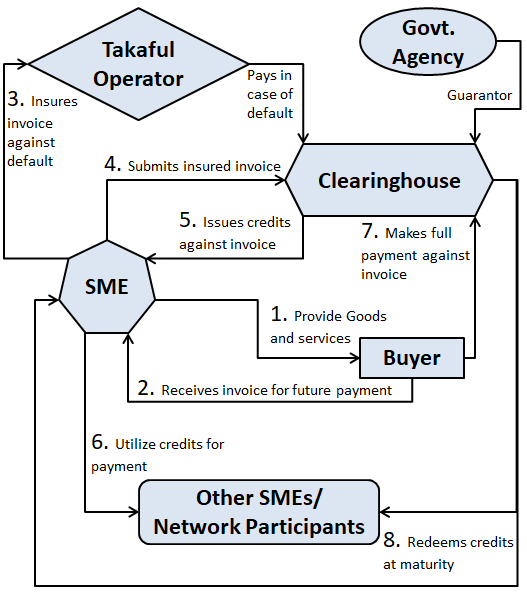
A MSME is providing goods and services to one of their customers, which is a large corporation. The MSME is already registered within the credit network. The following steps outline all actions that occur from the time the MSME provides goods and services on credit, until the time the receivables are paid off by the buyer.
1. The MSME has provided goods and services to a Buyer (assume a large
corporation) on a 60 day credit.
2. The MSME obtains an invoice that indicates payment will be made after
60 days by the buyer.
3. The invoice is insured against default with the Takaful Operator. The
MSME may pay a periodic premium to avail this insurance, and the
premium may be based on the scale, nature and frequency of their
business.
4. The MSME then submits the insured invoice to the Clearinghouse.
5. The Clearinghouse will then issue equivalent credits which will be backed
by the amount stated in the invoice submitted.
6. The MSME now has the option to either convert the credits for cash or
utilize it within the network with other MSMEs or participants registered
with Clearinghouse. The MSME can use these credits to pay off existing
liabilities.
7. At settlement date (after 60 days), the Buyer will pay the full invoice
amount to the clearinghouse.
8. The holder(s) of the credits (that were backed by the invoice) at settlement
date will receive payment in national currency from clearinghouse and
disbursed credits will be redeemed.
9. In case of default by the buyer, the Takaful operator pays the full invoice
amount to the clearinghouse on the settlement date.
RESULT AND DISCUSSION
Benefits Of The Proposed System
In this section, the key benefits of implementation of the proposed system will be discussed for each of the parties involved.
1.1.6 MSMEs
The main party that this system aims to benefit and empower is the SMEs themselves. The main benefit that the MSMEs can derive is in the improvement of its liquidity positions, as credits can be obtained readily which can then be used for payment and consumption within the network. MSMEs do not need to be constrained until the maturity of its trade credit terms to receive funding and liquidity. When implemented, this system can issue credits against its receivables, which is almost as good as holding cash in itself. This can help strengthen their balance sheet positions, as these credits can be listed as current assets, which have purchasing power of their own. By participating, the MSMEs can transfer the default risk of the buyer to the clearinghouse, and hedge it through the Takaful Operator, and utilize the credits obtained for business purposes within the network or convert them into cash, hence adding certain flexibility to their working capital management decisions. The total benefit of this option will be realized once the network grows and there are a lot of participants, particularly other MSMEs, within the circuit. When the network is large enough, and the credibility of the system is strengthened, then the velocity of the credits within the network can be increased.As all the transactions will be conducted and monitored on an electronic payment platform, the system can be developed to generate credit records for all the transactions of a particular MSME within the system. These records can include the information on the amount of trade credit extended and received, and the payment periods of these receivables. These records can then be used as official records by the financial institutions to assess the creditworthiness of MSMEs, which can help the MSMEs to obtain better financing from formal institutions.With the participation of financial institutions within the network, credit records generated can help MSMEs gain better financial inclusion within the formal financial markets, as the electronic payment platform can provide information that was previously limited to supplier and buyer alone. Greater financial inclusion can provide more efficient allocation of financial resources towards the MSME industries. The overall effect would be that of a higher endogenous growth within the MSMEs, as they are able to produce higher output with no major change towards their business practices. This will help promote full utilization of existing resources, both physical and human, into production.
1.1.7 Buyer
There will be benefits to the buyers and customers of these MSMEs. The major benefit for buyers is that they will be able to maintain business with their MSME suppliers, and avail trade credit as usual without any extra cost or impairment of the existing relationship, as the MSMEs can still sustain their businesses through alternative credits. Previously, SMEs that have been credit constrained were not able to sustain production and delivery of goods and services due to late payment and lack of short term financing. As this system puts focus on the creditworthiness of the buyer, than the seller, the buyer (especially the MSMEs) would have a better incentive to pay on time to ensure that it keeps a good track record in order to avail competitive trade credit terms from the market.
1.1.8 Clearinghouse
The clearinghouse can earn revenues from service charges, early redemption fees, financial report generation and collateralization. These methods of revenues will be described in detail in the sections to follow. The clearinghouse will be the “heart” of this system by ensuring circulation of the “lifeblood”, which are the credits.
1.1.9 Banks
Banks and other financial institutions would also benefit by being part of this network, as it can help extend their current portfolio. The activities and payment behaviors of MSMEs which are recorded in this network can help in risk assessment and mitigation strategies that can be used when disbursing loans to them. This can lead to greater financial inclusion, and the active trade and payment using credits can help strengthen the possibility of banks extending financial statement lending to MSMEs.
1.1.10 Local Governments
By placing a dedicated government agency as a guarantor can be advantageous to the overall economy in several ways. Firstly, it can help add credibility to the overall system, and thus provide some confidence to MSMEs to participate. This factor, combined with the other elements above, may provide the strongest credence and motivation for enterprises to be part of the system.As for local governments, it provides an alternative system of tax monitoring and tax collection, as tax may be imposed on each transaction, or from the membership fees and services provided by the clearinghouse. The local government may also avail the financial report generation service by the clearinghouse, in order to assess the creditworthiness of bona fide companies which may wish to seek further government assistance and financing. A further step can be taken whereby the local government may accept the payment of tax in the form of the credits in circulation, thus making them also active participants of the system.The increased trade and employment, can give rise to a multiplier effect of the amount of tax that can be collected in the form of Goods and Services Tax (GST) or income tax. Though the benefit may not be direct, but active participation by the local government can help in the sustainability and operational credibility of the system in the long run.
Alternate Revenue Generation For Clearinghouse
This model can also open up avenues for alternate revenue streams for the clearinghouse. Alternate revenue streams would be instrumental towards the sustainability of the clearinghouse, and ultimately the whole system. In this study, four methods of revenue generation will be discussed, namely membership fees, early redemption charges, collateralization and financial report generation Although the main function of the clearinghouse is to manage debits and credits of the individual MSME accounts, there are still operational costs that are incurred. It is important to identify methods to generate revenue for the clearinghouse that would be both feasible and sustainable. As a starting point, the purpose of the clearinghouse is not to make a profit, rather to facilitate the disbursement and distribution of credits as an alternative payment system.The first method that is proposed is by charging membership fees to firms that wish to be part of this system. The membership fee could be a one-off payment at the beginning, or a periodic fee. It is imperative that the fee be a nominal amount in order to encourage subscription by the highest number of firms. The benefits for the firms, especially the MSMEs, far outweigh the costs, and they will be heavily incentivized to be part of the network that would allow them liquidity through alternative credits. The second method proposed for revenue generation is by charging a fee for early redemption of credits. As has been described earlier, the credits are issued against the invoiced receivable which is to be redeemed at maturity. There may be a need for MSMEs to redeem these credits at an earlier date to settle payments or liabilities outside of the network. Thus, MSMEs can be charged a certain transaction fee for early redemption. This can also serve as a deterrent for MSMEs to not redeem credits before maturity, and encourage further circulation of credits until they mature. The third method proposed is collateralization, which will be an attractive option once there are many participants in the credit network. MSMEs may pledge certain assets, other than their invoiced receivables, with the clearinghouse in exchange for credits. A possible motive for SMEs to avail this method is to obtain credits for payments by collateralizing assets that may not be accepted in other traditional financial institutions. The clearinghouse may charge a fee for collateralization under this plan. As Haron and Shanmugam [9] explain, pawnbroking is an arrangement whereby certain collateral is pledged in return for a loan. Traditionally, the ownership of the pledged item, or collateral, is transferred to the lender in the event of non-repayment of loan.The fourth avenue of revenue is through the generation of financial reports of MSMEs by the clearinghouse. As the credits that have been issued and circulated are monitored through an electronic platform, it allows for certain records and reports to be generated detailing the transactions of the MSMEs selling and payment behavior in the past. These records can be then used to create an alternative credit report or credit score that can be used for loan or financing applications with traditional financial institutions such as banks. This can be feasible, and beneficial, once the MSME has been with the network for a certain minimum period of time, or have conducted a number of transactions through the credit network. This is directly related to the informational theory of trade credit; the supplier has an advantage over traditional lenders in assessing the creditworthiness of their buyers, monitoring their payments and forcing repayment from their buyers.There may be other methods in which the clearinghouse can earn revenues, such as service fees for providing an online platform for advertising by participating firms, relationship fees with Takaful agencies, service fees for financial institutions who wish to obtain credit records, and so on. These may be developed and implemented once the system is fully functional and in place. In this way, the financial institutions can benefit as they would save on the information cost of trade credit behavior of MSMEs, and the expense would be borne by the MSMEs themselves, as both parties seek to benefit from each other. This can subsequently lead to greater financial inclusion of previously small and credit-constrained businesses.
Potential Issues And Their Remedies
Although the proposed model can bring out many benefits for all the parties involved, there are some foreseeable issues that would require resolution once it is implemented. Firstly, it is to be determined as to how much of credit is to be issued against the invoiced receivable. As trade credit discount will be issued for each invoice, and if credits can be used as a medium of payment, it is to be identified if credits should be issued according to the full amount stated on the invoice, as the buyer may choose to take advantage of the early payment discount, leading to a situation whereby the seller may be getting extra credits from the system. For example, if the seller chooses to give a 2/10/30 credit term, whereby the buyer has 30 days to make full payment and the option of a 2% discount if payment is made in 10 days, and need to identify how much of credit should be disbursed against this invoice, and for how long.In an attempt to mitigate this issue, it is proposed that disbursement of credits is only allowed after it is established that the buyer will not be availing the early payment discount. The credits can be disbursed after the early payment discount period is over, as stipulated in the invoice. As in the above scenario, credits should be disbursed after the first 10 days, and should have a maturity of 20 days. This can allow for the buyer to avail the trade credit discount if he had the means.The second issue relates to the convertibility of the issued credits into national currency. From the modus operandi, it can be seen that the payment of the backed invoice takes place at maturity of that particular trade credit term. As such, the currency for conversion will only be available at the maturity of the credit term, implying that credits can only be converted at maturity, and will remain in circulation as credits until that date. This can lead rise to two possible problems. The first is that MSME managers will be unable to use these credits as a medium of payment with stakeholders who are outside this network. The second issue is that a comprehensive system needs to be designed in order to track each credit issued and their respective maturities. This is necessary if such a system is going to be implemented on a large scale, as there will be many transactions undertaken each day.A third issue that can crop up is with regards to the circulation velocity of these credits. There has to be an incentive for the buyers or holders of credit to circulate it within the network. If a seller exchanges his invoice for credits, and holds it until maturity, and then redeems the credits for cash, the overall effect would be like as if he had to wait for his buyer to pay in cash, minus the transaction costs of exchanging invoice for credits. The existence of transaction costs, although very nominal, will help spur circulation of credits in pursuit of returns that are higher. Also, the opportunity cost of holding onto credits without circulating, is the numerous business transactions that can take place in the meantime. This can include settling accounts payables, purchasing of more raw materials for production, payment of utilities and salaries among others. This can be particularly useful for suppliers who have high frequency orders and those whose raw materials and products are of perishable nature. Therefore, it can be assumed that the presence of transaction costs, and the credit constraint often faced by MSMEs for working capital management, will help ensure circulation of credits at a sustainable velocity. This can help further improve employment of resources across the firm, both physical and financial.
Shariah Compliance
In the attempt of designing a solution that is Shariah compliant, the main issue that arises is the nature of the credit as money, and its permissibility within the realm of Islamic finance. This is related to the intrinsic nature of credits, and if it should be categorized as money or quasi-money, and the restrictions around it. To this end, this paper proposes using the concept of Bay al Dayn to support the credit network, and the permissibility of trading or securitizing account receivables for liquidity purposes will be explored.Dayn is an Arabic word, which can be translated as debt, or a payment obligation that is borne from a transaction where “one of the counter values is deferred”. Bay al Dayn, translates into “trading of debit”. In the context of the proposed model, Dayn refers to the payment receivable that arises due to the trade credit offered. There are two types of Bay al Dayn, namely Bay al Dayn al Naqd and Bay al Dayn Nasi’ah.Bay al Dayn al Naqd refers to the spot sale of debt for cash. Bay al Dayn Nasi’ah refers to the sale of debt on a deferred basis, one that is rejected by most scholars [10].As such, for the proposed model, look into the Bay al Dayn al Naqd, where the debt is transferred for credits, acting as money, which will have purchasing power within a specialized network. Within this type of trade, there are two subcategories: Bay al Dayn li al-Madin, where the debt is sold back to the debtor itself, and Bay al Dayn li Ghayr al-Madin, where the debt is sold to a third party [11].As this paper looks at trading of credits around a network, Bay al Dayn li Ghayr al-Madin is best suited to fit the description. There are several differing juristic opinions regarding this type of sale. Some schools of thought, namely Hanafis, Hanbalis and Zahiris, do not allow this type of trade due to the excessive uncertainty that surrounds the repayment of debt by the debtor. However, Malikis and some Shafii scholars have allowed this as there are no explicit texts demanding its prohibition. The basis is that as the ownership of debt lies with the creditor, it is within his right to sell it to anyone whom he wishes [12].According to the Shariah Advisory Council in Malaysia, Bay al Dayn is endorsed for Islamic financial instruments, as they opined that sale of debt to a third party is permissible as long as the debt is guaranteed and exchanged on a spot basis for a counter value, be it cash or any other tangible assets [13].Upon evaluating the nature and rulings of Bay al Dayn, this study propose that credits be issued against the trade credit amount at a par value and can only be exchanged at par with a full conversion at maturity once the debt is paid in full. The credits issued should not have any element of interest, nor should be priced according to time value of money. Hence, this method will be conducive as the underlying asset that backs the credits, as proposed by Raheem, Meera, and Adewale [14]. Due to the relatively short maturities of trade credit, it is expected that the maximum term of a credit issued be up to 60 days, which will be the maximum time these credits will be circulated before being converted into national currency.On the topic of convertibility of debt into cash, Mufti Taqi Usmani [15] rules that “In fact, the prohibition of bai„-al-dain is a logical consequence of the prohibition of ‘riba’ or interest. A ‘debt’ receivable in monetary terms corresponds to money, and every transaction where money is exchanged for the same denomination of money, the price must be at par value. Any increase or decrease from one side is tantamount to ‘riba’ and can never be allowed in Shariah.”The main objective of the proposed model is to boost the liquidity of MSMEs to fulfill their current obligations. As such mechanisms should be put in place to encourage circulation of credits until they mature, in order to benefit from the multiplier effect. One method proposed is to attach a fee to conversion and redemption of credits prior to maturity. This fee must be reflective of the administrative cost borne and should not be linked to the amount of trade credit that is to be converted. It is expected that these features proposed and explained above will help render the system Shariah-compliant.
CONCLUSION
MSMEs face financing problems when encountering late payments from their customers, to who trade credit have been extended. In order to facilitate trade and ensure liquidity availability to the MSME, a model is proposed in this research that effectively monetizes trade credit and enables the MSME to remain liquid and maximize employment of its available resources. Finally, this research also covers alternative income generation methods for clearing houses, as well as potential problems and remedies, and compliance with Sharia law.
ACKNOWLEDGMENTS
The authors would like to express their deepest gratitude to the College of Business, Effat University.
REFERENCES
Malhotra, M. 2007. Expanding access to finance: Good practices and policies
for micro, small, and medium enterprises. World Bank Publications.
Fabbri, D., and Menichini, A. M. C. 2010. Trade credit, collateral liquidation,
and borrowing constraints. Journal of Financial Economics. 96, 3,
413-432.
Petersen, M. A., and Rajan, R. G. 1997. Trade credit: theories and evidence.
The review of financial studies. 10, 3, 661-691.
Todorof, M. 2018. Shariah-compliant FinTech in the banking industry. ERA
Forum 19. 1-17. DOI=10.1007/s12027-018-0505-8
Parguez, A. and Seccareccia, M. 2000. The Credit Theory of Money: The
Monetary Circuit Approach, in J. Smithin, (ed.), What is Money?
(London: Routledge).
Van Arkel, H. G. P. 2012. U.S. Patent Application No. 13/501,316.
Lietaer, B. 2008. Commercial Credit Circuit (C3) A Financial Innovation to
Structurally Address Unemployment. [Internet]. [cited 28 January
2021]. Available from:
Credit-Circuit-a-Financial-Innovation-to-Structurally-Address-
Unemployment-2008
Kassim, Z. A. M. 2005. Takaful: the Islamic way of insurance. Contingencies,
January/February, 38.
Haron, S., and Shanmugam, B. 1997. Islamic banking system: concepts &
applications. Pelanduk Publications.
Najeeb, S. F. 2014. Trading in Islam: Shari’ah Rules and Contemporary
Applications in Islamic Financial Transactions. Journal of Emerging
Economies & Islamic Research. 2, 2. DOI= DOI:
10.24191/jeeir.v2i2.9624
Zuḥaylī, W., and Eissa, M. S. 2007. Financial Transactions in Islamic Law:
Wahbah Al-Zuḥaylī’s Al-Fiqh Al-Islāmī Wa Adillatuh (Islamic
Jurisprudence and Its Proofs). Dar al-Fikr.
Moustapha, S. K. 2001. The Sale of Debt As Implemented By the Islamic
Financial Institutions in Malaysia. International Islamic University
Malaysia.
Shariah Advisory Council. 2002. Resolutions of the Securities Commission
Shariah Advisory Council.
Raheem, M. M., Meera, A. K. M., amd Adewale, A. 2018. Viability of Trade
Credit as an Underlying Asset in a Shari’ah Compliant Alternative
Credit System. Journal of Islamic Finance. 7, 2, 014-020.
Taqī Us mānī, M. 2002. An introduction to Islamic finance (Vol. 20). Brill.