
An Analysis of Yusuf (AS)’s Counter-Cyclical Principle
and its Implementation in the Modern World
Jameel Ahmeda, Ahamed Kameel Mydin Meerab, Patrick Collinsc
aUniversity of Balochistan, Quetta 87300, Pakistan, [email protected] bIIUM Institute of Islamic Banking and Finance, Kuala Lumpur 50480, Malaysia cAzabu University, Sagamihara Kanagawa 252-0206, Japan
Abstract
Objective – This study examines the present-day implementation of the counter-cyclical principle suggested by Yusuf (AS) around four thousand years ago, in response to the King of Egypt’s dream, to overcome the famine of seven years through saving grain during seven years of abundance. In general, the counter-cyclical principle encourages saving during times of plenty and spending during times of scarcity, activities which today help to stabilise the business-cycle. Method – Library research is applied since this paper relies on secondary data by thoroughly reviewing the most relevant literature. This paper reviews the commodity-based currency systems proposed before, during and after the Second World War by several prominent economists (particularly Keynes, 1938; Graham, 1940; Hayek, 1943; Grondona, 1950 and Lietaer, 2001) all of which basically incorporated the counter-cyclical principle of Prophet Yusuf (AS). The primary purpose of these commodity-based currency systems is to stabilise the real value of money in order to improve macroeconomic stability. Additionally, this paper provides an in-depth analysis of Grondona system of conditional currency convertibility. Results – The Grondona system would partially stabilise the real value of each country’s national currency in terms of a range of durable, essential, basic imported commodities, thereby also partially stabilising the prices of the selected commodities in terms of the national currency of each country implementing the system. Conclusion – The Grondona system of conditional currency convertibility as compared to other commodity-based currency systems is more practical. Its primary advantage in comparison to other proposals of commodity reserve currency is that it could be implemented in parallel with the existing monetary system. Accordingly, it could be taken as a preliminary step towards a monetary system based on real money such as gold dinar. Keywords : Counter-cyclical principle; Grondona system; Commodity-based currency system (s).
Abstrak
Tujuan – Penelitian ini menguji implementasi prinsip counter-cyclical terkini yang disarankan oleh Yusuf (AS) sekitar empat ribu tahun yang lalu, sebagai tanggapan terhadap mimpi Raja Mesir, Hasil – Sistem Grondona sebagian akan menstabilkan nilai riil mata uang masing-masing negara dalam hal tahan lama, penting, komoditas impor dasar, demikian juga sebagian menstabilkan harga komoditi yang dipilih dalam hal mata uang masing-masing negara yang menerapkan sistem tersebut. Kesimpulan – Sistem Grondona bersyarat mata uang konvertibilitas dibandingkan dengan sistem mata uang berbasis komoditas lain adalah lebih praktis. Keuntungan utama dibandingkan dengan usulan lain dari mata uang cadangan komoditas adalah bahwa hal itu dapat dilaksanakan secara paralel dengan sistem moneter yang ada. Dengan demikian, dapat diambil sebagai langkah awal menuju sistem moneter berbasis uang riil seperti dinar emas . Kata kunci : prinsip Counter- cyclical, sistem Grondona, sistem mata uang berbasis komoditi ( s ).
1. Introduction
Since the demise of the Bretton Wood agreement, the incidence of financial crises around the world has increased (Reinhart and Rogoff, 2008). According to a database compiled by Laeven and Valencia (2008), there have been 395 episodes of financial crises during the period of 1970-2007. These increased incidences of financial crises around the globe provides ample evidence about the intrinsic weaknesses of the existing financial and monetary system and requires consideration of commodity reserve currency systems based on real commodities.
There have been various proposals recommended by some of the most prominent economists on currency convertibility based on a range of primary commodities over a long period of time (for example Keynes, 1938, Graham, 1940; Hayek, 1943; Grondona, 1950; Borsodi, 1972 and Lietaer, 2001). They argued that the real value of money could be stabilised in terms of primary commodities because the deep cyclical fluctuations of +/- 50 % and more which happen in the primary market could be reduced in terms of primary commodities and have positive impact on trade flows, terms of trade, balance of payment and economic growth (Collins, 1985).
The commodity reserve currency systems, as mentioned above, incorporated the counter-cyclical principle suggested by Prophet Yusuf (AS) around four thousand years ago. The counter-cyclical principle encourages saving in times of plenty and spending during the period of shortage. It helps to stabilise the business cycle. The effectiveness of this principle has been proved four thousand years ago. Taking in view the ongoing incidence economic and financial crises, it is imperative to reconsider the commodity reserve currency systems based on counter cyclical principle suggested by Prophet Yusuf (AS). The primary objective of this paper is to highlight the significance of commodity reserve currency systems proposed few decades ago and suggest Grondona system as a possible solution for OIC countries during existing economic situation particularly for the transition period, because the immediate implementation of a monetary system based on real money (such as the gold dinar) is not possible due to political difficulties.
This paper discusses the historical underpinnings of commodity reserve currency systems. It reviews the commodity reserve currency systems suggested by some of prominent economists particularly during and after the inter-war period. It provides detailed analysis of one of the commodity reserve currency systems i.e. Grondona system.
2. Methodology
Library research is applied since this paper relies on secondary data by thoroughly reviewing the most relevant literature. This paper reviews the commodity-based currency systems proposed before, during and after the Second World War by several prominent economists (particularly Keynes, 1938; Graham, 1940; Hayek, 1943; Grondona, 1950 and Lietaer, 2001) all of which basically incorporated the counter-cyclical principle of Prophet Yusuf (AS). The primary purpose of these commodity-based currency systems is to stabilise the real value of money in order to improve macroeconomic stability. Additionally, this paper provides an in-depth analysis of Grondona system of conditional currency convertibility. 2.1. Historical Background of Commodity Reserve Currency Systems
The commodity reserve currency systems proposed above are actually based on the original and ancient philosophy of stabilising the commodity prices by accumulating the reserves of commodities when price are falling and releasing the reserves of those commodities when prices are going high (Turnell, 1998). This idea of maintaining reserves of commodities can be traced back to the story of Prophet Yusuf (AS) in Egypt explained in the Holy Quran; where Yusuf (AS) interprets the dream of the King as follows:
The king (of Egypt) said: “I do see (in a vision) seven fat kine, whom seven lean ones devour – and seven green ears of corn, and seven (others) withered. O ye chiefs! Expound to me my vision, if it be that ye can interpret visions.” (Surah
Yusuf, 12:43)
“O Joseph!” (he said). “O man of truth! Expound to us (the dream) of seven fat kine whom seven lean ones devour, and of seven green ears of corn and (seven others) withered: That I may return to the people and that they may understand.” (Joseph) said: “For seven years shall ye diligently sow as is your wont: And the harvests that ye reap, ye shall leave them in the ear – except a little, of which ye shall eat.”
“Then will come after that (period) seven dreadful (years), which will devour what ye shall have laid by in advance for them – (all) except a little which ye shall have (specially) guarded.” (Surah Yusuf, 12:46-48)
In the above verses of Holy Quran, Yusuf (AS) interpreted the dream of the King and warned him of seven years of calamity exactly after the seven years of abundance (good crops). He suggests him to hold the reserves of corn in granaries during the good years; which were used in the difficult times to overcome the famine of seven years.
The Holy Quran narrates the king’s dream in verse 43 as stated above. The king mentions his dream to his courtiers and priest and asks them for its interpretation. But, they fail to offer a plausible interpretation of their king’s dream and rather described it as a disturbing and confused vision (Sayyid Qutub, 2004). Since, Yusuf (AS) was blessed by Allah (SWT) with the knowledge of interpreting dreams. Accordingly, Yusuf (AS) interprets the king’s dream in verses 46-48 as cited above.
By seven fat cows and seven green ears, Yusuf (AS) referred to seven consecutive years of abundance (where there is bumper crop); while the seven thin cows and seven dry ears of grain, he (AS) interpreted as seven difficult years (where there is no harvest). The seven fat cows eaten up by the thin cows depicted that the wheat stored during the first seven good years will be consumed during the seven difficult years (or years of famine) (Ibn Kathir, 2004; Usmani, 2005; and Qadhi, 2003).
Thus, Yusuf (AS) warned the king of seven years of abundance (bumper crop) followed by seven years of famine. He advised them to cultivate during the seven good years and store the extra wheat into its ears expect the small portion of which will be eaten and used for further cultivation. In fact, Yusuf (AS) was asked for only interpretation of the dream; but he also gave them the solution to cope with the problem of future calamity. It shows Yusuf (AS)’s wisdom, height of generosity and concern for the people (Usmani, 2005; Qadhi, 2003). Additionally, he also told them the secret of storing wheat for long period of time i.e. to store wheat in its ears; which will protect wheat from insects, atmospheric effects and bacteria (Ibn Kathir, 2004; Syyid Qutb, 2004; and Usmani, 2005). It has been found from experience that keeping the wheat in its ear protects it from bacteria (Usmani, 2005). 2.2. The Economic Implications of Prophet Yusuf (AS)’s Planning
The strategy suggested to the Egyptian king by Yusuf (AS) to overcome the famine and drought of seven years is applied in the area of modern economics and termed as counter-cyclical moral/ principle. This strategy of Yusuf (AS) (counter-cyclical moral/ principle) encourages saving during the times of plenty and spending during the period of shortage. This principle is useful in stabilising the business cycle. The two basic principles of Keynes work on General Theory can be traced back to Yusuf (AS)’s strategy.
The first principle is the dominance of effective demand; it is related with Yusuf (AS) strategy in that Yusuf provided employment to the Egyptians by granting them lands, which not only benefited national economy in order to properly operate but also guaranteed the survival of nation in long run. The second principle of Keynes is dependent on the first one. It shows the attainment of an actual full employment economy through counter-cyclical principle; that is the correct remedy for business cycle is to abolish slump and consequently remain in a quasi boom. In other words, it is pertinent for the government to intervene and save during the booms in order to abolish the downturns by spending more in period of downturns (Grote, 2012).
Furthermore, this ancient philosophy of maintaining reserves and counter cyclical principle was incorporated by many economists (For example, Keynes, 1938; Graham, 1940; Grondona, 1950; Hart, Kaldor and Tinbergen, 1964; and Lietaer, 2001)in their proposals of commodity currency convertibility systems to stabilise real value of money in order to attain macroeconomic stability.They incorporated the fundamental idea of maintaining reserves of primary commodities during the times of plenty and releasing the reserves of those commodities during the times of scarcity to have stabilising effects on the business cycle and various other economic indicators.
3. Results and Discussions
3.1. Commodity Reserve Currency Systems
Over the past centuries, there have been various rational schemes proposed for stabilising the value of money based on the real commodities (Keynes, 1938; Graham, 1940; Hart, Kaldor and Tinbergen, 1964; Luke, 1975; Borsodi, 1989; Greco, 1990; and Lietaer, 2001). This section will discuss some of those plans suggested for stabilising the real value of money in terms of prices of imported commodities. 3.1.1. Keynes Plan
This idea of currency convertibility not only stabilises the real value of money but also tends to dampen the sharp fluctuations in the primary commodities market (Collins, 2006). Keynes described it as follows:
At present a falling off in effective demand in the industrial consuming centres causes a price collapse which means a corresponding break in the level of income and of effective demand in the raw material producing countries, with a further adverse reaction, by repercussion, of effective demand in the industrial centres; and so, in the familiar way, the slump proceeds from bad to worse. And when recovery comes, the rebound to excessive demand through the stimulus of inflated prices promotes, in the same evil manner, the excesses of the boom (Keynes, 1938).
Keynes (1938) proposed a plan based on stockpiling of raw materials to stabilise the trade cycle. He suggested about the formation of an international body (namely General Council for Commodity Controls) to manage the activities of number of international organizations (i.e. Commodity Controls) who would be involved in operating the raw material stockpiles. Commodity Control organizations would also be responsible for stabilising the price of each one of the main internationally traded primary commodities.
Commodity Control organizations would stand ready to buy and sell the individual primary commodity on price set at 10 percent above and 10 percent below the fixed price computed by the experts in terms of previous market conditions. He argued that such a system may counter the trade fluctuations. Collins (1985) highlighted the limitations of Keynes proposal in terms of practicality. He argued that the difficulties involved in international negotiations about many aspects of his proposed system (such as setting of prices, formulation of rules for price adjustment etc) are undervalued by Keynes. 3.1.2. Graham’s Commodity Reserve Currency System
After the Great Depression of 1929-1933, Graham (1940) proposed Commodity Reserve Currency System (CRC) based on primary commodities, strongly supported by U.S. economist Professor Frank Graham. Graham’s CRC plan is one of the well-known systems of currency convertibility. He envisaged the commodity price fluctuations as a significant cause of economic instability. Consequently, the main idea behind his plan was to stabilise the market value of composite group of primary commodities. For this purpose, a composite basket of primary commodities, ranging from fifteen to twenty-five, would be defined based on standard proportions. The historical prices of different commodities would be used to determine the standard price for the composite commodity unit. A specific Government department would be established to stand ready to purchase at a price 5% below the standard price and sell them at 5% above that standard price. The purchases of commodity units would be financed by the issue of currency (Graham, 1937; Collins, 1985).
Professor Hayek also supported the mechanism of currency convertibility which helps reduce the variations in the primary commodities market in order to stabilise the business cycle:
With this system in operation an increase in the demand for liquid assets would lead to accumulation of stocks of raw commodities of the most general usefulness…. And as the hoarded currency was again returned to circulation and demand for commodities increased, these stocks would be released to satisfy new demand…. (Hayek, 1943).
He envisaged various benefits including the stabilisation of the commodity prices, smooth the progress of economic activities, forming commodity stockpiles and providing a more stable currency (Collins, 1985).However, Friedman (1951) criticized the Graham’s CRC plan for not determining the monetary policy. Additionally, the CRC system would periodically distort the function of commodity markets and have an unlimited government liability (Collins, 1985). Luke (1975) argued that the principle of fixed proportion used in Graham’s CRC plan to constitute composite basket of commodities unnecessarily locks the scarce commodities until there is contraction of the money supply.
Mehrling (2007) asserted that although Graham’s CRC plan would not be supportive in determining the monetary policy, it would have some other economic effects. It would have countercyclical effects along the business cycle; that is, during recession when the market prices of basket of commodities fall, the commodity reserve money tends to rise. While, during expansion with the rise in market prices of commodities, the commodity reserve currency tends to fall. Consequently, it had some effects on the money supply. Also, Frank Graham proposed the CRC plan combined with 100 % reserve money, as he has been supporter of 100 % reserve money; which could be helpful in determining the monetary policy (Collins, 1985). 3.1.3. Hart, Kaldor and Tinbergen Plan
In 1964, three economists namely Albert Hart, Nicolas Kaldor and Jan Tinbergen put forward a detailed version of Grahams’ plan to United Nations Conference on Trade and Development (UNCTAD). They proposed creation of an International Commodity Reserve Currency based on composite basket of primary commodity units. An International organization (similar to government department in Graham’s plan) would be held responsible for purchase and sale of composite commodity units in exchange for new international currency.
The new international currency issues would be raised from purchases of composite units and cancelled out with sale of those units (Hart, et al., 1964). The initiators of this proposal envisaged the same benefits, in terms of monetary policy, stabilising commodity price as well as the international economic activity, as alleged by the both Grahams (Benjamin Graham and Frank Graham). However, their proposed scheme was also subject to similar limitations as that of Grahams’ plan (Collins, 1985).
Later, Nicolas Kaldor, who was one of the authors/ advocates of this plan, withdrew his support in favour of this plan. He argued that it is complex to operate a system of international reserve currency convertible into a composite commodity unit (which includes around thirty commodities altogether). However, it would be rather easy to operate a separate buffer stock for the various commodities to avoid complications inherent in international reserve currency system (Kaldor, 1983). 3.1.4. Luke’s Generalized Commodity-Reserve Currency
Luke (1975) examined the pricing rules as part of “Generalized Commodity-Reserve Currency” (GCRC). He strongly advocated the idea of allowing the prices of individual commodities to change independently as part of a GCRC in a way to retain the value of certain price index constant, instead of using a composite commodity unit. However, his work was not detailed in terms of practical implementation of the system (Collins, 1985). 3.1.5. Borsodi Constant Currency System
Ralph Borsodi and his associates conducted an experiment (called Exeter Experiment) on a privately issued currency called “Constant” in 1972 and proposed Constant currency system. He used market basket of thirteen most important primary commodities which were redeemable in Constant. The total market basket with the following composition of basic commodities was equal to 50,000 Constants (Borsodi, 1989 and Greco, 1990).
(Borsodi, 1989) 3.1.6. Greco’s Global Standard Unit of Account
Greco (1990) proposed Global standard unit of account based on a composite of basic commodities. He used “market basket” of basic commodities as a standard measure of value for defining an accounting unit called Val. Unlike other proposals of commodity reserve currency (for example Graham, 1940; Lietaer, 2001; Borsodi, 1972 etc), Greco used the market basket of basic commodities to define the standard accounting unit which would not be redeemable in any form of currency (neither national nor private). In other words, this market basket of commodities would not be used as a backing for the issuance of a currency; it would only be used as standard accounting unit. He used fixed quantities of physical basic commodities. To define the standard unit in terms of the “market basket”, he used the following criteria for selecting around thirteen primary commodities to define the standard. According to Greco (1990), the commodities should possess the following attributes: Freely exchanged (the commodity must be traded in one or more free markets) High volume (importance of commodity in world trade) Necessity (importance of commodity in terms of satisfying basic needs of human) Stability (constancy in price over time) and Uniformity (standardized in terms of quality) After selection of commodities based on the above criteria, Greco (1990) suggested the following six steps to define the unit of account (composite commodity standard). 1. Compute the economic importance (I ) of each commodity:
Ix = Px * Vx Where Px = Average price of commodity x during the base year in one specified market
Vx = world production of commodity x 2. Compute the fractional weight (W) for each commodity in the market basket

I1,I2,…In = All economic importance figures 3. After selecting the initial value of the market basket (for example equal to $ 1,000,000), determine the initial value amount (D) of each commodity
Dx = Wx * $ 1,000,000 Where Wx = Weight of commodity x in the market basket 4. Computing the physical quantity (Q) of each commodity
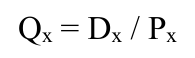
Where Dx = Value amount of commodity x
Px = Average price of commodity x
5. Adjustment of quantities (Q) (while maintaining the initial value of market basket close to $1,000,000)
6. Consider the value of the final market basket to be equal to 500,000 standard accounting units (called Val). Hence the initial value of a Val will be equal to $2 U.S. or $1 U.S. will equal 50 Val cents. This standard accounting unit of the specified market basket can easily be used to determine the value of any circulating currency.
Greco (1990:4) asserted that this standard unit would particularly be important for the “accounting of values” and the “specification of contractual obligations”; which will ultimately benefit the traders in managing their businesses more fairly and with low risk. 3.1.7. Lietaer’s Global Reserve Currency
Lietaer (2001) proposed the “Global Reserved Currency” (GRC) whose main objective would be to facilitate international contracts and trade based on a stable currency in the form of GRC. The unit of account for GRC named as “Terra” would be based on a standard basket of most essential real commodities and services traded in the international market. The GRC plan incorporates the ideas of currency backed by standard basket of real commodities with demurrage charge. Consequently, the problem of storage costs would be resolved by charging the bearers of Terra demurrage charge (of 3%- 4% per annum) for holding the currency.
The organization called Terra Alliance would be held responsible to issue Terra in the form of “electronic inventory receipt” rather notes or coins. The Terra Alliance would issue Terra in exchange for commodities sold to them by the producers. The Terra as an electronic receipt would be entitled to receive a standard basket of commodities and services or its value in any national currency against a small fee. The main advantage of GRC plan over other commodity reserve currency proposals is that it would operate in parallel with the conventional national currencies. Additionally, it would provide resistance to inflation, operate countercyclical along the business cycle and would be convertible into any of national currencies. However, it is akin to other commodity reserve currency proposals in a sense that it would use the collective basket of commodities. Consequently, it would be subject to similar limitations inherited in earlier proposals of collective basket of commodities. 3.2. Grondona’s Conditional Currency Convertibility System
Leo St. Clare Grondona (1880-1982), proposed a practical solution to this problem, based on the above-mentioned philosophy of currency convertibility, during the 1950s. He devised a system of conditional currency convertibility based flexibly on a range of durable, essential, basic imported commodities. The Grondona system has two fundamental features; first it handles reserves of each primary commodity separately, and aims only at partial stability in primary commodities prices, thereby limiting the financial liability involved. Second, since the system does not involve an open-ended liability, it can be set up by a single country, and so can use the national currency, which would be backed by the range of durable, essential and basic imported commodities, and thereby help to stabilise the real value of the national currency (Grondona, 1975).
Grondona’s system was highly praised in the United Kingdom (UK) parliament and press in the 1950s. Some eminent economists and mainstream economic media supported Grondona System.
A powerful automatic stabilizer….The Grondona system would enormously enhance the effectiveness of monetary policy (Professor Lord Nicholas Kaldor).
Mr. Grondona proffers a long-term solution to a problem which, thus far, has baffled not only HM Government but government the world over…The tragedy is that his highly practical proposals have not long since been implemented (Sir Roy
Harrod).
It can be only a question of time before man’s reason and self-interest overcome his inertia and Mr. Grondona’s proposal is accepted. When they are, they will define the beginning of an era as surely as did the introduction of the gold standard….(The Manager).
(Grondona, 1975)
This system of conditional currency convertibility tends to partially stabilise the prices of primary commodities in terms of the currency of respective country. Accordingly, it stabilises the real value of the national currency in terms of range of primary imported commodities handled separately by the country’s Commodity Reserve Department. It contributes towards the financial and economic stability of the country depending on the scales chosen and partially insulates it from destabilisation (Collins, 2011).
The implementation of this conditional currency convertibility system would require establishing Commodity Reserve Department (CRD) (similar to Bank of England’s Issue Department under classical gold standard) which stands ready to exchange national currency on demand for each of the primary commodities, according to specified price schedules; thereby buying the primary commodities when the prices of primary commodities fall and selling them when prices of those commodities rise (Collins, 1996). The transactions of CRD would be determined by the market participants thereby making its role completely passive (Collins, 2002). And the transactions of CRD would have an effect on the country’s money supply by an amount equivalent to the value of net sales to and purchases from the CRD. Furthermore, the CRD would publish the price-schedule for each individual primary commodity on regular basis and the level of reserves of each commodity is also be made public daily (Collins, 1996).
This system has several distinctive characteristics compared to alternative commodity reserve currencies proposed by different economists. First, it guarantees the convertibility of commodities conditionally; which means the CRD would exchange the commodities into currency at the maximum available price only as long as it holds reserves of that particular commodity. Consequently, it would involve only a limited financial liability, unlike other proposals. Thus, it would not have any severe implications for the monetary policy of the country due to its feature of conditional convertibility (that is the maximum outlay required for each commodity under extreme market conditions could be determined in advance) (Collins, 2002 and Collins, 2011).
Second, this conditional currency system would treat each commodity independently unlike the other proposals of commodity reserve currency. It is neither based on any collective unit/ basket of commodities nor involves fixed price limits. As a result, it would not alter the market prices; it would rather help to reduce the fluctuations in the commodity prices. Additionally, this system would also be helpful in avoiding the problems of dealing with basket of commodities. Third, the implementation of this conditional currency convertibility system is feasible from the political viewpoint that is it could be implemented by individual countries independently within their existing monetary systems, because the scale of liability is limited in advance. Consequently its implementation does not need any international agreements (Collins, 2002).
Fourth, the implementation of the system across multiple countries is easy. It could be established in various countries in terms of their own currency on a scale suitable to the each country’s economy. Fifth, it involves minimal operating costs (that are for maintenance of building and for a small administrative staff); since the appraisal and delivery costs would be charged from the customers. The only major cost needed is for construction of the warehouses required for storage of commodities’ reserves (Collins, 2011). Finally, it is fully counter-cyclical over the business cycle that is it expands the money supply during recession to stimulate the economy and contracts the money supply during inflation to counter inflationary pressures (Collins, 2006).
3.2.1. The Fixed Price Schedule, its Rules and Parameters
The CRD would function under some important rules formulated by the Grondona (1975). Those rules guarantee that the prices at which the CRD stands ready to buy or sell reserves of individual commodities on demand from the traders would remain in line with the market forces. For that, the CRD maintains a fixed price schedule for each commodity separately. The price schedule would primarily include the information about buying/ selling prices (lower/upper points) of commodity and a certain prescribed quantity for each individual commodity. The CRD deals in specific large quantities of each individual commodity which it defines as “Block”. The CRD’s buying and selling prices adjust automatically according to that fixed price schedule in opposite direction to the level of reserves with CRD and would be in line with the market forces. Consequently, the price schedules used by the CRD, would not distort the commodity market prices. It would rather lessen the large and unexpected fluctuations in the commodity market prices. The role of CRD would always remain passive and CRD will never enter the market (Grondona, 1975; Collins, 1985).
Fig. 1. Price Schedule for a Commodity
The above figure depicts that the reserves of specified commodities with CRD and their lower/upper points move in opposite direction. The buying prices (or lower points) and the selling prices (or upper points) of the individual commodities fall with a stipulated percentage as the CRD accumulates more reserves of those commodities; while the lower and upper points of individual commodities rise by same prescribed percentage with the decline in the CRD level of reserves (Collins, 2011).
The CRD stands ready to buy or to sell individual commodities on demand based on the price schedule (as shown in figure-I and Table 1). When CRD acquires a whole block of any commodity, the lower and upper points (buying price/selling price) would drop by a certain percentage and as a result the CRD reserves rise by a certain (pre-stated) amount. With the purchase of subsequent blocks on demand, the buying prices (along with selling prices) fall further by the same percentage while the reserves increase by the same amount. So, there would be successive falls in the buying and selling prices of the commodity with each sale of commodity’s blocks to the CRD and increase in level of reserves by same quantity (block). (Thus, each sale of commodity’s blocks to CRD would cause an increase in reserves of the commodity by the same quantity, and subsequent falls in the buying and selling prices of the individual commodity).
| Besides | the | basic | principle | of | fixed | price | schedule, | Grondona | developed | some | |
|---|---|---|---|---|---|---|---|---|---|---|---|
| other rules | for | smooth | operation | of the | CRD. | Collins | (1985) | explains | those rules | as | |
| follows: | |||||||||||
| Firstly, the CRD’s maximum upper point (or selling price) for any individual commodity | |||||||||||
| is conditional | to | the availability | of | that commodity’s | reserves | with CRD | as shown in | the | |||
| figure-I (see | the point | 1). In | other words, | if and when the CRD’s | reserves of any specific | ||||||
| commodity | are | exhausted, | it would | no | longer | guarantee | the | maximum | selling | price. | |
| However, | it would | guarantee | the | lower | point | until | the accumulation | of | reserves | once |
The drop in buying price of the commodity with each purchase of block is to discourage further sales into CRD. On the other hand, the CRD also stands ready to sell individual commodities held in reserves on demand by using the upper limits (selling prices) specified in the price schedule. The CRD’s upper limits would be higher than the price it charged for acquiring the commodities at first place. The repurchase of each block of individual commodities from the CRD would rise the upper and lower points by a specific percentage, and reduce the level of CRD reserves for that individual commodity by a certain amount. The fall in CRD reserves would increase the commodity’s upper points (selling prices) to discourage further purchases from the CRD reserves (Collins, 1985).
Besides the basic principle of fixed price schedule, Grondona developed some other rules for smooth operation of the CRD. Collins (1985) explains those rules as follows: Firstly, the CRD’s maximum upper point (or selling price) for any individual commodity is conditional to the availability of that commodity’s reserves with CRD as shown in the figure-I (see the point 1). In other words, if and when the CRD’s reserves of any specific commodity are exhausted, it would no longer guarantee the maximum selling price. However, it would guarantee the lower point until the accumulation of reserves once again. This enables the system to avoid open-ended financial commitment by not guaranteeing the fixed maximum price. This will also prevent the system from distorting commodity markets, and avoids the need for an international system (which would be required to handle an unlimited liability). Secondly, the margin between lower and upper points for each commodity should be substantially higher than the 0.2 percent (margin maintained under gold standard). The optimal margin varies among the commodities and depends on the extent of fluctuations for each commodity. For commodities, having high market price fluctuations, a margin of 20 percent would be adequate. Conversely, the price band of 10 percent is considered to be suitable for commodities with low level of fluctuation. Thirdly, the Commodity Reserve Department (CRD) earns premium (profit) due to the pre-determined range between the CRD’s buying (lower point) and selling (upper point) prices. The CRD keeps the customers aware of these pre-determined ranges in prices via CRD’s “price-schedule” which is publicized on regular basis. A portion of this premium is used for covering the administrative costs. The remaining portion of the premium is deposited in a “special Holding Account” in order to form a “Disaster Fund”, to provide relief in certain circumstances around the world. Fourthly, the system would include all the durable, essential, basic imported commodities. For commodities which have different major standard grades, these would be handled separately by the CRD. The initial list of CRD would include only the main, imported non-fuel commodities. It would not consider the domestic commodities and the commodities with high storage cost for inclusion. The reason for not including the domestic commodities is the existence of domestic price support arrangements. However, once the system is operational, these commodities could also be included.
Grondona’s initial list is comprised of the sixteen durable, essential, basic imported commodities as follows (which vary between countries):
Wheat Rice
Sugar Cocoa
Coffee Maize
Soya Bean Barley
Cotton Wool
Copper Tin
Lead Zinc
Aluminum Nickel
Fifthly, the CRD would function on a large scale by dealing solely with large units of quantity of individual commodities (or standard grades of commodities) stipulated in price schedule (e.g. 40 ton units). This would facilitate the system to attain the main economic benefits of currency convertibility at low cost. Sixthly, the CRD would only accept the national currency for settling its transactions. It would make payment in national currency for the commodities sold to them by the traders and accept national currency from the traders for repurchase of commodities. Consequently, the system would stabilise the value of national currency based on the prices of primary imported commodities. It would also help to determine the maximum outlay involved in implementing the system. Seventhly, all the CRD’s transactions would be according to “Customs bond”; the CRD would not be liable for payment of tariffs or duties. The buyers would pay all these charges at the time of purchase of individual commodities from CRD reserves. This would make the system compatible with the international trade agreements and promote free trade of primary commodities. Eighthly, the commercial seller or buyer of the commodity would be responsible for payment of all charges pertaining to appraisal, transportation and handling when doing transaction with CRD. This would bring the operating costs of CRD to its minimum. The CRD would require only a small staff for mainly clerical work. 3.2.3. Parameters of the Price Schedule
Grondona (1975) described the parameters of the price schedules for specified commodities which he named as “gearing of the system” (see figure-II). These parameters are important in deciding the extent of system’s monetary and economic influence and the government financial commitment involved in resumption of conditional currency convertibility system. These parameters include the range of commodities, initial price levels, size of blocks, width of price-bands and price-steps between successive price-bands. The description of these parameters would provide detailed explanation of the price schedules used within the system. There are number of factors that need to be considered in deciding each of these parameters. This would also help in determining the optimum scale of the system to stabilise influence on the national economy. 3.2.3.1. Range of Commodities
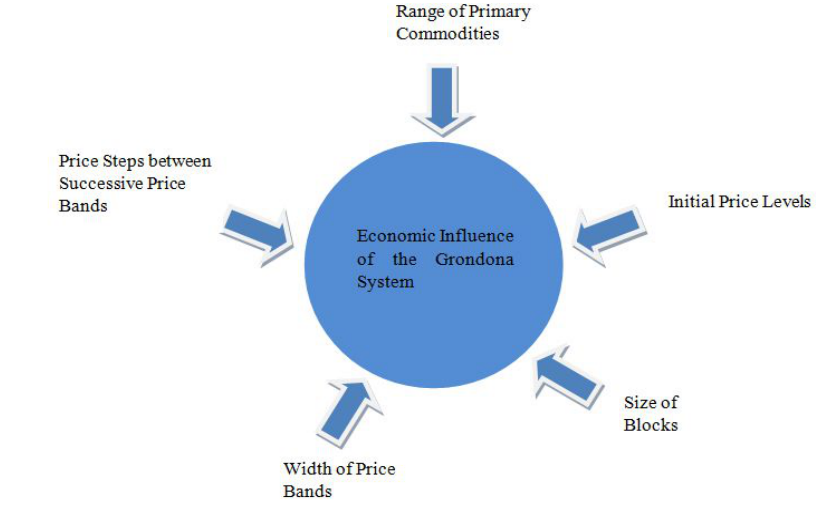
Grondona (1975) proposed to include only those commodities which are durable, essential, and basic. The domestically produced commodities and fuel minerals should not be part of the system at least initially. Apart from these commodities, the larger the range of commodities prescribed by Grondona, the greater would be the stabilising influence of the system on the real value of currency as well as on the prices of different commodities. 3.2.3.2. Initial Price Levels
According to Grondona (1975), the initial “Index” for each commodity should be based on the average trend of previous years average c.i.f. price for each commodity (adjusted for inflation), other things being equal. The lower and upper points of the CRD should be set within a certain percentage of the figure of initial “Index”. The higher initial levels of the lower and upper points of CRD would have greater anti-inflationary influence under rising prices. 3.2.3.3. Size of Blocks
Grondona (1975) suggested that the 10 percent of average annual imports is appropriate figure for computing the quantity in the “Block” for many commodities. However, there are various factors (such as the trend in the level of national imports, the percentage of world production or trade represented by national imports, the storage cost of the commodity and the relative significance of the commodity) which need to be considered in deciding the size of “Blocks”. So the CRD’s “Block” size may be 20 percent or more of average annual imports for some commodities. 3.2.3.4. Width of Price-Bands
The width of price band is the difference between lower and upper points of the CRD for each commodity. This varies from commodity to commodity and depends on the normal range of fluctuations for each commodity. The narrower range of price band would produce less recurrent movements in the level of reserves while the wider price range would result in more recurrent movements in level of reserves (Collins, 1985). According to Grondona (1975), it is appropriate to set the price band of approximately 10 percent below and above the initial “Index” for more unstable commodities. However, there are various factors such as normal size of price fluctuations for the commodity, the pattern of resulting monetary impacts and the expected improvement in price-stability for each commodity, which are pertinent to consider in determining the appropriate price-band for each commodity. In principle, simulating the system should help to decide these factors. 3.2.3.5. Price-Steps between Successive Price-Bands
The total quantity of reserves would be determined by the size of the price-step between subsequent price-bands which could be accumulated by the CRD at any market price for the individual commodity (Collins, 1985). The size of the price-step between successive price-bands should be fixed, as proposed by Grondona; because this would adjust the upper and lower points in each price-band by a constant ratio. Grondona proposed that the CRD’s upper and lower points should adjust by 5 % of the initial level, as result of withdrawal or accumulation of each full block of any commodity. This figure is trivial enough to avoid any market distortion as result of CRD’s upper and lower point adjustment; but it would be large enough if little adjustment required. However, the value of this parameter may vary for different commodities (Grondona, 1975).
The extent of outlay required during the system’s operation could be determined from the three important parameters of price schedule namely the size of Blocks of each commodity, the width of the price-band between lower and upper points and the size of the price-steps between successive price-bands (Collins, 1985).
3.3. The Diagrammatic Explanation of Conditional Currency Convertibility System
The Grondona’s conditional currency convertibility system has the anti-inflationary and anti-deflationary effects over the business cycle which would be explained with the help of diagram shown below (Collins, 2006). As the Ringgit depreciates against the US Dollar, the Ringgit prices of commodities rise. The traders tend to purchase commodities from the CRD at relatively higher prices; which will reduce the CRD reserves. Because domestic users of commodities will also be interested in buying commodities from CRD due to transportation insurance and freight charges, this would reduce imports as well. The reduction in the rise of Ringgit prices would help to stabilise the terms of trade.
Furthermore, deposits with the Malaysian Central Bank (i.e. Bank Negara) will decrease, which would reduce the money supply, as well as the flow of Ringgits abroad (i.e. as reduced payments to foreign suppliers of commodities). Consequently, these all may affect the economic indicators such as economic growth, inflation, exchange-rate, interest-rate, balance of payment and terms of trade, and may be classified as anti-inflationary effects of Grondona system. Similarly, an increase in international market prices of commodities would result in higher Ringgit prices of commodities causing the Grondona system to exert the same anti-inflationary effect over the upward phase of the business cycle, helping to prevent “over-heating” of the economy.
On the contrary, when the Ringgit exchange-rate strengthens against the US Dollar, this would reduce the Ringgit prices of imported commodities. The foreign exporters of primary commodities will sell their commodities to the CRD. This would increase imports, money supply, and Ringgit exports, through reducing the fall in the flow of Ringgits abroad. Purchases of reserves by the CRD from foreign suppliers of commodities would increase the flow of Ringgits abroad, and increase deposits at the Malaysian Central Bank.
Accordingly, the Grondona system would tend to stabilise macroeconomic indicators such as economic growth, inflation, exchange-rate, interest-rate, balance of payments and terms of trade through its anti-deflationary effect over the downward phase of the trade cycle. In the same way, Ringgit prices of primary commodities would fall with a decrease in the world market prices of commodities, causing the Grondona system to exert the same anti-deflationary effect. RM Commodity Prices RM Ringgit Foreign Exchange Exchange Rate Market RM Prices Fig.3. Diagram of Macro-economic Influence of the Grondona System
Anti-Inflation
▪G.S Reserves↓ ▪RM Money Supply↓ ▪Commodity Imports↓ ▪RM flow abroad ↓ ▪Economic activity → Stabilised: ▪Commodity prices ▪Inflation / Deflation ▪Exchange-rate ▪Balance of Payments ▪Terms of Trade ▪Economic growth ▪G.S Reserves↑ ▪RM Money Supply↑ ▪Commodity Imports↑ ▪RM flow abroad ↑ ▪Economic activity →
Anti-Deflation
4. Conclusion
This paper revisited the idea of counter-cyclical principle suggested by Prophet Yusuf (AS) almost four thousand years ago and highlighted its importance in stabilising the business cycles. It reviewed commodity-based currency systems (which incorporated the idea of counter-cyclical principle) proposed during and after the interwar period and recommended the Grondona system as possible policy matter for implementation to OIC countries in context of the ongoing financial crises. The researchers highlighted the fact that underlying idea of counter-cyclical principle was borrowed from the story of Prophet Yusuf (AS); where he suggested a plan to the Egyptian king as result of interpreting his dream and later successfully implemented the plan, as Minister of finance and agriculture of Egypt, to overcome the famine and drought of seven years. The major element of his plan was the decision of saving during the times of plenty and consuming during the period of scarcity which we termed as countercyclical principle.
This principle has been incorporated by the some eminent economists into their proposals of commodity-based currency systems, which makes the operations of their commodity-based currency systems automatically counter-cyclical over the business cycle. It helps to expand the money supply during recession by holding reserves of primary commodities as result of fall in prices in the primary commodities market and contracts the money supply during inflation by releasing reserves of primary commodities due to rise in prices of commodities. Accordingly, it functions anti-inflationary and anti-deflationary over the business cycle. There are various potential benefits of the commodity-based currency systems. First, they provide the necessary link between the money and real economy. Second, they help to dampen the sharp fluctuations in the prices of primary commodities. Third, they help to stabilise the value of currency in terms of primary commodities and finally these plans are less susceptible to inflation.
However, most of these commodities-based currency plans are too ambitious, require international negotiations and cannot be implemented by individual countries independently. For this reason, we underscored the Grondona system of conditional currency convertibility which is more practical and could be implemented by the OIC countries independently in terms of their own national currencies. The primary advantage of this system in comparison to other commodity-based currency systems is that it could be implemented in conjunction with the existing monetary system. Accordingly, it could be taken as a preliminary step towards monetary system based on real money (such as gold dinar).
This paper is more theoretical in nature thus the next phase of this research would be focused on economic evaluation of Grondona system in selected OIC countries in order to provide an alternate for OIC countries. The implementation of the Grondona system in several OIC countries is important because it would stabilise their currencies in terms of primary commodities which would be helpful in stabilising their mutual exchange-rates and increasing trade among the OIC countries.
References
Ali, Abdulllah Yusuf. (2006). The Meaning of the Holy Quran. Belsville. Maryland, U.S.A: Amana Publications.
Allen, F. and Carletti, E. (2010). An Overview of the Crisis: Causes, Consequences and Solutions. International Review of Finance, 10 (1), 1-26.
Benston, G.J. and Kaufman, G.G. (1997). FDICIA After Five Years. Journal of Economic Perspectives, 11 (3, Summer), 139-158.
Borsodi, Ralph. (1989). Inflation and the Coming Keynesian Catastrophe: The Story of the Exeter Experiment with Constants, Published jointly by the E. F. Schumacher Soceity (Great Barrington, Mass.) and the School of Living (Cochranville, Penn.).
Collins, P. (1985). CurrencyConvertibility: The return to sound money. New York: St.Martin’s Press.
Collins, P. (1996). Implications for Japanese Monetary Policy and its Simulation of the Implementation of Conditional Currency Convertibility (the Grondona System). Submission to Bank of Japan.
Collins, P. (2002). The Grondona System of Conditional Currency Convertiblity: abasis for Conflict-Free Monetary Cooperation. Paper presented at Conference on 1st International Conference of the Japan Economic Policy Association (JEPA)
organized by Japan Economic Policy Association, Tokyo. November 2002.
Collins, P. (2006). Conditional Currency Convertibility and its Applicability in Japan.Paper presented at Conference on Monetary Economics organized by Japan Society for Monetary Economics, Tokyo.
Collins, P. A Shariah Foundation for Stabilising D-8 Currencies: the Grondona System of Conditional Currency Convertibility. Paper presented at Conference on Second World Conference on Riba organized by Thinkers Trends Resources, Kuala Lumpur.July2011 Curry, T. and Shibut, L. (2000). The Cost of the Saving and Loan Crisis: Truth and Consequences. FDIC Banking Review.
Devlin, R. and Ffrench-Davis, R, (1995). The Great Latin America Debt Crisis: A decade of Asymmetric Judgement. Revista de Economia Politica, 15 (3,59).
El Diwany, Tarek. (2009). Transition Issues in Monetary Reform. In Ahamed Kameel Mydin Meera (eds.), Real Money: Money and payment systems from an Islamic perspective (pp.
119 – 189). Malaysia: IIUM Press.
Fisher, I. (1913). Compensated Dollar. Quarterly Journal of Economics, 27 (February), 213–35.
Fisher, I. (1928). The Money Illusion. New York: Adelphi.
Friedman, R. (1951). Commodity-Reserve Currency. Journal of Political Economy. 59, 203-32.
Furman, J. and Stiglitz, J.E. (1998). Economic Crises: Evidence and Insights from East Asia. Brookings Papers on Economic Activity, 1998 (2), 1-114.
Graham, B. (1937). Storage and Stability. New York: McGraw-Hill.
Greco, T.H. (1990). Money and Debts: A Solution to the Global Crisis. Tucson, Ariz.:
ThomasH. Greco, Jr.
Greco, T.H. (2009). The End of Money and the Future of Civilization. White River Junction, Vermont: Chelsea Green Publishing.
Greco, T.H. (2009). The End of Money and the Liberation of Exchange. In Ahmed Kameel Mydin Meera (eds.), Real Money: Money and payment systems from an Islamic perspective (pp. 191 – 219). Malaysia: IIUM Press.
Grote, D. (2012). The Imposition of Austerity During a Slump is Arrogance of Biblical Proportions: The Fate of Keynesian Faith in Joseph’s Countercyclical Moral. Retrieved May 28, 2012 from http://www.counterpunch.org/2012/11/30/the-fate-of-keynesian-faith-in-josephs-countercyclical-moral/ Hart, A.G., Kaldor, N. and Tinbergen, J. (1964) The Case for an International Commodity Reserve Currency. Geneva: United Nations Conference on Trade and Development.Hayek, F.A. (1943). A commodity Reserve Currency. The Economic Journal, 53 (210/211-Jun-Sep), 176-186.
Hoppe, H.H. (1994). How is Fiat Money Possible? – or, The Devolution of Money and Credit.The Review of Austrian Economics, 7 (2), 49-74.
Ibn Kathir, Emmaduddin (2004). Tafseer Ibn-Kathir, Translation. Lahore, Pakistan: Zia-ul-Quran Publications.
Kaldor, N. (1976). Inflation and Recession in the World Economy. Economic Journal, 86 (344, December), 713.
Kaldor, N. (1983). The Role of Commodity Prices in Economic Recovery. Lloyds Bank Review, July, 33.
Kawai, M. Newfarmer, R. and Schmukler, S.L. (2005). Financial Crises: Nine Lesson from East Asia. Eastern Economic Journal, 31 (2, Spring).
Keynes, J. (1938). The Policy of Government Storage of Foodstuffs and Raw Materials. Economic Journal, 48 (191), 449-60.
Lapavitsas, C, Kaltebrunner, A. Lindo, D. Michell, J, Painceira, J.P. Pires, E. Powell, J. Stenforrs, A. and Teles, N. (2010). Eurozone Crisis: Beggar Thy and ThyNeigbour. Journal of Balkan and Near Eastern Studies, 12 (4, December).
Laeven, L. and Valencia, F. (2008). Systemic Banking Crises: A New Database. IMF WorkingPaper WP/08/224. November.
Lietaer, B. (2001). The Future of Money: Creating new wealth, work and a wiser world. London: Century.
Luke, J.C. (1975). Inflation-free pricing rules for a Generalized Commodity Reserve Currency.Journal of Political Economy, 83, 786.
Meera, Ahamed Kameel Mydin. (2002). The Islamic Gold Dinar. Selangor: Pelanduk Publications Sdn Bhd.
Meera, Ahameel Kameel Mydin and Aziz, Hassanuddin. Abdul. (2002). The Islamic Gold Dinar: Socio-economic Perspectives. Paper presented at Conference on Stable and Just Global Monetary System: Viability of the Islamic Dinar. Kuala Lumpur: IIUM Press.
Meera, A.K.M. (2004). The Theft of Nations: Returning to Gold, (Suban Jaya: Pelanduk Publications Sdn Bhd).
Mehrling, P. (2007). The Monetary Economics of Benjamin Graham. Retrieved November29,2011.http://www.gmu.edu/centers/publicchoice/HES%202007/papers /7d%20mehrling.doc Moessner, R. and Allen, W.A. (2010). Banking Crisis and the International Monetary System in the Great Depression and Now. BIS Working Paper No. 333. December.
Mises, L.V. 1981. The Theory of Money. (H.E. Batson, Trans.). The Liberty Fund.Orgininal work published 1912.
Mohamad, Nik. Mahani. (2009). Between Islamic Banking and the Gold Dinar: a complicationof paper and articles. Kuala Lumpur: Percetakan Advanco Sdn, Bhd.
Nuri, V.Z. (n.d). Fractional Reserve System as Economic Paraitism: A Scientific, Mathematical and Historical Expose, Critique and Manifesto. Retrieved May 28, 2011. http://concen.org/forum/archive/index.php/thread-18160.html Qadhi, Yasir. (2003). Tafseer of Surah Yusuf (Part 01-15) [Audio file]. Retrievedfrom http://www.audioislam.com/?subcategory=Tafseer Redish, A. (1993). Anchors Aweigh: The Transition from commodity money to fiat money in Western Economies. Canadian Journal of Economics, 16 (4, November).
Reinhart, C.M and Rogoff, K.S. (2008). This Time is Different: A Panoramic View of Eight Centuries of Financial Crises. NBER Working Paper 13882. April.
Rothbard, M.N. (2008). The Mystery of Banking, Auburn, Alabama: Ludwing von Mises Institute.
Reserve Bank of India. (2010). Report on Currency and Finance 2008/09: Global Financial Crisis and the Indian Economy. Mumbai: Gunjeet Kaur.
Riboud, J. (1981). The Mechanics of Money, (Macmillan).
Qutb, Sayyid. (2004). In the Shade of the Quran. (A. Salahi, Trans.). United Kingdom: IslamicFoundatoin.
Turnell, S. (1998). The Quest for Commodity Price Stability: Australian Economists and ‘BufferStocks’,” Macquarie Economics Research Papers. Number 10/1998, August 1998.
Usmani, Taqi. (2008). The Text of the Historic Judgement on Riba 23 December 1999, Petaling Jaya, Malaysia: Percetakan Zafar Sdn Bhd.
Usman, Muhammad, Shafi. (2005). A Comprehensive Commentary of the Holy Quran. (M.H. Askari and M.Shamim, Trans.). Karachi: Darul-Uloom.
Wade, R. (1998). The Asian Debt-and-Development Crisis of 1997-?: Causes and Consequences. World Development, 26 (8), 1535-1553.
Notes
untuk mengatasi kelaparan tujuh tahun melalui simpanan gandum selama tujuh tahun pada masa melimpah. Secara umum, prinsip counter-cyclical mendorong penghematan selama masa melimpah dan pengeluaran selama musim paceklik, kegiatan yang saat ini membantu untuk menstabilkan – siklus bisnis . Metode –Tulisan ini menggunakan studi kepustakaan yang bergantung pada data sekunder dengan teliti meninjau literatur yang paling relevan. Tulisan ini membahas tentang sistem mata uang berbasis komoditas yang diusulkan sebelum, selama dan setelah Perang Dunia II oleh beberapa ekonom terkemuka ( terutama Keynes, 1938 ; Graham, 1940, Hayek, 1943; Grondona, 1950 dan Lietaer, 2001) yang semuanya pada dasarnya memasukkan prinsip counter-cyclical Nabi Yusuf (AS). Tujuan utama dari sistem mata uang berbasis komoditas ini adalah untuk menstabilkan nilai riil uang dalam rangka meningkatkan stabilitas ekonomi makro. Selain itu, makalah ini memberikan analisis mendalam tentang sistem Grondona bersyarat konvertibilitas mata uang .