
International Islamic University Malaysia; Effat University, Saudi Arabia; The Dayanine Group, Malaysia
1.0 Introduction
Owning a home brings about security, psychological and social benefits to the citizen. Studies have shown an inverse relationship between owning a home and psychological distress, whereby those who rent reporting highest levels and those who own homes without mortgages reporting the lowest levels (Cairney, 2011).
Homeowners have also reported higher life satisfaction, higher self-esteem and were more likely to be active in the community as compared to those who did not own a home (Rossi & Weber, 2010; Rohe & Stegman 2007). In addition, the children of homeowners were found to be significantly more likely to attain a higher level of education, which ultimately translated into higher earnings (Boehm, Schlottman, 1999). As such, it can be seen that owning a home is a key contributor to personal satisfaction, family security and social harmony, which can lead to better citizens who are happier and more productive, ultimately benefitting the economy as a whole.
However, owning a home in today’s world is no easy feat. With growing populations and urbanization that is not matched with the population growth, there are many challenges that face the suppliers and demand of housing. Globally, access to credit and current income remains one of the main determinants of owning a home. Other life factors such as student loans and other loans, financial obligations, and family related factors such as marriage and parenthood also play a part in the need of a home (Xu et al, 2015). This is no different for the case of Malaysia. Impediments to owning a home has resulted in citizens settling for rental properties, shared accommodations, living in the family homes or in extreme cases, being homeless (Yaacob et al, 2017).
Most people today acquire homes after strenuous efforts over long periods due to absurd high prices and high financing costs. Once the home is acquired, a settled life is still not guaranteed as they are still susceptible to debt default, which can render them homeless and unsheltered, or even bankrupt. Ghee and Omar (2015) stated that some people become homeless as a result of debt and/or financial or legal trouble. Accordingly, fresh graduates and low-income earners are more inclined to rent homes than owning them.
Homeownership is a complex issue that is a result of many determinants, including the home characteristics (home and property types, location etc.), employment, income trends, sociocultural and demographic descriptors etc. (Tan, 2008). It is a combination of many factors as mentioned before but financial affordability is believed to be the core problem of individuals when comes to home ownership. When analyzed from a macro level, the origin of the problem seems mainly caused by the flaws within the monetary system that continue to affect the distribution of income and wealth while causing inflation itself. In particular, the concerned characteristics are namely fiat money, fractional reserve banking and interest charges (Meera and Larbani, 2005).
Solving the monetary problem is likely take a long time and substantial political will, that starts with shaping people’s perception thereafter followed by the implementation of a better system. That is why in concurrence of the attempt to redesigning the monetary system, several instant remedies have been suggested to solve the ongoing housing problems that is in urgent need. In housing, few remedies have been suggested which includes the Islamic Cooperative Housing that being implemented in Canada and private pooled-financing method. (Goud, 2009).
This paper proposes and analyzes a possible new method using solar power to subsidize home ownership. Our model proposes a home financing concept that combines solar energy harvesting to make homes affordable. This paper analyzes this proposal and provides a formula which solar energy providers can use in determining cost and revenue structure if they intend to indulge in such innovative and green social business activity.
2.0 Literature Review
2.1 Affordable Housing Global Context
Housing plays a momentous role in a country’s economy and is central to the societal well-being that it is emplaced in the United Nation Universal Declaration of Human Rights (Samad et al, 2016).
Wilson et al (2018) defines affordable housing as social rented, affordable rented and intermediate housing, provided to eligible households whose needs are not met by the market. The idea of affordable housing recognizes the needs of households whose incomes are not sufficient to allow them access appropriate housing without assistance (Milligan et al 2004). Thus, the term ‘affordable housing’ describes housing that assists lower income households in obtaining and paying for appropriate housing without experiencing undue financial hardship (Milligan et al 2004). Conceptualizing and measuring affordability are as complex as understanding the causal factors of the housing affordability problem itself (Worthington, 2012). There is no precise meaning in the term affordable housing. It can be a low-cost house provided by the private sector or from the public and social sectors.
There are different definitions and contexts of affordability within every nation, and in between different aspects of housing, be it from demand or supply side. In the US, the prevalent definition is that housing should constitute no more than 30 percent of the household income (Rohe & Stegman, 1994).
Several other approaches may also be used to determine affordability. The most common method is the income-ratio approach, whereby it posits that regardless of income level, housing expense will always form a component of their income. The family budget approach attempts to identify if all basic expenses, housing and non-housing, can be covered within a household’s income. The residual income approach attempts to determine if a household’s income is adequate to cover non-housing expenses once housing related payments are taken care of (Cai, 2017).
In this paper, we employ the median multiple method, which is endorsed by The United Nations Centre for Human Settlements and the World Bank, to determine housing affordability. This measure categorizes a house as affordable as long as its price is capped at three times the annual income of a household. (Ling & Almeida, 2016).
2.2 Affordable Housing – Malaysian Context
With urban migration in Malaysia rapidly increasing, coupled with rate of urbanization of 76.7% in 2020, it was estimated that 77.16% of the population were residing in urban areas by 2020 (DOSM, 2021). As such, the supply of affordable housing is unable to match the increase in urban growth, at a price that is within the reach of lower income migrants (Teck-Hong, 2011). Rapid urbanization has led to a boom in the property market nonetheless, however this has resulted in an overall increase in house prices, at a level beyond affordability, and an uncontrolled housing supply (Shapee et al, 2018). Other factors that affect home prices significantly include income, housing prices, cost of land, demand and supply (Yap & Ng, 2018).
However, housing affordability has been an issue of major concern in Malaysia (Hassan et al, 2021; Yap & Ng, 2018; Samad et al, 2017). It was found that in the short-run, all types of housing were deemed unaffordable, whereas in the long run, housing unaffordability is increasing, despite an increase in existing housing stock (Rangel et al, 2019). As discussed earlier, this paper shall adopt the median multiple method to assess affordability. The median multiple method factors in annual household income with house prices, and a house is deemed affordable if the median multiple is 3.0 and below. Data on median income and housing prices were collated and aggregated, and the affordability of houses across various states in Malaysia is shown in Table 1 below.
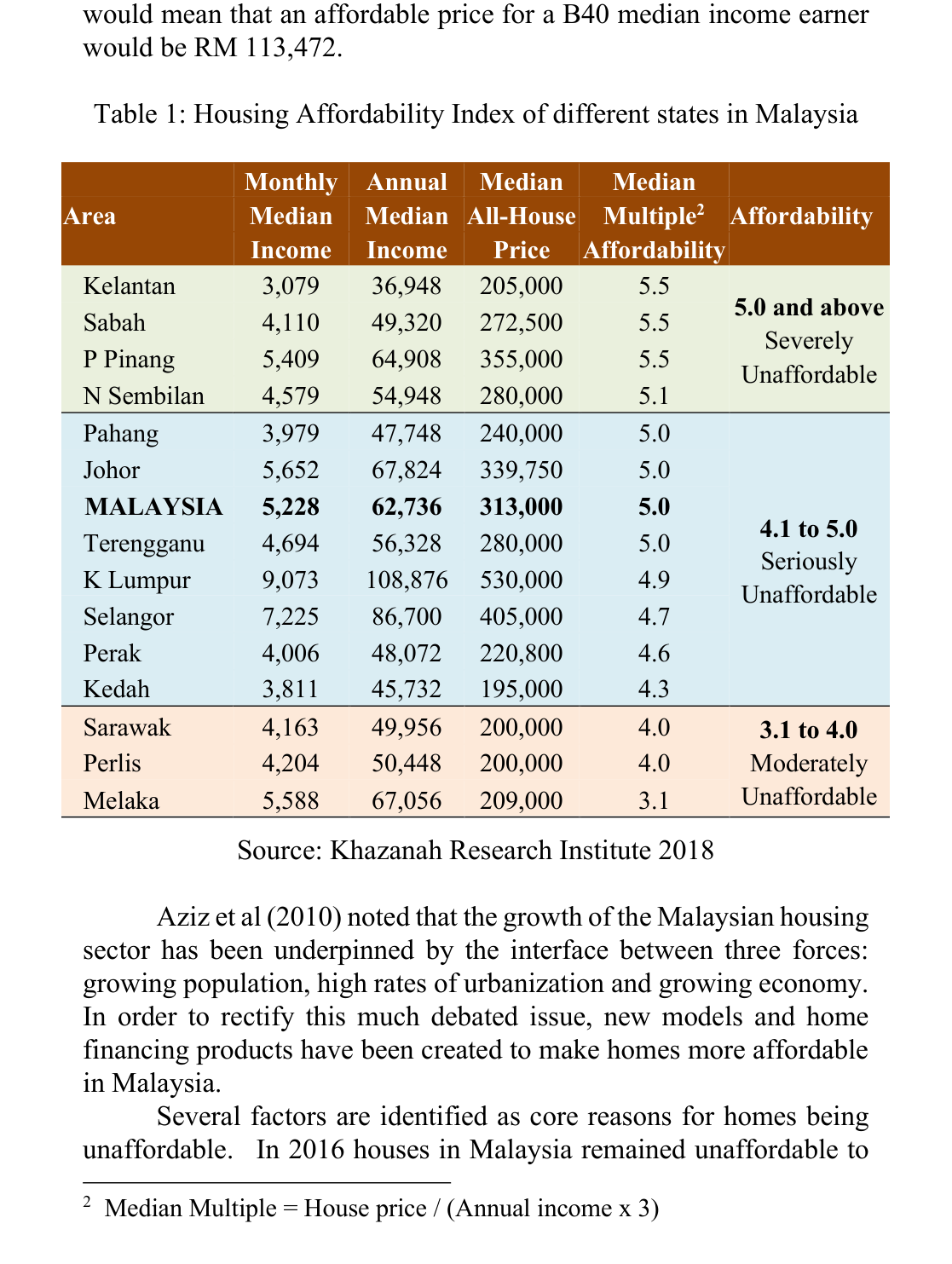
From the Table 1, it can be seen that housing is considered unaffordable across all states. Those who are earning the national median income, will find the median housing price way beyond their reach. The fact that seven states report 5.0 median multiple, which is seriously unaffordable, paints a grim picture.
When analyzing income groups, we look at the categorization as T20 (top 20%), M40 (Middle 40%) and B40 (Bottom 40%). As reported by Department of Statistics Malaysia (DOSM, 2020), the T20 earn a median household income of RM 15,031, the M40 earn a median household income of RM 7,093 and the B40 earn a median would be RM 113,472.
Kelantan 3,079 36,948 Sabah 4,110 49,320 P Pinang 5,409 64,908 N Sembilan 4,579 54,948 Pahang 3,979 47,748 Johor 5,652 67,824
Terengganu 4,694 56,328 K Lumpur 9,073 108,876 Selangor 7,225 86,700 Perak 4,006 48,072 Kedah 3,811 45,732 Sarawak 4,163 49,956 Perlis 4,204 50,448 Melaka 5,588 67,056
Unaffordable 209,000 3.1 many households due to the failure of the market to produce a sufficient quantity of affordable housing for the masses (Ling, Almeida & Wei 2017). Ling, Almeida and Wei (2017) also depicted that one of the several factors is the demand and supply mismatch and slower income growth. It argued that, since 2012 new affordable housing supply has consistently fallen short of the increase in demand by households; and over the period 2014-2016, there was an average supply of 114,000 new homes, sharply lower than the formation of 154,000 new households.
In the private sector, priorities and preferences were given to the construction of higher-end homes, due to increase in price of lands and homes and limited land supply area. Despite the requisite for private sector developers to integrate affordable housing within their projects, the development costs due to limited land supply and the absence of large-scale townships makes it inefficient for compliance (Teck-Hong, 2011).
The other factor stated by Ling, Almeida & Wei (2017) is that new launches are skewed towards the unaffordable range. From 2016- Q12017, while 35% of Malaysian households could only afford houses priced up to RM250,000, only 24% of new launches were in that range, indicating an undersupply of affordable homes. This also reflects the trend in new housing supply that is skewed towards the higher-end property segment since 2012. It was found that in 2019, around 50% of the property overhang were of residential properties estimated to be valued at RM18.82 billion. However, it is important to differentiate between overhang and oversupply, as this supply may not cater to the existing demand (Lee, 2020). The next factor that was also brought up by Ling, Almeida & Wei (2017) is that growth in house prices outpaced growth in household income. From 2016 to 2019, mean household income only increased by 3.9%, whereas house prices grew by 45% over the past 10 years (Hassan et al, 2021).
From the supply side, it is important to reduce the cost of housing to cater to the lower income group. Construction costs, especially materials, labor and compliance, remain high. Land cost is another factor that can drive the prices of houses upwards, sometimes making up to 80% of the house price. As such, it is imperative that new and disruptive initiatives be undertaken in the construction of affordable housing, such as utilizing new technology in building, pooling of resources under one entity to reduce transactional and legal costs and optimizing the compliance cost.
As for land, it is proposed that the government provide from existing land banks on a leasehold basis for purpose of affordable housing. This can also help drive the value of the land up, through further development of township and infrastructure stemming out from the affordable housing project.
Though there are housing stock available within the affordable pricing range, these are usually situated in undesired locations, with inadequate amenities and scarce employment and business opportunities, hence remain unsold. As such, any affordable housing initiative must be supported with proper infrastructure investment and economic opportunities (Tan, 2008).
There are several initiatives by the Malaysian government to provide public housing, however, most of them have not resulted in an improved quality of life to their residents (Hong, 2011). In a study by Rangel et al (2017) using a cut-off of 0.35 for mortgage instalment to income ratio as an indicator of affordability, it was found that there was a lack of improvement in affordability over time despite government initiatives towards affordable housing targeted towards the lower income household groups.
In addition, the government of Malaysia had set out on an ambitious plan to build one million affordable homes in 10 years as outlined in the National Housing Policy 2018 – 2025, despite reaching only a maximum of 63% of the target in its 6 previous plans. This plan was later scrapped, and the targets were revised to 227100 units in 10 years, once it was reported that around 20% of the unsold housing units were indeed low-cost apartments (Plans for 1Mn Affordable Homes Scrapped, 2020).
The public housing sector is specifically designated for houses for lower-income groups and public employees. This is a clear indicator that affordable housing is the need of the hour, and that for sustainable long-term economic growth, it is imperative that this sector is addressed immediately.
2.3 Solar Power as Green Energy
Solar energy is one of the cleanest sources of energy, that can be harvested with just the presence of sunlight alone, without the need for any fuel or other resources. An interesting fact to note is that the sunlight that hits the Earth in an hour has more energy than what the world uses in one whole year (Hantula, 2010).
Solar power can be generated through a photovoltaic (PV) system, that usually is made up of solar cells that transform light energy into electricity. This method causes no pollution, requires minimum maintenance and provides instant electricity (Gratzel,2007).
Usually for buildings including homes, energy is transferred from the public power system or what we call as grid. Some homes use solar panels as a backup energy provider in case of a grid breakdown and also to use less electricity from the costly grid. Nowadays, there are homes that totally rely on solar panels, particularly in rural locations that are “off the grid”.
The location of Malaysia along the equator, enables the country to receive sunshine throughout the year with an average solar radiation of 400–600 MJ/m2 per month. It is estimated that the annual average daily solar radiation is 4.21-5.56 kWh/m2. Solar radiation is reported to peak during August and November and is lowest in December. The northern and eastern regions of Malaysia have the highest potential for solar energy application, due to high solar radiation throughout the year. Despite the potential for solar energy application, especially for rural electrification, the costs of PV panel acquisition and technology is still high for mass power generation (Rosli et al, 2018).
2.4 Solar Housing Model
The idea of solar housing is truly an ingenious and revolutionary one. This is because it is environmentally friendly; neither it emits any greenhouse gas when producing energy nor pollute the air with harmful components. On top of that, it eases the underprivileged to own a house by converting the energy generated as income, by selling to energy companies.
Solar houses have had a remarkable development throughout the years since its initiation in 1933. Its goal is of course to contribute to sustainable design of homes and hopefully it will be more affordable in the coming years by enhancing supply and institutions to participate in this “way forward” innovation. One of the benefits a household can gain by living in a solar-powered house is that energy bills can be reduced or eliminated. Energy absorbed can even exceed consumption in warm spring days in the case of places that have four seasons. Moreover, the solar-powered houses have good resale value. According to Wee (2016), most homeowners see an average of $5,911 resale value increase per installed kilowatt that makes it an increase resale value of $18,000 if a 3.1-kilowatt system is installed.
Finally, solar-powered houses help the environment by combatting greenhouse gas emissions and reduce our dependence towards energy generated from fossil fuels (Pothoof, 2019). Hence, public health will be improved through the reduction of water contamination and air pollution that were made from fossil fuel energy generating activities. This will also stop the disruption on the world’s water supply and also reduce overall health care costs. Therefore, solar housing is a benevolent invention in its outcome that provides a glimpse of hope in affordable housing, sustainable design and also environment protection.
2.5 Solar Home Project Initiatives
Most solar home projects are initiatives to solve an issue of rural electrification or with the purpose of realizing a cheaper and sustainable alternative to bring power to places that are far from the national electricity grid (Palit & Chaurey, 2011).
There have been several initiatives in different countries towards the aim of poverty alleviation and sustainable energy generation. However, these initiatives had their own challenges and pitfalls. In Sri Lanka, the provision of solar home systems (SHS) in poor households through microloans led to an overall improvement in quality of life due to the availability of electricity. However, it was also found that this did not translate to better productivity in agriculture and other sectors. In addition, households reported frequent issues with the systems, and were mostly incapable of repairing or replacing any faults or inoperability of the system within the loan tenure, leading to reduced benefits (Laufer & Schafer, 2011).
The government of Bangladesh had an ambitious target of installing 1 million SHS systems by 2012, following success in achieving previous targets ahead of schedule. However, shortcomings were incurred within operations, that included incompatible configurations, faulty installations and the absence of proper quality control (Chowdhury et al, 2015).
As in Sri Lanka, most of the SHS are financed by microfinance, and have brought about various benefits such as improved communication, higher women participation in economic activities, better healthcare and a significant reduction of CO2 emissions.(Kabir et al, 2010). Hence, as a green initiative, SHS has shown promise in attempts to improve environment and eco-efficiency of the community (Chakrabarty & Islam, 2011).
From the initiatives above, it can be seen that solar homes have gained traction over the recent years, though the main objective of these initiatives is to provide rural electrification for communities that are off the national grid. Most of the technical limitations are due to the onus of the households to maintain the solar panels installed, and do not involve the selling of electricity back into the national grid. The model proposed in this paper seeks to overcome these limitations by having the solar company be responsible for maintenance and upkeep of the solar panels and ensure sale of electricity into the national grid through a Feed-in Tariff agreement with TNB, thus encouraging the utilization of this technology for a multipronged benefit to homeowners, community and the environment.
2.6 Solar Power Generation
The amount of electricity that is expected to be generated depends on several variables such as the irradiation data of an area, type of solar panel used and the area size of the roof (Singh, 2013). These variables will directly affect the utilization of the solar panels depending on the quality (type of solar panels), quantity (house roof size) and the location (irradiation) of where it takes place towards the revenue generation for the targeted FELDA residents. These FELDA residents will expect to receive RM100 per month for 21 years on top of owning a house from the sale of the electricity to TNB.
The rate paid by TNB rate will be fixed, instilling a better sense of security to the houses that are part of this project. The rationale for employing a fixed tariff is that it is superior to using a market tariff where the solar electricity price is expected to drop 8% annually due to the increase in supply every year. The risk of a lower revenue will emerge if the price plunges in the upcoming years. Here in this paper, we will explore further the variables other than the fixed tariff. Fixed tariff will not change the revenue generation.
There are a number of variables that relate to revenue gained from the sale of electricity to TNB. One of the main factors that determines solar power generation is solar irradiance. Solar irradiance is defined as the rate at which solar energy falls onto a surface and is typically measured as power per unit area (W/m²) (Eicker, 2006). In this paper’s context, the amount of a location’s irradiation will determine the utilization of the solar panels as well as generating electricity for sale to TNB. The higher the irradiation, the better.
Solar electricity that can be generated is a function of solar irradiance, type of solar panel used and its related conversion efficiency, and the amount of sunlight falling on the panel, mainly dependent on the area size of the roof and tilt angle (Singh, 2013).
Global Formula: E = A x r x H x PR
Where:
E = Energy (kWh)
A = Total solar panel area
R = solar panel efficiency
H = annual average solar radiation
PR = performance ratio (range: 0.5 – 0.9; default = 0.75)
Solar panel efficiency is the ability of the panel to convert sunlight into electricity. Assuming same level amount of sunlight falls on two panels, the more efficient panel will produce more electricity than its less efficient counterpart. Currently, the most efficient solar panels rates at around 22% efficiency, with the average ones ranging between 15% to 17% (Dincer & Meral, 2010).
Performance ratio takes into account all types of possible losses of energy, mainly through inverter losses, temperature losses, DC cable losses, AC cable losses, shadings and losses due to weak radiation. This value is typically between 0.5 to 0.9, and a default value of 0.75 is used in calculations (Alsema, 2000).
Irradiation is also dependent on the locations where the solar panels are set up. Some have a higher intensity of irradiation than others throughout the year. Table 2 below provides the irradiation data for some main cities in Malaysia in terms of the amount of kWh generated per square meter, as reported in Lau et al (2016).
| Towns in Malaysia | kWh/m2 |
|---|---|
| Kota Bharu | 1705 |
| Kuala Terengganu | 1714 |
| Ipoh | 1739 |
| Taiping | 1768 |
| George Town | 1785 |
| Bayan Lepas | 1809 |
| Kota Kinabalu | 1900 |
Table 2: Solar-generated Electricity Based on Potential Irradiation in
Source: Lau et al (2016).
From the table above, it is obvious that the irradiation levels in some locations are visibly higher than others. Kota Kinabalu has an impressive irradiation of 1900 kWh per square meter. Such data can assist us in determining the location for a project or deciding the cost of home that can be built with such irradiation.
The monthly variation of irradiation has also been taken into account. Due to seasonal changes, different month of the year is likely to provide different irradiation levels. Based on the different level of irradiation of each month, the income that can be generated will also differ from month to month.
3.0 Proposed Model – Affordable Housing Centre
In this paper, we propose that the government sets up an Affordable Housing Institute (AHI), that will serve as a one-stop center to deal with all related matters. This entity will oversee the construction and financing of affordable housing. The AHI can be at the forefront of new construction technologies and alternative financing methods that are aimed towards making homes affordable for all segments of the society. The solar homes idea proposed can be the flagship initiative.
In this paper, we propose that the housing developer construct solar power generating homes, whereby the solar power sold to the national grid will further reduce the selling price of the house. Each home will be fitted with solar panels, that will then generate electricity that will be sold to the national grid at a stipulated feed-in tariff rate. The income gained from the sale offset the costs incurred in home construction and help lower the selling price of the house, making it more affordable to the public.
It is proposed that the financing tenure be 21 years, the implications of which will be discussed in the next section. At the end of 21 years, the complete ownership of the house and the solar panels will be fully transferred to the buyer. The model will be explained in two parts, in terms of (3.1) construction and (3.2) financing. For each part, the implications to the developer and the homebuyer will be discussed.
3.1 Construction
As discussed in the previous sections, the amount of solar power that can be generated is dependent of several variables, as illustrated in Equation 1. Once we have derived how much of solar power can be generated, and the income that can be derived from it, we derive the present value of the solar power income over the tenure period by the following formula.
Equation 1:
% (𝐴. 𝑟!. 𝐻. 𝑃𝑅)8𝑟”#$9 < 31 − ?1 −𝑘
𝑃𝑉 (𝑠𝑜𝑙𝑎𝑟 𝑝𝑜𝑤𝑒𝑟 𝑖𝑛𝑐𝑜𝑚𝑒) = 3 1 + 𝑟@ <
𝑟+ 𝑘 Where:
A = Total solar panel area (m2)
rs = solar panel efficiency
H = Average annual solar radiation
PR = Performance ratio
rfit = Feed-in tariff rate
k = annual loss in solar panel efficiency
n = number of years
r = discount rate
Once the present value of solar income is determined, the breakeven selling price of the home construction for the housing developer can be computed using Equation 2. This formula will help us determine the breakeven selling price of the house once the cost of the house and cost of solar panel installation is imputed. Any selling price above the breakeven price represents a profit to the AHI.
Equation 2:
Breakeven Selling Price = (Cost of house construction + Cost of Solar panel installation) – PV (Solar power income)
When determining the breakeven price (the price which makes the net present value of the project equal to zero), the cost of house construction and solar panel installation is included.
Traditional methods of sale may dictate that the selling price of the house should be above the breakeven point in order to make a profit. Reduction in construction costs through new technology and building techniques, and also lower solar panel installation costs may result in a lower breakeven selling price. The selling price can also be estimated based on the household affordability and solar irradiation of a particular location.
However, with the intention of keeping financing costs down for the homebuyer, and to improve revenue streams for the housing developer, the following section proposes an alternative home financing approach that is both Shariah compliant and affordable.
3.2 Financing
In this section, we shall explore a financing method that can help keep costs low for homebuyers, and also provide a considerable return for developers. It is also desired that the methods proposed be Shariah compliant, so as to make it more appealing for Muslim homebuyers. As explained earlier, the ownership of the solar panels, and the income from the solar power generation belongs to the home developer for a specified period. Therefore, the method of financing should factor in the transfer of ownership of the solar panels at the end of the tenure period too.
The prevalence of Islamic banks and financial institutions presents a plethora of financing options of the homebuyer. However, for a comprehensive in-house service provider, it is proposed that the AHI also provides financing through Islamic finance principles, making it easier for them to control the end-to-end process, and perhaps offer a cheaper alternative to homebuyers without sacrificing its own returns.
Towards this end, two methods of financing are proposed, namely the rent-to-own (Ijarah Muntahiah Bi-Tamleek) mechanism and the diminishing partnership (Musharakah Mutanaqisah) model. Both methods require only AHI and the buyer to be involved. Both methods will ensure that that the monthly payments required will be lower than the other available alternatives and ensures full ownership of the homes and solar panels within the specified tenure of 21 years.
Ijarah Muntahiah bi-Tamleek (IMBT) Ijarah Muntahiah Bi-Tamleek (IMBT) is basically a lease contract that ends with a transfer of ownership to the buyer at the end of the financing tenure. For this model, it is proposed that three contracts will be executed back-to-back, namely Hamish Jiddiyah, Ijarah and Bay or Hibah, as Islamic finance does not recognize combining two contracts in one agreement. Hamish Jiddiyah is a form of security deposit that is paid by the buyer to secure his undertaking to purchase the house in the future. This amount can be part of the final purchase price if agreed upon by the transacting parties. Should the buyer choose not to purchase the house at the end of the leasing period, then the Hamish Jiddiyah payment may be used to compensate any loss that is incurred by the developer, and any excess can be refunded to the buyer (Thomas, 2001).
Upon securing the property, the developer can then lease it out to the buyer on an Ijarah contract, at an agreed upon rental rate for a stipulated tenure. It must be noted that the ownership of the property remains with the developer until the end of the leasing period. At the conclusion of the leasing period, the ownership of the property may be transferred to the buyer by either a sale (Bay) at a nominal value, or as a gift (Hibah) (Thomas, 2001).
Musharakah Mutanaqisah Partnership Under a Musharakah Mutanaqisah Partnership (MMP) financing scheme, the house is jointly bought and owned by both the developer and the buyer. The ratio of ownership begins at usually 90:10 ratio, as the buyer pays up 10% of the house price as a down payment. Once the house is acquired, the buyer then pays a monthly rental, that will then be shared between the developer and the buyer according to the current home ownership ratio. The buyer’s portion of the rent will then be used to buy back the developer’s share of the house ownership, and this will continue until the buyer has fully bought off the ownership shares of the developer.
Should the buyer wish to own the house in a shorter period, he may contribute an additional payment on top of the monthly rental, hence expediting the ownership transfer. It is important to note that the monthly rental should reflect the true market rental rate of the property, so as to prevent any misuse or exploitation of the buyer. Throughout the financing period, the property will be jointly owned by the developer and buyer, albeit in varying degrees with each payment made.
However, the ownership of the solar panels and the gains from the solar power generation remains with AHI until the home is fully owned by the homebuyer. At the end of the financing tenure, the ownership of the solar panels can be transferred to the homeowner by means of gift, or Hibah (Meera & Razak, 2005).
4.0 A Mini Case Study
To illustrate this, we present the following example. Assume the following variables for the house below.
Costs
Solar Installation – RM 100,000
House construction – RM 150,000
Solar panel area – 122 m2
Solar panel efficiency – 16%
Average annual solar radiation (kWh) – 1739
Performance ratio – 0.75
Annual loss of solar panel efficiency – 2.50%
Using Equation 2 as above, we determine the breakeven selling price of the low-cost house based on the variables above.
Breakeven Selling Price = (RM 150,000 + RM 100,000) – RM
191,355.45 = RM 58,645
In this example, the cost of land is not factored into the calculation. As a method of minimizing the cost of the house to make it affordable, it is proposed that the land be provided by the government on a leasehold basis.
In addition, we assume the tenure of the feed-in tariff agreement is 21 years. For the year 2019, the feed-in tariff rate is RM 0.6014 per kWh. However, the house is also eligible for a bonus FiT rate of RM 0.1130 per kWh, as it fulfils the criteria of being installed on a building3. As such, the total FiT rate that is applicable is RM 0.7144 per kWh. In addition, we also assume the 10-year risk-free rate as the
3 Rates retrieved from the website of Sustainable Energy Development Authority of Malaysia: http://www.seda.gov.my/reportal/fit/ discounting rate for purpose of determining present value. Upon input of all related variables in Equation 1, it is found that the present value of solar power income over 21 years is RM 191,355.45.
This derivation proves that for the developer or the housing provider, the breakeven selling price of the house is at RM 58,645. Any price above RM 58,645 will result in a profit for the housing developer. Given this method, it is possible that these homes be priced to match household affordability levels. Assuming the house is sold at breakeven point, a price of RM 58,645 will be deemed affordable to a household earning an annual income of about RM 19,550 (or RM 1629 monthly). A house sold at breakeven point, indicates that the buyer is buying a home that is worth RM 250,0004 at the price of RM 58,645, with the difference being subsidized by solar power generation.
Once it was determined that the breakeven point of RM 58,645, we conclude that any price above RM 58,645 results in a profit. In order to evaluate the different types of proposed financing methods, viz the Musharakah Mutanaqisah Partnership (MMP) and the Ijarah Muntahiah BiTamleek (IMBT), we will consider two different selling prices, and the related monthly payments using the different contracts for a tenure of 21 years. For the example below, we look at the cases where the low-cost housing is sold at RM 145,000 and RM 80,000 price points.
Costs
Solar Installation – RM 100,000
House construction – RM 150,000
Financing
Rental Yield: 4%
4 It is estimated that a terrace house built at a cost of RM 150,000 retails at RM 250,000.
Table 3: Comparison of payments between IMBT and MMP home
| Monthly | Total monthly | |
|---|---|---|
| Payment | ||
| Selling Tenure | Rental | payments paid |
| Contract of 10% of | ||
| Price (RM) (months) | Payment | by Homebuyer |
| Selling | (RM) | (RM) |
| Price (RM) | ||
| 145,000 14,500 252 | 766.27 | 193,099.71 |
| IMBT | ||
| 80,000 8,000 252 | 422.77 | 106,537.77 |
| 145,000 14,500 252 | 732.00 | 198,963.37 |
| MMP | ||
| 80,000 8,000 252 | 403.86 | 109,772.89 |
| From the traditional methods of calculating monthly payments, | ||
| and utilizing the rental yield as a proxy for interest rates, we find that | ||
| the monthly payments for the Selling price of RM 145,000 comes up | ||
| to RM 766.27 and RM 732 for the IMBT and MMP financing contracts | ||
| respectively. For a B40 median income earner, this would mean that | ||
| the monthly payment would constitute up to 24% of his monthly | ||
| income. | ||
| If the low-cost housing is further subsidized to sell at RM | ||
| 80,000, then the monthly payments come up to RM 422.77 and RM | ||
| RM 403.86 for the IMBT and MMP financing contracts respectively. | ||
| The example presented above is rather simplistic, as in reality, | ||
| there may be other administrative costs and fees that may be | ||
| incorporated into the final selling price. However, this illustrates that | ||
| the government can undertake several creative measures to ensure | ||
| affordability and mutual benefit. | ||
| 5.0 Conclusion |
Selling Tenure Rental payments paid Contract of 10% of
From the traditional methods of calculating monthly payments, and utilizing the rental yield as a proxy for interest rates, we find that the monthly payments for the Selling price of RM 145,000 comes up to RM 766.27 and RM 732 for the IMBT and MMP financing contracts respectively. For a B40 median income earner, this would mean that the monthly payment would constitute up to 24% of his monthly income.
If the low-cost housing is further subsidized to sell at RM 80,000, then the monthly payments come up to RM 422.77 and RM RM 403.86 for the IMBT and MMP financing contracts respectively.
The example presented above is rather simplistic, as in reality, there may be other administrative costs and fees that may be incorporated into the final selling price. However, this illustrates that the government can undertake several creative measures to ensure affordability and mutual benefit.
Solar powered electricity generation is the future. This research proposes to utilize this perennial energy source towards affordable homes for citizens. This paper proposes the set-up of an Affordable Housing Institute (AHI), that will be responsible for both construction and sale of affordable homes. Through this initiative, it is possible to provide cheap and affordable housing targeted to the low-income group. It is proposed that homes be built with solar panels installed, whereby the electricity generated may be sold back to the national grid.
It is also proposed that the AHI considers provision of financing using Islamic finance products, namely Ijarah Muntahiah Bi Tamleek and Musharakah Mutanaqisah, so that it may be appealing to the Muslim segment of the society. It is hoped that governments will take heed of this proposal towards provision of affordable homes for their citizens.
References
Alsema, E. A. (2000). Environmental life cycle assessment of solar home systems (p. 89). Utrecht, The Netherlands: Department of Science Technology and Society, Utrecht University.
Aziz, W. N. A. W. A., Singaravelloo, K., Doling, J., & Hanif, N. R. (2014). Towards a housing policy in Malaysia. In Housing East Asia (pp. 140-161). Palgrave Macmillan, London.
Boehm, T. P., & Schlottmann, A. M. (1999). Does home ownership by parents have an economic impact on their children?. Journal of Housing Economics, 8(3), 217-232.
Cai, Z. (2017). Analyzing Measurements of Housing Affordability (Doctoral dissertation).
Cairney, P. (2011). Understanding public policy: theories and issues. Macmillan International Higher Education.
Chakrabarty, S., & Islam, T. (2011). Financial viability and eco-efficiency of the solar home systems (SHS) in Bangladesh. Energy, 36(8), 4821-4827.
Chowdhury, S. A., Aziz, S., Groh, S., Kirchhoff, H., & Leal Filho, W. (2015). Off-grid rural area electrification through solar-diesel hybrid minigrids in Bangladesh: resource-efficient design principles in practice. Journal of cleaner production, 95, 194-202.
Department of Statistics Malaysia (DOSM). 2021. Migration Survey Report 2020. Putrajaya: DOSM
Department of Statistics Malaysia (DOSM). 2020. Household Income And Basic Amenities Survey Report 2019. Putrajaya: DOSM
Dinçer, F., & Meral, M. E. (2010). Critical factors that affecting
efficiency of solar cells. Smart Grid and Renewable
Energy, 1(01), 47.
Dusuki, A. W., & Abdullah, N. I. (2007). Maqasid al-Shariah,
Maslahah, and corporate social responsibility. American
Journal of Islamic Social Sciences, 24(1), 25.
Eicker, U. (2006). Solar technologies for buildings. John Wiley &
Sons.
Ghee, W. Y., & Omar, R. N. B. R. (2015). Homelessness In Malaysia:
Victims Of Circumstance Or By Choice?. Asian Journal For
Poverty Studies (Ajps), 1(1).
Grätzel, M. (2007). Photovoltaic and photoelectrochemical conversion
of solar energy. Philosophical Transactions of the Royal Society
A: Mathematical, Physical and Engineering
Sciences, 365(1853), 993-1005.
Goud, B. (2009). Islamic Finance in North America. Dubai: Yasaar
Media.
Hantula, R. (2010). How Do Solar Panels Work?. Infobase Publishing.
Hassan, M. M., Ahmad, N., & Hashim, A. H. (2021). A Review on
Housing Affordability in Malaysia: Are We Doing
Fine. Malaysian Journal of Consumer and Family
Economics, 26, 181-206.
Kabir, A., Dey, H. S., & Faraby, H. M. (2010, April). Microfinance:
The sustainable financing system for electrification and socio-
economic development of remote localities by Solar Home
Systems (SHSs) in Bangladesh. In 2010 IEEE International
Systems Conference (pp. 82-85). IEEE.
Kameel Mydin Meera, A., & Larbani, M. (2009). Ownership effects
of fractional reserve banking: an Islamic
perspective. Humanomics, 25(2), 101-116.
Lau, A. K. K., Salleh, E., Lim, C. H., & Sulaiman, M. Y. (2016).
Potential of shading devices and glazing configurations on
cooling energy savings for high-rise office buildings in hot-
humid climates: The case of Malaysia. International Journal of
Sustainable Built Environment, 5(2), 387-399.
Laufer, D., & Schäfer, M. (2011). The implementation of Solar Home
Systems as a poverty reduction strategy—A case study in Sri
Lanka. Energy for sustainable Development, 15(3), 330-336.
Lee, Racheal (2020, November 24). Cover Story: The disparity
between income and house prices. The Edge Markets.
https://www.theedgemarkets.com/article/cover-story-disparity-
between-income-and-house-prices
Ling, C. S., & Almeida, S. J. (2016). Demystifying the affordable
housing issue in Malaysia. Annual Report 2016.
Ling, C. S., Almeida, S. J., & Wei, H. S. (2017). Affordable Housing:
Challenges and the Way Forward. Bulletin. Bank Negara
Malaysia. Available Online at http://www. bnm. gov.
my/files/publication/qb/2017 Q, 4.
Meera, A. K. M., & Razak, D. A. (2005). Islamic Home Financing
through Musharakah Mutanaqisah and al-Bay Bithaman Ajil
Contracts: A Comparative Analysis. Review of Islamic
Economics, 9(2), 5.
Milligan, V., Phibbs, P., Fagan, K., & Gurran, N. (2004). A practical
framework for expanding affordable housing services in
Australia: learning from experience.
Palit, D., & Chaurey, A. (2011). Off-grid rural electrification
experiences from South Asia: Status and best practices. Energy
for Sustainable Development, 15(3), 266-276.
Plans for 1m affordable homes scrapped (2020, September 23rd). The
Malaysian Reserve.
https://themalaysianreserve.com/2020/09/23/plans-for-1m-
affordable-homes-scrapped/
Pothoof, J. (2019). The Societal Effects of Solar-Driven Energy.
In Global Consensus on Climate Change: Paris Agreement and
the Path Beyond (pp. 89-97). American Chemical Society.
Rangel, G. J., Ng, J. W. J., Murugasu, T. T., & Poon, W. C. (2019).
Measuring Malaysian housing affordability: the lifetime income
approach. International Journal of Housing Markets and
Analysis.
Rangel, G. J., Ng, J., Murugasu, T., & Poon, W. C. (2017). A micro-
level view of housing affordability in Malaysia using an age
cohort-housing type analysis. Available at SSRN 3080212.
Rohe, W. M., & Stegman, M. A. (1994). The impact of home
ownership on the social and political involvement of low-
income people. Urban Affairs Quarterly, 30(1), 152-172.
Rosli, M. A. H., Rahman, M. M., & Kamaruzaman, N. (2018). Energy
Efficiency in Academic Buildings Through Optimization and
Operational Strategies. Jurnal Mekanikal, 41(2).
Rossi, P. H., & Weber, E. (1996). The social benefits of
homeownership: Empirical evidence from national
surveys. Housing policy debate, 7(1), 1-35.
Samad, D., Zainon, N., Rahim, F. A. M., & Lou, E. (2017). Malaysian
affordability housing policies revisited. Open House
International, 42(1), 44-51.
Samad, D., Zainon, N., Rahim, F. A. M., & Lou, E. (2017). Malaysian
affordability housing policies revisited. Open House
International, 42(1), 44-51.
Shapee, N. A. S., Bujang, A. A., Jaafar, M. N., Jiram, W. R. A., &
Zarin, H. A. (2018). Household’s Economic Wellbeing in
Homeownership Affordability: A Review. Advanced Science
Letters, 24(6), 4290-4294.
Singh, G. K. (2013). Solar power generation by PV (photovoltaic)
technology: A review. Energy, 53, 1-13.
Tan, T. H. (2008). Determinants of homeownership in
Malaysia. Habitat International, 32(3), 318-335.
Teck-Hong, T. (2011). Neighborhood preferences of house buyers: the
case of Klang Valley, Malaysia. International Journal of
Housing Markets and Analysis, 4(1), 58-69.
Thomas, A. (2001). Methods of Islamic home finance in the United
States. The American Journal of Islamic Finance, 1-14.
Wee, S. (2016). The effect of residential solar photovoltaic systems on
home value: A case study of Hawai ‘i. Renewable energy, 91,
282-292.
Wilson, W., Barton, C., & Smith, L. (2018). Tackling the Under-
Supply of Housing in England (Briefing Paper No. 07671).
London: House of Commons.
Worthington, A. C. (2012). The quarter century record on housing
affordability, affordability drivers, and government policy
responses in Australia. International Journal of Housing
Markets and Analysis, 5(3), 235-252.
Yaacob, M. A., Bakar, S. H. A., & Aziz, W. N. A. W. A. (2017).
Housing Challenges Among Young People in Greater Kuala
Lumpur (GKL), Malaysia. Advanced Science Letters, 23(8),
7870-7873.
Yap, J. B. H., & Ng, X. H. (2018). Housing affordability in Malaysia:
perception, price range, influencing factors and
policies. International Journal of Housing Markets and
Analysis, 11(3), 476-497.
Notes
Tenure: 21 years (252 months) Down Payment: 10% of Selling price