BEDJO SANTOSO
Ph.D. Candidate Islamic Banking and Finance IIUM,
Lecturer in Economics Faculty, Islamic University of Sultan Agung Semarang
Email: [email protected]
AHAMED KAMEEL MYDIN MEERA
Professor in Economics and Business Faculty, International Islamic University Malaysi
Email: [email protected]
Abstract
Financial inclusion (FI) is a global movement under the World Bank programs to make the poor is able to access any financial service. The Rate of FI in Indonesia achieve 32 %, this means 68% of the poor are not reached by any financial services while the average in the world is only 50%. Besides, the poverty rate in Indonesia is 59%. Hence, FI is urgent for Indonesia to tackle the issue. Meanwhile, in Indonesia, it’s just started by adopting mobile payment system, the vision and mission concept have been arranged by the government. Currently, the most literatures and practices is just partial. The research on geographic and community based is being neglected. It is therefore, this research aims to accommodate specialties of Indonesia which is very heterogeneous in term of areas, values, traditions, customs, communities, and local wisdom. This study is a qualitative approach by conducting interview to the stakeholders, deductive method is used to explore and to design the proposed model. The result offered three scenarios; the appropriate model is community based, then, standard global model of FI, and finally, mobile payment system based on gold as measurement of value. By accommodating the community model which is implemented together with the two models will strengthen to national unity.
Keywords: Financial Inclusion, Unbanked People, Community, Mobile System.
Introduction
Financial inclusion (FI) is a condition in which all people have access to the financial system, not only to banks, but also other financial institutions. These institutions are encouraged to increase the distribution scope of banking services to rural areas (Yesi and Kasmiati, 2013:21). Financial inclusion strategy is indispensable for Indonesia because the financial inclusive level in Indonesia is 32%; this means 68% of the poor are not touched by banking financial services (Mulya E,S, 2012:1). The condition is worse than the exclusive financial world average which is only 55.14% (McKinsey, 2010:10). Disha Bhanot, et.al. (2012:467) stressed that the poor to be excluded because of: access exclusion, i.e. unavailability / remote availability of banking services; price exclusion; condition exclusion i.e. inappropriate conditions attached to financial product; marketing exclusion; and self exclusion, i.e. cultural/religious/psychological barriers and mistrust etc.
The objectives of financial inclusion in general is focused to serve the poor to better live especially in term of financial access, some literatures (McKinsey, 2010:7), (Chiba, 2009:216), (Radcliffe Dan and Voorhies Rodger, 2012:4-5) introduced the detail aims are: Firstly, all part in the society has same chance to access financial inclusion for both bank and/or other financial institution in order especially the poor has the opportunity to improve their standard of living. Secondly, it has the potential to stimulate social, economic activity and improve the overall quality of life of their citizens and to serve for financial literacy that is an ability to employ power, skills, and knowledge to ménage financial resources effectively for social-economic welfare continuously. Thirdly, to build a financial model that could be used by providers to develop products that are better to customers‟ needs, cash flow, risk profiles, fee-for-service offerings and smaller-unit transactions. Fourthly, it is generating the economy digital efficiently by connecting large numbers of poor people to one another, government, financial services, providers, and businesses.
The special objective for Indonesian financial inclusion is primarily focused on poverty alleviation as the poverty scale reached to 11.767% (Central Statistics Agency (BPS), 2014:1). Yet, if the poverty scale uses the World Bank standard size of spending by US$ 2 per day, the poverty rate reaches 43% or about the 103 million (Tempo, 2014:1).
The poverty level is still high because poverty alleviation programs is still not well-arranged, not focus on the target, less oriented toward the weak and unbanked people; and less attention to the medium and small enterprises (MSEs). In addition, the obstacles the poor to access financial assistances to develop business, especially small and medium businesses to be worsen the situation (Mubyarto, in Kodim , Nasrindan dan, Sampurno (2012:8). It is therefore, financial assistance and empowerment for this group is necessary to increase their capability in business sector through MSEs .
In general, many of unbanked, marginalized, poor people and SMEs have difficulties to get services in formal financial sector, because they have problems to meet the standard, mechanism and procedure to fulfill it. To get formal financial services, every entity must have cash flow, accounting system, data history, and others. These sectors usually can‟t provide these requirements and became financial excluded. To deal with this problem, some experts proposed the usage of ICT and mobile phone payment system such as Morthi et.al. in Yesi (2013:16) suggested using mobile phone in branchless banking system. In addition, Fuller proposed a bottom-up approach by placing institutions heterogeneous model based on local community (Duncan Fuller et.al, 2014:265). However, the design is not entirely built yet, specifically in researching best mechanism and framework to make this system work.
In order to accelerate implementation process FI, government must actively contribute in solving those problems. Indonesian President gave his commitment for FI program, as he said in G-20-AFI summit in 2012 that “….financial inclusion is going to be national agenda to tackle poverty issue in Indonesia”. Furthermore, Darmin Nasution[ As Indonesian Central Bank governor]) said that financial inclusion has became the main program to decrease economic discrepancy that began in 2010. Moreover, Hadad[ As Indonesian Central Bank deputy governor] said that government is ready to implement financial inclusion to reach unbanked people in order financial services have to be available for everyone including poor people. In addition, Mulya E Siregar[ As Indonesian Central Bank R&D director ] said that financial inclusion has become national issue to strengthen nationalism value (Gerai Info, 2011:1-4).
Then the question is what method to be used in Indonesia to develop FI, because most of the existing global literatures about development model of FI are top downs and none of them concerns about local values that grow in the society. For example, believes, customs, traditional cultural institutions, and Cooperative value.
Furthermore, a study to explore appropriate FI model for Indonesia has to be started by adopting global FI model or Indonesian special characteristics or combining them altogether. Therefore, this study proposed a mobile phone FI model based on community. Writing systematic of this study is by reading literature of developing FI model in the world, then analyzing the drawback of the existing model in the literature, then appropriate model is proposed regarding special characteristics, culture, institutions and value as unique excellences that another countries don‟t have. Finally, last method is deductive method by interviewing the stakeholders and the viability of the model in the society.
Objectives of Study
Financial Inclusion design is very important, it is therefore, the aim of the study to design the appropriate financial inclusion model in Indonesia by focusing some Indonesian characteristic in term of cultures, religions, communities, and local believe. In this research also involves the role of information and communication technology (ICT) in form of mobile phone, provider, and infrastructures for supporting to the program.
This study is a qualitative approach based on issues that have been raised. Deductive method is considered as an appropriate method to address the problem. This is because it requires a comprehensive discussion on the data collection, data analyses, and deductive conclusion. Then, it will be analyzed to develop an appropriate model. Moreover, this research employs library research and secondary data were employed especially cultures, values, customs, geographic, and institutions. Besides that the current financial inclusion data in the world wide is also collected. In addition, in-depth interview was done to ensure the model is viable.
Literature Review
Mobile Money, Mobile Banking, and Branchless Banking in the Financial Inclusion Development
In the ICT‟s eras, payment settlement by using mobile phone is definiteness. A study by Ahmed Dermish (2011:81) revealed that around 2.6 billion people in the developing countries do not have access to formal financial services, and yet 1 billion of them have a mobile phone. It is therefore branchless banking systems is possible way to deal with the problem. Branchless banking related to the electronic money, and mobile banking. Mobile banking is a model of banking and financial services which are supported of mobile telecommunication devices. It allows customers use their mobile phones as another channel for their banking services,such as deposits, withdrawals, viewing of statements, account transfers, bill payments, transactions, account management and balance inquiries (Donner, J. and Camilo T., 2008:319-320). A mobile banking is a strategy for financial inclusion aims at providing complete banking facilities and financial services for the customers through their mobile devices (Janet H., et.al (2011:4).
Besides that, electronic money is also used on the branchless banking system. Electronic money is a monetary value stored on an electronic device issued on receipt of funds or accepted as a means of payments (Carat, 2002:11). The European Commission website describes electronic money (e-money) as a digital equivalent of cash, stored on an electronic device or remotely at a server. The users store relatively small amounts of money on a smart card to use for small payments. It also involves to e-money that stored on and used via mobile phones or internet-based payment accounts (Michelle B. G, 2004:240).
The mobile banking strategy include: Mobile retail banking, mobile channels, mobile cheque deposits, mobile peer to peer payments, money transfers or payments directly to one another using mobile channels, and mobile money transfers which is enable local and cross-border money transfers can help many customers to make money transfers easily from their mobile devices or using their card/banks. Transfers involve inter-account transfers, transfers within the same bank and same country, transfers within the same bank across the globe, and transfers to other banks within the same country, the same region, or across the globe. Various mobile core banking services are currently being offered in developing nations providing financial inclusion to the billions of unbanked people in the worldwide.
Mobile money in emerging countries is more than just technology. A well-developed agent network is essential in order to achieve scale. In addition to providing vital cash-in and cash-out services, agents are important for building trust for first-time users of formal financial services. The agents receive a commission for the work they do, i.e. converting cash into e- money and vice versa. In addition, since the mobile money services involve both telecommunications and financial services sectors, there is a wide range of stakeholders in both these areas. Moreover, the whole sector requires government regulation to establish a level playing field for operators in both the financial services and the telecommunications sectors and to protect consumers.
In developing countries, the monetary value of most of the financial transactions carried out using mobile payment services is small. The main services offered by mobile money service providers in emerging economies are: money transfers for both domestic and international, payment of bills, government to person payments, person to person (P2P) transactions, Business to Business (B2B) transactions, Business to Person (B2P) transactions and conversely, banking services, purchasing airtime, check balances, pay electricity bills, pay for goods and services, pay school fees, view statements, and receive salary.
Governments have also started using mobile money transfer services for making payments to citizens i.e. salaries, pensions, and to collect revenues such as taxes. In Afghanistan, mobile system is used by policemen and other officials to pay their wages using a local M -PESA system. Tanzania accepts tax payments through mobile-money services. In India, it is being used to deliver welfare or social aid payments. M-money has been used in Haiti, to serve the victims 2010‟s earthquake. Through a cheap mobile phone loaded with an e-wallet from Indonesia‟s PT Telkomsel.
Moreover, some institutions such as the World Bank, GSMA and the Melinda and Bill Gates Foundation have initiated and are funding mobile money program for the unbanked people. There are some mobile money system that have been developed in the world wide namely; M-PESA in Kenya, Tanzania, South Africa and Afghanistan, Easy paisa in Pakistan, T-Cash in Haiti, Globe GCash in Philippines, Airtel Money in India and 14 African countries including Uganda, Tanzania and Kenya, MTN Mobile Money in Africa, including Uganda, Ghana, Cameroon, Ivory Coast, Rwanda and Benin, EKO in India, WIZZIT in South Africa.
The next issue is branchless banking; it is a right path to deal with the cost problem for operating the bank physically. The operational cost to open a new branch is very expensive i.e. fixed investment amount USD 15 million and the annual operational cost around USD 100,000 (Bank Indonesia, 2013b:3). Basically, bank location is concentrated in the urban-city as feasibility business consideration such as business potency, infrastructures, market, and externalities which are not available in the rural. Moreover, other obstacle is the view of the grassroots, they regard that bank is not for me, then they prefer to the usurer agencies.
Related to the issue, Yesi,H,S and Kasmiati, (2013:30) postulated that branchless banking can be able to strengthen financial inclusion effort; he believes that branchless banking model the right path. Because, branchless banking is a limited banking service which focuses for serving to unbanked people such as money transfer, saving, insurance, and credit for financing their businesses. Actually, the specific target is low income group and they don‟t have enough experience to access financial products and services from the bank. Moreover, they actually marginalized class who don‟t have any capabilities to deal with the requirement which is needed to obtain banking facilities. In the world wide emerging market, branchless banking is not new, from the literatures are recognized more than a hundred countries has been implementing the concept such Malaysia, India, Filipina, Kenya, Pakistan, and Mexico. While in Indonesia, branchless banking is new idea to be developed in the banking industry. However, government has great vision and mission for adopting the model to address the poverty problem.
The Role Pillars on the Financial Inclusion Development
Chiba (2009:216) introduced that financial inclusion has four key pillars; private (financial and non-financial) sector development, financial literacy, microfinance and public sector support. Financial sector development is well recognized as being a prerequisite to growth and poverty reduction (Hossein and Kirkpatrick, in Chiba,2009:216). Financial development is very important which involves; the institutional regulatory, economic dimensions (the medium-long term). Besides that, the role of non-financial private sector is also important to FI development, such as; e-banking and telecommunications, information technology, mobile phone, and servicing the poor to be banked to financial sector.
NFER (1992) defined that financial literacy as „the ability to make informed judgments and to take effective decisions related to the use and management of money. The important role of financial literacy became obvious in field research and connected analysis , particularly in assisting the informed use of microfinance, in promoting involvement in the formal financial sector, and in dealing with the issue of traditions that guide the conduct of many citizens with respect to do financial transactions (Chiba, 2009). While IDB (2009) stressed financial literacy is looked as „the next training frontier,‟ particularly by both donor country and multilateral organizations.
Research regarding the role of microfinance to financial inclusion in average concluded that there is no success without micro finance some of them stated that micro finance is the key successful factor to promoting financial inclusion, in some cases give an evident that micro finance is powerful means to facilitate financial inclusion through the soft smart approach for customer to be banked people based on trust. Karlan and Zinman, (2007:24) proven that microfinance provides strong evidence in support of the positive role of microfinance in tackling poverty. Additionally, Jayati, G. (2013:1210) has done a study in the recent literature on microfinance in developing countries and a critical assessment of its effectiveness in India. This study found that the significant role of microfinance sectors for strategies for viable financial inclusion of the poor and of small producers.
The role of public sector support / government has central role to facilitate financial inclusion in term of regulations and legislation, policies, procedures, programs and accountability mechanisms. Public sector should be involving in political economy, political will, multipartite negotiations, charters, incentives, and monitoring mechanisms. These items should be authorized by government as related to power of authority and it is not enough private sectors to take over (Chiba, 2008:199). The role also involves the initiative conducting education for people, there is no financial inclusion without education activity. Related the issue Bhave (2014:231) conducted research in India founded that this activity can reduce the gap between the rich and the poor in India by staging method till 2019 by educating people through financial literacy activity.
Moreover, there are more study around the role of ICT and branchless and mobile banking in developing countries. Demish, Ahmed, (2011:98) founded that Branchless banking systems take advantage of increasingly in term business transactions for poor people live and work and socio-economic impacts. While, the role of mobile phone has been studied in Africa which concluded that the role mobile phone in the digital financial in African countries contributed significantly to economic growth as part of financial inclusion strategy (Mihasonirina, Andrianaivo, 2012:19). In addition, Sankaramuthukumar et.al (2012:121) highlighted from the relationship between user demand side, financial access strategy, and financial usage. He concluded that there are the direct relationship between financial access strategy and financial usage, to increase financial inclusion can be achieved by increasing four critical elements; convenience, reliability, flexibility and continuity in order to achieve greater financial inclusion in Africa.
From the above discussed, there some issues which has not been discussed, the most literatures focused on partial research the role pillars financial inclusion such ICT, public sector, financial sector microfinance and financial literacy. The research on geographies of financial inclusion focusing on special community as alternative institutions and their relationship to the financial mainstream is being neglected. Moreover, only a research was detected namely the important research related the role community for financial inclusion success addressed by Fuller and Jonas (2002:98-99), basically, this study is important for this research which concluded that the role of community economic agencies is a crucial to combat social and financial exclusion. Basically, this research focuses in credit union community in British which elaborated the role community agency to financial inclusion success. Furthermore, in this session therefore, it will be analyzed whether the existing literatures does match for Indonesian which has specific criteria of heterogeneity involved wider area in the world and populated by more than 300 million. It can be reviewed as follows:
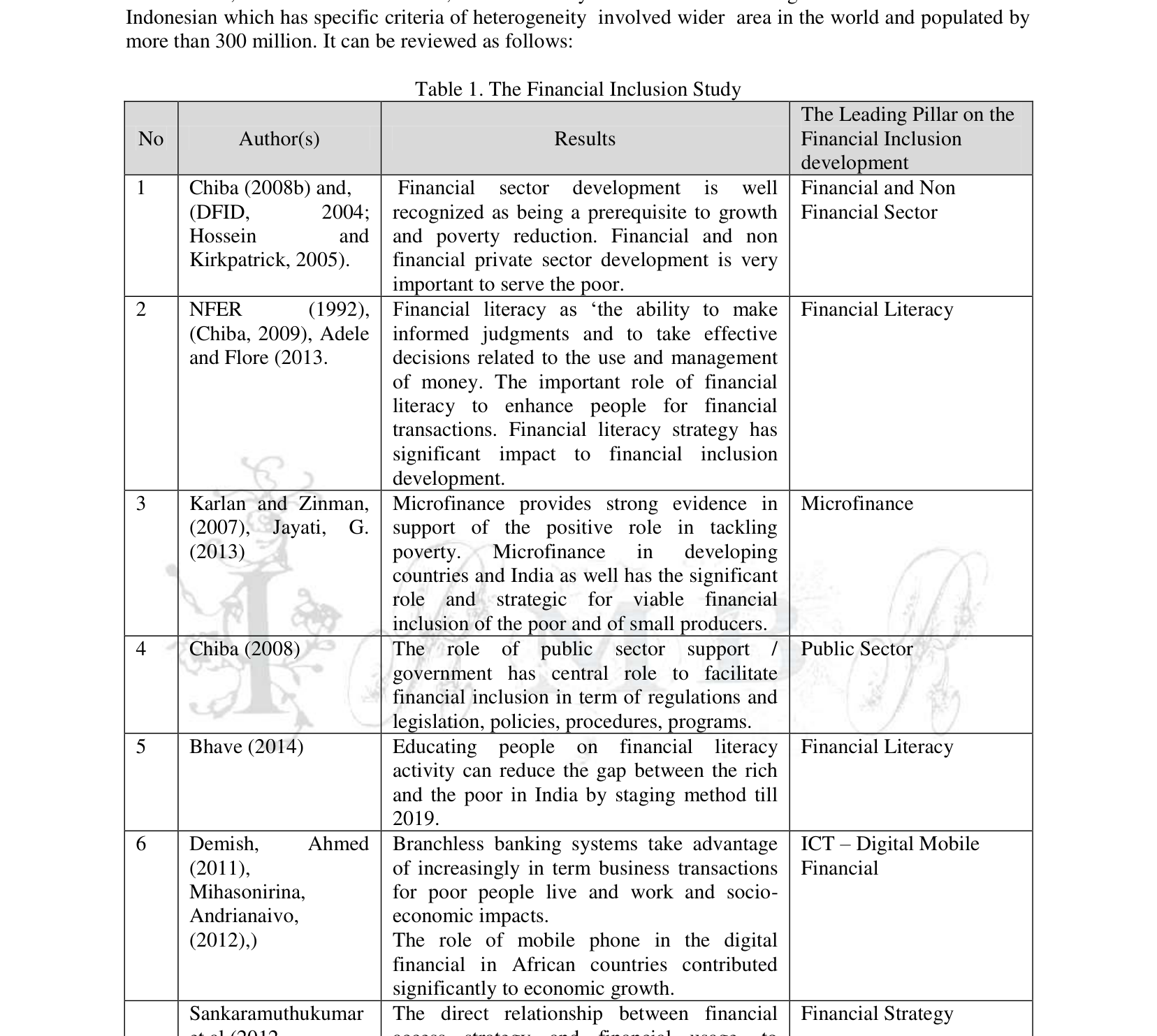
The Leading Pillar on the No Author(s) Results Financial Inclusion development 1 Chiba (2008b) and, Financial sector development is well Financial and Non (DFID, 2004; recognized as being a prerequisite to growth Financial Sector Hossein and and poverty reduction. Financial and non Kirkpatrick, 2005). financial private sector development is very important to serve the poor. Financial literacy as „the ability to make 2 NFER (1992), Financial Literacy (Chiba, 2009), Adele informed judgments and to take effective and Flore (2013. decisions related to the use and management of money. The important role of financial literacy to enhance people for financial transactions. Financial literacy strategy has significant impact to financial inclusion development. 3 Karlan and Zinman, Microfinance provides strong evidence in Microfinance (2007), Jayati, G. support of the positive role in tackling (2013) poverty. Microfinance in developing countries and India as well has the significant role and strategic for viable financial inclusion of the poor and of small producers. 4 Chiba (2008) The role of public sector support / Public Sector government has central role to facilitate financial inclusion in term of regulations and legislation, policies, procedures, programs. 5 Bhave (2014) Educating people on financial literacy Financial Literacy activity can reduce the gap between the rich and the poor in India by staging method till 2019.
ICT – Digital Mobile 6 Demish, Ahmed Branchless banking systems take advantage (2011), of increasingly in term business transactions Financial Mihasonirina, for poor people live and work and socio-Andrianaivo, economic impacts. (2012),) The role of mobile phone in the digital financial in African countries contributed significantly to economic growth. Sankaramuthukumar The direct relationship between financial Financial Strategy et.al (2012. access strategy and financial usage, to increase financial inclusion can be achieved by increasing; convenience, reliability, flexibility and continuity in African countries.
From Table 1 shown that there is no direct research which prepares a basic standing for Indonesian financial inclusion development based on geographies, special community, value, customs, and traditional institutions.
Financial Inclusion Strategy in the World Wide
In fact, a study by World Bank (2010) shows the effect of the financial exclusion is resources miss allocation. The financial assistance does not touch to the unbanked people who really need, instead, people who have surplus to financial access having more assistance (McKinsey, 2010). The unbalance situation will be sustainable and systemic epidemic. Hence, it needs a preventive strategy that is financial inclusion.
Financial inclusion has been initiated in 112 countries in the globe and just 14 countries are in the maturity stages. However, these countries used the partial approach. The review of 14 countries in term of approach is as depicted in Table 2:
| Country | Implementation Process | The Involved Sectors |
|---|---|---|
| the all pillars? | ||
| India The public sector provides the overall | Public sector, No | |
| framework, FINANCIAL INCLUSION | Cooperatives, | |
| policy/product | guidance from the | Microfinance, ICT |
| central bank. | ||
| Guatemala, Commercial banks offer microfinance | Private formal financial No | |
| Continental, services to the unbanked. CEMEX as a | institution, ICT Provider, | |
| Banrural, private | sector non-financial firm | Financial sector, Public |
| Mexico assisting the FINANCIAL INCLUSION | sector | |
| through a savings and credit scheme for | ||
| the poor and unbanked people | ||
| China Financial literacy in support of effective | NGO , Interventions of No | |
| and efficient microfinance. NGOs to be | NGOs active in financial | |
| effective partners for financial literacy | literacy | |
| and microfinance. | ||
| Philippines The | Globe Telecom Co., mobile | Private-Non-financial No |
| telephone providers offers mobile | Firm, ICT provider, | |
| banking services(bill payment, „mobile | Central Bank, Financial | |
| wallets‟, non | -bank accounts and cash – | Sector |
| transfers) | to the banked and unbanked. | |
| Telecommunication service firms are | ||
| providing cost-effective and efficient | ||
| financial services to the unbanked, | ||
| including those in remote areas. | ||
| Brazil Remote and under serviced areas can | Private and Formal No | |
| receive improved access to financial | financial institution, | |
| services | through private bank | Communities |
| collaboration | Partnership between | |
| private banks and the post office is one | ||
| effective way to raise up existing | ||
| infrastructure. | ||
| Mexico Bank accounts for the unbanked; funds | Public sector and Private No | |
| transfer service for remittances from the | Sector | |
| US | to Mexico‟s unbanked. This | |
| strategic led by central banks to address |
India The public sector provides the overall Public sector, No framework, FINANCIAL INCLUSION Cooperatives, policy/product guidance from the Microfinance, ICT central bank. Guatemala, Commercial banks offer microfinance Private formal financial No Continental, services to the unbanked. CEMEX as a institution, ICT Provider, Banrural, private sector non-financial firm Financial sector, Public Mexico assisting the FINANCIAL INCLUSION sector through a savings and credit scheme for the poor and unbanked people China Financial literacy in support of effective NGO , Interventions of No and efficient microfinance. NGOs to be NGOs active in financial effective partners for financial literacy literacy and microfinance. Philippines The Globe Telecom Co., mobile Private-Non-financial No telephone providers offers mobile Firm, ICT provider, banking services(bill payment, „mobile
Central Bank, Financial wallets‟, non-bank accounts and cash
Sector transfers) – to the banked and unbanked. Telecommunication service firms are providing cost-effective and efficient financial services to the unbanked, including those in remote areas. Brazil Remote and under serviced areas can Private and Formal No receive improved access to financial financial institution, services through private bank Communities collaboration Partnership between private banks and the post office is one effective way to raise up existing infrastructure. Mexico Bank accounts for the unbanked; funds Public sector and Private No transfer service for remittances from the Sector US to Mexico‟s unbanked. This strategic led by central banks to address financial inclusion. Kenya, Microfinance services and Commercial Formal financial No South bank promote FINANCIAL institution, ICT Provider, Africa, INCLUSION. Microfinance and Public sector, Private
Ghana, financial services to promote sectors, Financial and Nigeria, entrepreneurs, and serving the non-Financial firms, ICT Maldives, ‘unbanked’ people. The role of IFC, provider. Columbia World Bank Group, to support and FINANCIAL INCLUSION. Technology – e.g., mobile phones, Mongolia, prepaid cards and electronic kiosks – South Africa. offers a viable medium for FINANCIAL INCLUSION. Guidance from the public sector, the formal financial sector developed a Financial Sector Charter (FSC) for FINANCIAL INCLUSION to serve the poor. Trinidad and The public sector lead FINANCIAL Public sector, Financial No literacy, NGO‟s Tobago LITERACY with the central bank as the (T&T) coordinating agency and with the support of other key stakeholders to support FI.
Sources: Chiba (2008), (2009), Jayati, G. (2013).
From the above Table described 14 cases the financial inclusion models in the world. It described the approach of financial inclusion development which does not in line with Chiba (2009:216) who proposed four pillars theory. For Indonesian model should be involving all pillars such financial literacy, public sector support, government, and political interest, NGO‟s, Communities, ICT providers, microfinance, finance public sector, and private sectors. The approach is better to address with the issue of heterogeneity and complex problem of Indonesia.
Barriers and Challengers for Financial Inclusion Development
The development of financial inclusion in the world wide has a number of common themes emerge main barriers ( Madhur, Jha,. Et.al. (2014:29):
a. Natural barriers such as geographic, distance and culture which affect to model development, heterogeneity of culture and value, difficulties and cost. Besides that, religious concerns over interest payments can also be a challenge to financial inclusion too low proportion of adults that are „banked people’ (Demirguc-Kunt, 2012:57).
b. Lack of financial infrastructure involves borrower-lender information access, public credit registries, and private credit bureaus, this lack can be tackled by governments play key role. Besides that, getting credit Strength of legal rights, depth of credit information, public registry coverage, and private bureau coverage consider as factors that influence financial inclusion development.
c. Restrictive regulations. The regulations have important role – to protect consumers and to act as prudential regulators principally concerned with maintaining the integrity of individual institutions and of the financial system as a whole. In other word, they want to limit exploitation of the poor through unfair contracts, fraud, excessive prices and interest rates. In this regard, Kaddu (2014:80) initiated that national and international regulatory policies are often cited as further barriers to broader formal financial inclusion for the world‟s poorest people. For example at the national level, banks often require individuals to register themselves in order to meet regulations around the prevention of money laundering and to combat the financing of terrorism. d. Governance failures. The governance failure indicators that which affect to financial inclusion development are rule of law, regulatory quality, government effectiveness, control of corruption and political stability. While, minimizing corruption and ensuring a stable political environment will mean that better progress can be made towards addressing the key barriers to financial inclusion.
e. Products features. Innovation and creation is the key to perform attractive financial products. Financial products need to be tailored to meet the needs of the poor. Products need to be affordable, available within reasonable physical proximity and regulated to protect consumers, differentiation, segmentation, and design features strategy are important to have better financial product. Besides that, lack of financial literacy among the poorer segments also represents a significant barrier to the access and proper use of formal financial services.
f. Moreover, Juan (2014:22) considered that culture and traditional are the most barriers faced by the financial inclusion based on community. However, these obstacles also present as the greater opportunities (Juan, Blanco et.al. 2014). Moreover, Sankar (2013:74) postulated that psychological and cultural barriers also cause to negative Financial Inclusion in India, besides, physical barrier stemming from distance to bank branch or automated teller machine (ATM).
From the above discussed, it is therefore this paper concluded six constrains of the financial inclusion development, and it is assumed as the criteria to evaluate the proposed model. The barriers are: geographic and distance factor, infrastructures and physical facilities, national and global finance regulations, governance failures, products and services features, culture and religion value
Some Issues Related to the Indonesian Financial Inclusion Establishment
The specialty of Indonesia in term wide range area, number of ethnics, cultures, value and traditional value, and religions as it was discussed as above; it is therefore, need specific design which encourages a comprehensive approach and strategy.
Combining top-down and bottom-up for establishing financial inclusion is considerably necessary. In this regard, the writing issues related to the development of financial inclusions in Indonesia, firstly, the positive and externalities factors as a positive influence including the government and other formal financial institutions, community support and the existence of Cooperatives and NGO‟s institutions. Besides, there are many factors that could either hamper or support the financial development in Indonesia, such as the existence of micro financial institution, traditional values and religion institutions, and the financial institution based on other community. These factors can be considered as positive and negative factors.
Several positive externalities which are support to Indonesia financial inclusion establishment can be categorized into programs, infrastructures, and institutions. Program and process comprises; government vision, instruments, political climate, and financial sector and private sectors existence. All of the things put Indonesia in secure area as Indonesian President said that financial inclusion is going to be national agenda to tackle poverty issue in G20-AFI summit and Global Policy Forum 2012 in Bali and Mexico then followed up by pilot projects development initiated by Indonesian central bank (Bank Indonesia) for attaining financial inclusion national program 2015 in all provinces to cover unbanked people (Hadad, M. 2010:14) as it can strengthen unity.
Moreover, Darmin Nasution (Nasution, 2013:3)1 stressed that financial inclusion to be priority program to mitigate the income gap. Since, 2010 Indonesian Bank has launched the national strategy for financial inclusion by prepared a clear vision, mission, and objectives as well as the guidance its implementation for 1 ) Central bank governor fastening the financial inclusion implementation as means to serve unbanked group. Additionally, Indonesian bank has developed a program to change unbanked to be banked people by identifying a client with three stages namely financial identity number (FIN), then to be customer identity number (CIN). Finally, changing a client to be DIN (debt identity number) (Swadiyanti, S, 2011:4).
In term of micro finance as merchant instrument, Kartiko (2013) as Islamic micro finance activist ensure that micro finance sector ready to synergy in the program. While Rofah S., (2012) said that people in the society is ready because they have a good characteristic namely, easy for participating in the public development. Some of them obey to cultures value, local wisdom, and religion value such as Islamic value.
Furthermore, Muhammadiyah and Nahdlatul Ulama are the largest mass organization in Indonesia, where the two organizations have 30 million members has been reviewed and ready to implement a mobile payment system that applies to its members for a while by introducing Cooperatives. Besides that, in Indonesia also have so many Cooperatives that owned by NGO‟s, mass organizations, Islamic Boarding schools, Catholic and Christians, and government Cooperatives, the organizations are very potential as merchants, which is described in Table 3.
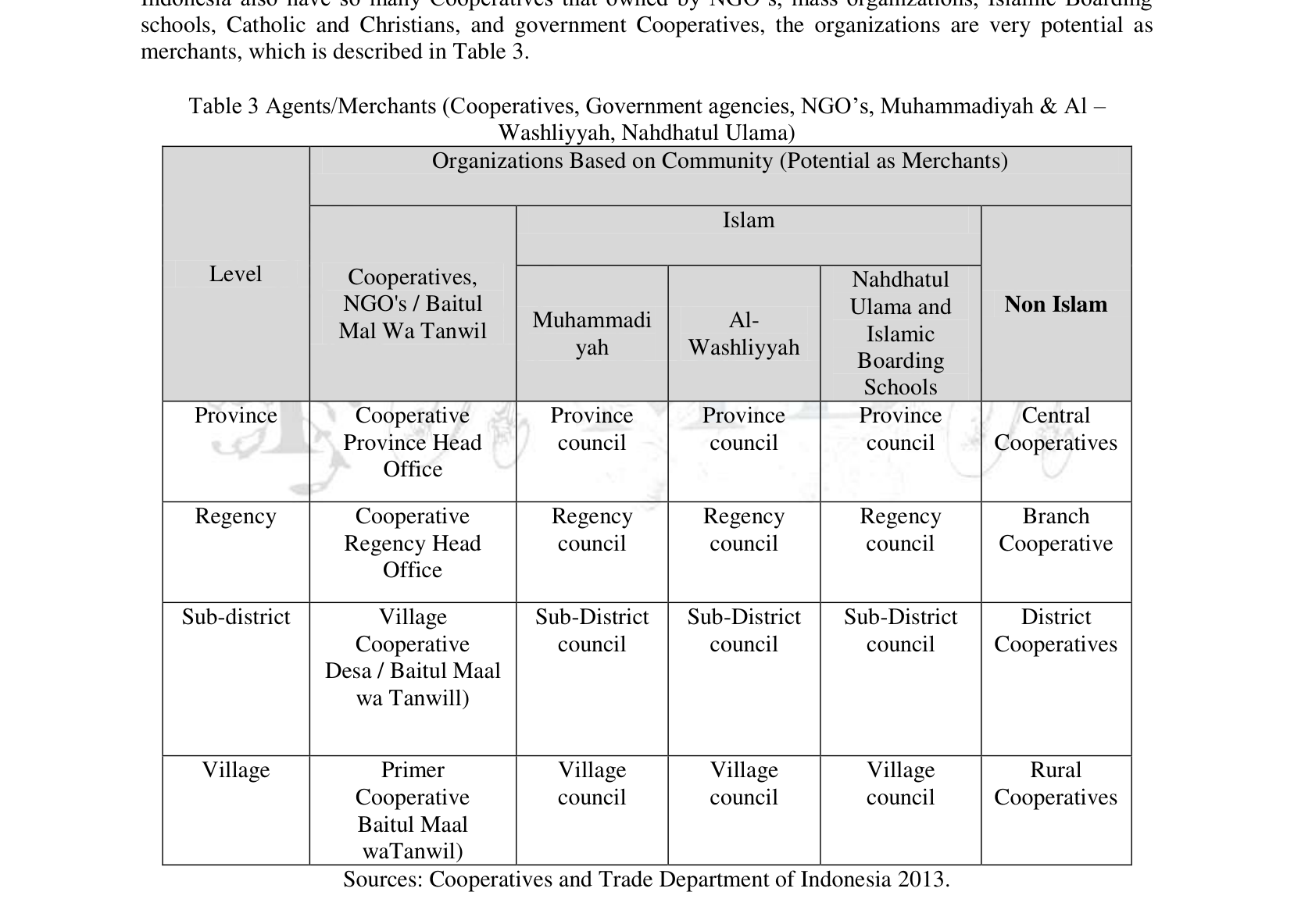
Table 3 Agents/Merchants (Cooperatives, Government agencies, NGO‟s, Muhammadiyah & Al –
Washliyyah, Nahdhatul Ulama)
Organizations Based on Community (Potential as Merchants)
Islam
Level Cooperatives, Nahdhatul
NGO’s / Baitul
Non Islam
Ulama and
Muhammadi Al-
Mal Wa Tanwil Islamic
yah Washliyyah
Boarding
Schools
Province Cooperative Province Province Province Central
Province Head council council council Cooperatives
Office
Regency Cooperative Regency Regency Regency Branch
Regency Head council council council Cooperative
Office
Sub-district Village Sub-District Sub-District Sub-District District
Cooperative council council council Cooperatives
Desa / Baitul Maal
wa Tanwill)
Village Primer Village Village Village Rural
Cooperative council council council Cooperatives
Baitul Maal
waTanwil)
Sources: Cooperatives and Trade Department of Indonesia 2013.
In addition, Indonesia also very strong in term of informal local financial institutions which has been grown in some places in the name of local transaction system based on values of cooperation, mutual trust with the main purpose of helping each other. This system covers all community activities such as economic and social, e.g credits, buying and selling, marriage, and other related religious transactions.
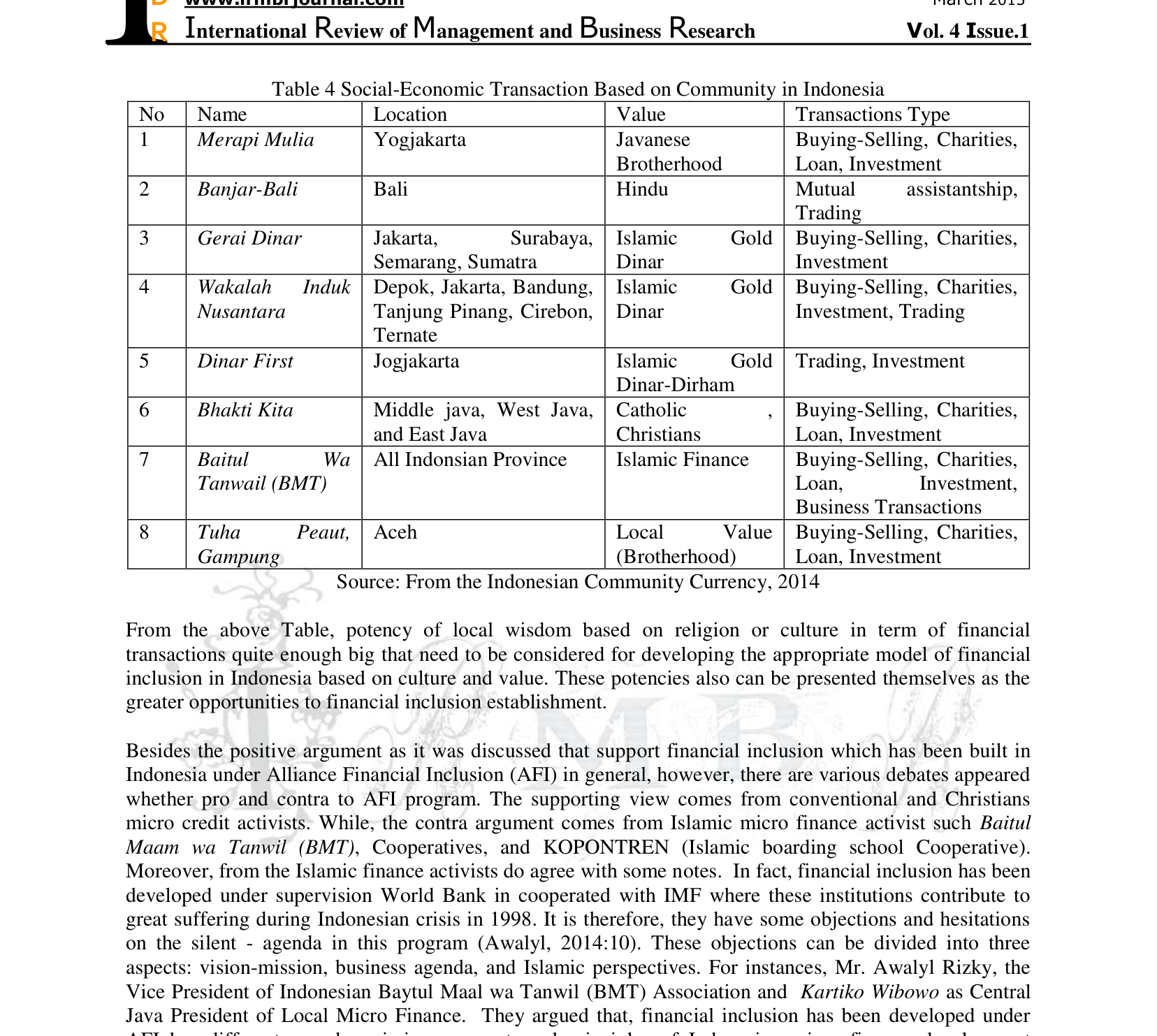
Merapi Mulia 1 Yogjakarta Javanese Buying-Selling, Charities, Brotherhood Loan, Investment
Gerai Dinar 3 Jakarta, Surabaya, Islamic Gold Buying-Selling, Charities, Semarang, Sumatra Dinar Investment
Wakalah Induk 4 Depok, Jakarta, Bandung, Islamic Gold Buying-Selling, Charities, Nusantara Tanjung Pinang, Cirebon, Dinar Investment, Trading
Bhakti Kita 6 Middle java, West Java, Catholic , Buying-Selling, Charities, and East Java Christians Loan, Investment
Baitul Wa 7 All Indonsian Province Islamic Finance Buying-Selling, Charities, Tanwail (BMT) Loan, Investment, Business Transactions
Tuha Peaut, 8 Aceh Local Value Buying-Selling, Charities, Gampung (Brotherhood) Loan, Investment
From the above Table, potency of local wisdom based on religion or culture in term of financial transactions quite enough big that need to be considered for developing the appropriate model of financial inclusion in Indonesia based on culture and value. These potencies also can be presented themselves as the greater opportunities to financial inclusion establishment.
Besides the positive argument as it was discussed that support financial inclusion which has been built in Indonesia under Alliance Financial Inclusion (AFI) in general, however, there are various debates appeared whether pro and contra to AFI program. The supporting view comes from conventional and Christians micro credit activists. While, the contra argument comes from Islamic micro finance activist such Baitul Maam wa Tanwil (BMT), Cooperatives, and KOPONTREN (Islamic boarding school Cooperative). Moreover, from the Islamic finance activists do agree with some notes. In fact, financial inclusion has been developed under supervision World Bank in cooperated with IMF where these institutions contribute to great suffering during Indonesian crisis in 1998. It is therefore, they have some objections and hesitations on the silent – agenda in this program (Awalyl, 2014:10). These objections can be divided into three aspects: vision-mission, business agenda, and Islamic perspectives. For instances, Mr. Awalyl Rizky, the Vice President of Indonesian Baytul Maal wa Tanwil (BMT) Association and Kartiko Wibowo as Central Java President of Local Micro Finance. They argued that, financial inclusion has been developed under AFI has different agenda, mission, concept, and principles of Indonesian micro finance development especially Islamic micro finance such BMT.
Vision-Mission: AFI model has been developed was guessed has some different agenda from Islamic micro credit development strategy that focus to brotherhood, cooperation, and assistantship. On the contrary, AFI has silent agenda to build a global networking toward micro finance liberalism without any value in other word based on materialism value which opposite with Islam (Kartiko, 2014). Moreover, the dissenting argument is supported by the facts; there is several evidence that most World Bank‟s assistance and involvement in Indonesia does not meet to the welfare issue. Instead, some of the World Bank‟s programs make some difficulties to the current. If it is true, it will make suffer to the ummah welfare whether material as well as spiritual welfare. In addition, in term of principles Islamic and conventional financial inclusion is difference, Islamic value based on gift value, and it does not based on debt principles, if person is not able to give, this person is encouraged to make saving little by little after that to be lenders. While, the common financial inclusion program the sense is focus to take benefit by borrowing from financial inclusion (Harjono S, 2014).
Program: Credit Cooperatives and Credit Units (Koperasi Simpan Pinjam & Unit Simpan Pinjam (KSP/USP) are the server for financial services to small and medium enterprises (SMEs) which is strategically for the economic ummah. And it is developed by mutual assistantship principles and inclusion among them. They are including 108,000 KSP/USP; this amount is about more than 90% of Indonesian KSP/USP all. Moreover, they cover to more than 18 million members include SMEs. It is therefore, they afraid that AFI will remove such cultures. It is well known, financial inclusion that built by AFI, World Bank, IBRD, and International Financial Corporation (IFC) just focus to global networking, society empowerment based on management, infrastructures, and principles which distinct to the current value. They focused to material value, whereas BMT focuses to both materially as well as spiritually.
Islamic value principles: Indonesian Baitul Maal wa Tanwil (BMT) is an Islamic micro finance agency which serves the society based on mutual cooperation, based on trust value. BMT‟s aid is based on Islamic financial credit principle such as Qiradh and Syirkah (profit loss sharing) which are encourages in Islamic value. Moreover, BMT declares that it is an Islamic missionary endeavor (Da’wah) institution to serve people toward better life today and hereafter. On the contrary, the current AFI program does not has clear vision to serve the ummah, they focus on the business calculation, as seemed on the interest charging which is prohibited in Islam.
Business and financial reason: World Bank, IBRD, and International Financial Corporation (IFC) are gigantic power with global networking. Sometimes they employ any strategy to force the government by some manner such as regulations involvement, political power, and economic power. The contender afraid it is not fair competition. They hope to the government to protect domestic interest and does not permit to compete with global power without any protections, they ask some request to the government to support micro credit and micro small medium enterprises (MSMEs) as during crisis thy have significant role for strengthening economic.
Finally, as above discussed, it can be concluded that the positive and negative factors can be seen as externalities issues should be addressed to deal with the development of Indonesian financial inclusion in Indonesia, firstly, financial Inclusion program under Alliance Financial Inclusion (AFI) is a global financial program hatched by the World Bank in cooperation with Bill Gates Foundation in terms of ICT. Basically, not all programs initiated by the World Bank are accepted by some of Indonesian people. They argue that any world programs cause some domino effects to the social economic. They grant a debt with some rigid requirements that will affect socio-economic life ratio in the future. This group of people tends to be unconcerned and unsupported the program (Awalyl, 2014:8).
Secondly, AFI program is worried to get a very limited support due to the fact that not all Indonesian people want to deal with banks, even conventional bank because the socio-cultural studies experts say that there are some tribes in Indonesia grudge against the Dutch colonized Indonesia when the oppressive, so they assume that every practice of bank and education is related to Dutch colonized (Raharjo, Trisno, 2014).
Thirdly, the program based on local knowledge needs to stimulate, for the people in Indonesia in business and social transactions, there are some factors built on traditional values that lead to the values of honesty, cooperation and mutual aid based on consensus. Institutional systems of indigenous are referenced by peoples in Sumatra, Kalimantan, Sulawesi, Maluku, Bali, West and East Nusa Tenggara and Irian Jaya.
For example, like in Aceh which has a value is called Gampong-Tuhapeut value. Generally, the value is based on cooperation, brotherhood, deliberation, and obedience (Damanhuri, 2012). By this value the people to be able build any project based on togetherness and cooperation, besides that, based on this system the people will implement or not implement something before consultation to their Islamic scholars which are very important and decisive in providing guidance, even they are very obedient to them. And this culture is still working and operating in the current system (Al Yasa, Abubakar, 2014).
Fourthly, the most financial barriers to adoption in the traditional value include the value religion, but it is still not clear how to resolve the issue. For example is in Bali which is called Banjar traditional society with a system based on the Hindu’s value system allows to execute transactions with community treasures. This system is headed by the head of customs and community members obeyed by him.
Sixthly, the role of Cooperatives in the community needs to consider because in Indonesia there are Cooperative networks, both formal and informal, this various types of cooperatives such as savings and loans help each other with capital purposes and to cooperate voluntarily. Even, Cooperative has been formed based on sharia, called Baitul mall Wa Tanwil (BMT). This cooperative has a network of grass roots up to the village. In fact, it has a network of services to 50 million people served by the BMT. So this fact cannot be neglected, on the Contrary it should be developed as the comparative advantages to build Financial Inclusion based on Cooperative.
Based on an overview of Indonesia in terms of barriers, challenges and externalities, then, it is proposed two models of the development process of financial inclusion, those are:
1. Top-down general models designed by central government.
2. Community Financial Inclusion Model based on the value of local wisdom, then, these two alternatives will be analyzed by six indicators of barriers which is discussed in the previous session of barriers and financial inclusion for development.
In this section we will analyze the alternatives model of financial inclusion to be implemented in Indonesia by using deductive analysis. Two alternatives offer two alternatives, namely: the top down global model designed by government linked with global finance institution and community financial Inclusion model based on local value wisdom. Then it will be analyzed by six criteria: geographic and distance factor, infrastructures and physical facilities, national and global finance regulations, governance failures, products and services features, and culture/religion value. By employing a deductive analysis, it will produce an appropriate model for Indonesian financial inclusion model.
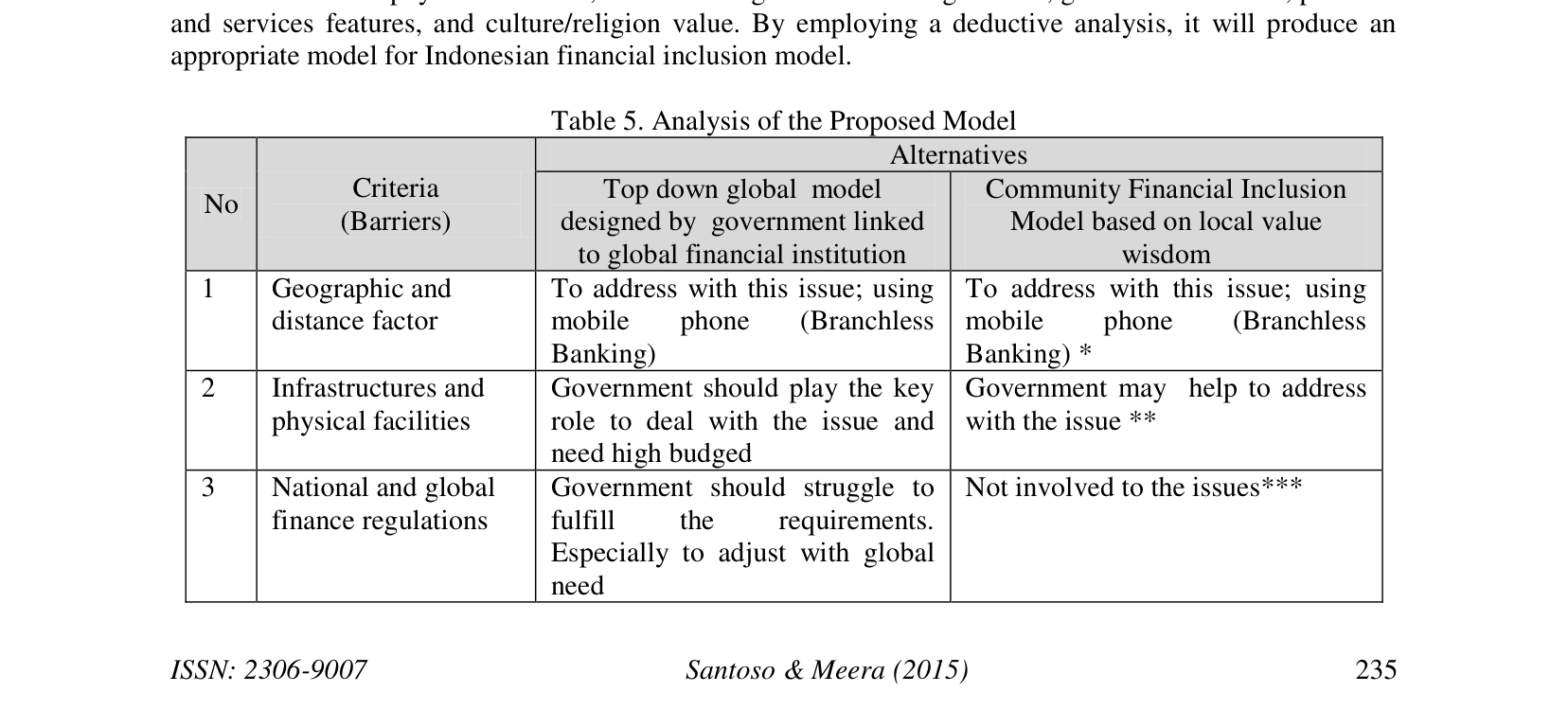
(Barriers) designed by government linked Model based on local value to global financial institution wisdom 1 Geographic and To address with this issue; using To address with this issue; using distance factor mobile phone (Branchless mobile phone (Branchless Banking) Banking) * 2 Infrastructures and Government should play the key Government may help to address physical facilities role to deal with the issue and with the issue ** need high budged 3 National and global Government should struggle to Not involved to the issues*** finance regulations fulfill the requirements.
4 Governance failures Government should struggle to Based on community, not involved achieve clean government and to government performance good governance 5 Products and services Can be improved by innovation The product and service are not features and creation and need more complex (based on community budged agreement)
6 Culture and religion Very difficult to address with the The designed model follows to value issue **** the certain value and culture ***** *: ICT and cellular provider should be facilitated by government and private ICT company
**: It is because government also takes benefit from the people transaction (tax)
***. The objective is just how to connect the poor to financial access, so the involvement global institution is not compulsory
****: The general model is not flexible, difficult to adjust to the specific characteristic
*****: It is because the community will create the appropriate model based on their agreement
Source: Author analysis by using deductive comprehensive analysis
From the above analysis, it is clear that the second alternative has some superiority in term of flexibility and acceptability; however the first model also has advantage to strengthen for achieving to the global financial networking and global financial access. It is therefore, the second model cannot be ignored by just focus to the first model only.
Framework of Mobile Financial Inclusion Based on the Community
As explained previously that Indonesia is viable to implement financial inclusion covered by mobile system. By using mobile phone the system to be effective and efficient. Mobile phone nowadays is very common owned by villagers. Hence, it can accelerate the poor for accessing financial products and services. A system which efficient manner, simple procedure, and to be accessed easily is needed particularly for village people and other stakeholders. However, government involvement such financial literacy and hardware assistance to this program is crucial thing as there are some benefit taken by government if the program successful. The current mobile financial inclusion for Indonesia was offered by some researcher such Kodim, Nasrindan (2012:20), Kasmiati (2013), Prasetyo, Dedy (2010:15), Satria, Arif et al. (2011). Supartoyo,Yesi H, (2013). They voiced to perform financial inclusion based on mobile phone to deal with the poverty problem. However, their proposed models are still general models in nature. The important issues is being neglected such Indonesian heterogeneity in term of culture, distance, value, institutions and traditional value. It is therefore, this paper attempt to cover the research gap. By proposing an integrated model where community is considered as important element in the model.
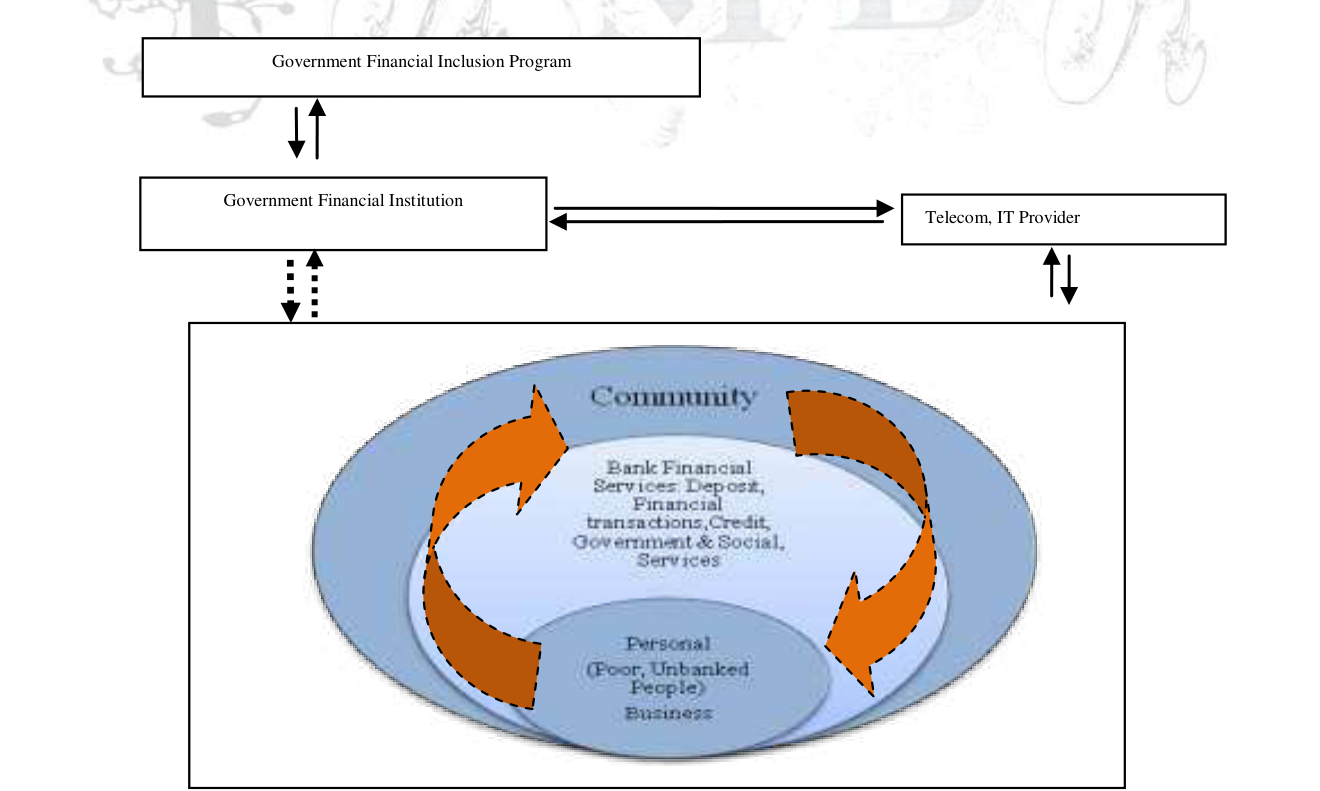
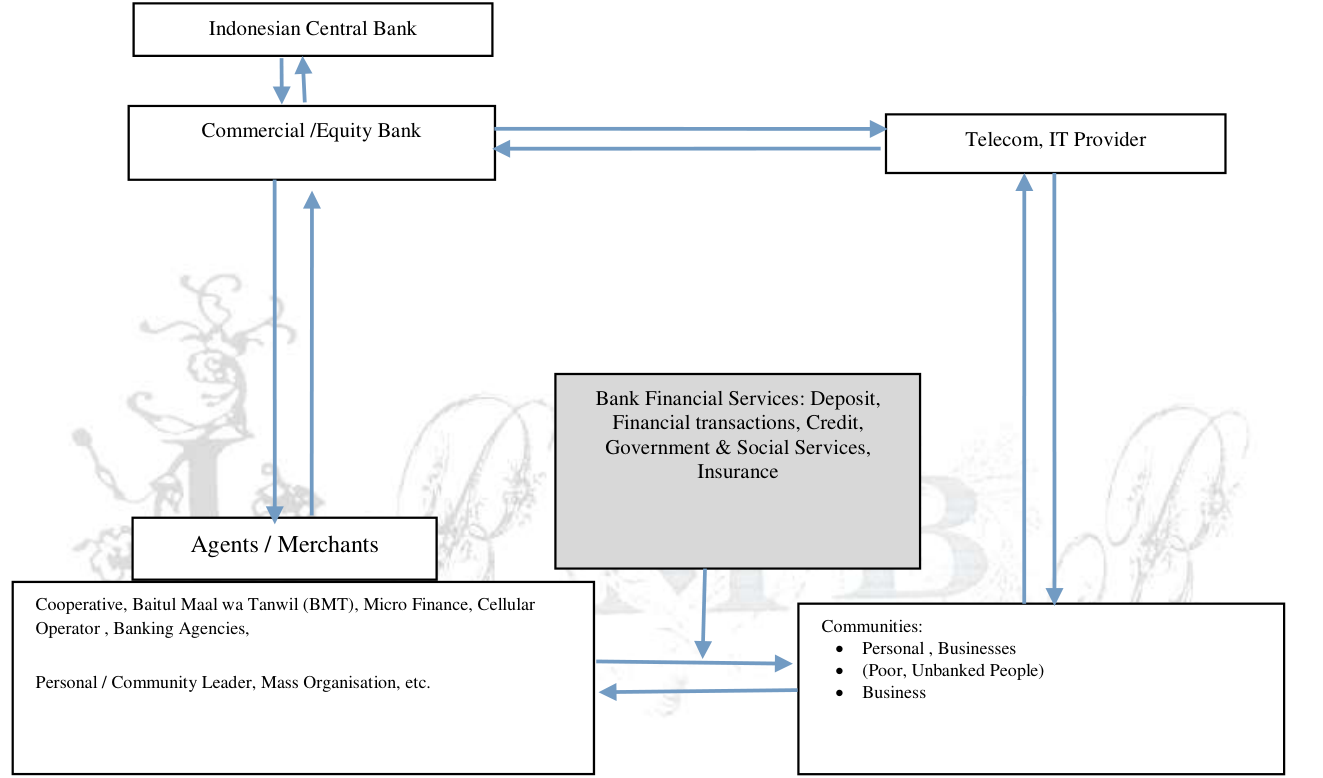
A design framework that connecting private sectors, civil society, unbanked people, public (government) sector, information and communication technology (ICT), financial providers, agents/merchants, and banks is offered in Figure 1a and 1b.
Detail of Framework
Fig. 1.a. shows that the poor and unbanked people and other business entities can be able to access financial services such as; access customized saving, credit, financial transaction, government financial assistant and insurance services facilitated by community. It has some features in terms of connect to institutions; reduce cost of utility linkages, reduce cost of government payments, reduce bank operational cost by implement Branchless Banking concept without any hesitancies because based on consensus among community. The community system is offered based on facts as it was discussed that in Indonesia, there are so many type cultures, values, and customs. Even, some of them are willing to be financial excluded as they consider that the model is prohibited by their culture. From Fig. 1.a. described that the role of government is just coordination, supervision, and some time give assistances such as government aids, etc.
Fig. 1.b. shows that the role of government is very central and urgent, the model is top down, homogenous, similar (uniform), and based on governmental orientation. The mobile phone is used to back up any transaction that collaboration with cellular provider such as Telkomsel. XL, IM3, Indosat, etc. The weakness of the design does not give a chance to special value, cultures, customs, traditional believe, geographic distance, and special community to grow in the system. It is because the model is top down and centralistic and general model, usually the model is useful to cover educated people, developed community, and based on the city.
In the Fig. 1.a. the role of government financial agency as care taker or coordination of the system by prepare the program and facilities. Besides that, government should ensure to the community members who don‟t want to join financial inclusion program by reasoning value, culture, and traditional custom who still misunderstanding or not willing join to global financial program. The group such as: mass organization, custom institutions, Cooperative, Baitul Maal wa Tanwil (BMT), micro finance, financial agency and community leader. In this condition, government cannot be forced them to join to the program, however government juts take function as a mediator by introducing some financial transactions such as government & social services, and insurance, deposit, investment, etc.
Moreover, government prepare ICT infrastructures in cooperation with the cellular providers as communication regulator by mobile phone which make possible a customers can access to financial products and services by using mobile phone. The transaction comprises B2B (business to business), P2P (personal to personal), P2B (personal to business) and B2P (business to personal). The services offered such as: money transfers, payment of bills, government to person payments, P2P transactions, B2B transactions, B2P transactions and conversely, banking services, purchasing airtime, check balances, pay electricity bills, pay for goods and services, pay school fees, view statements, receive salary, etc. Cooperation is the important key performance indicator that ensures the implementation process to be successful. The synergy between stakeholders is needed such as central bank, government institutions, public sector, micro finance, Cooperatives, Customs tradition, Communities, ICT provider and society/business, and other agents. In this case synergy with Chiba (2009:216-217) statement that FI includes pillars: society/community-private sectors, NGOs, public leaders/public sectors, information technology, micro finance and finance literacy which related to some steps namely; approach and process, main mechanisms / instruments, implementation, and lead players.
However, step by steps method is better to avoid the shock conditions, starting by educating the society, then identification for Financial Identity Number (FIN), after they have account, then, they encourage to be CIN (Customer Identity Number). By process sustain financial literacy; they are able to bankable person, then change to Debt Identity Number (DIN).
Reviews of the Proposed Model
Related to the issues, some interview was conducted to evaluate the proposed model. First and famous, Meera (2013,10-12) introduced that by implementing information & communication technology in the transaction is called mobile phone & internet payment systems. It will come to integrate in the monetary system in term of monetary and payment landscape and it is a monumental change in the global payment system in form financial inclusion to serve particularly the „unbankable‟ people. In addition Meera (2013:13) stressed mobile money has some beneficial such as; increase velocity of money due to convenience in use, easy payment/remittance, reduced transaction cost: secure, reduces probability of shortage of money that contributes to recessions. Moreover, this model enables to bring occurrence of riba in economy to be minimal. Then, next step can be implemented integration by using commodity such as gold and silver. Gold and silver can be employed as commodity for measurement of value because gold has stable and just value (Meera, 2013:11). This is a way for approaching the people who don‟t join to financial inclusion by reason Islamic value.
This is a way out to stimulate toward a just and fair system. Besides that, it is an initial step to strive riba alleviation. By this system, a just monetary system and exchange free from riba, gharar, and maysir make possible to bring into reality in the financial system. However, usury (riba) will be continuously if fiat money still inherent in monetary system. In fact, in the modern monetary system actually is based on fiat money, fractional reserve banking, and interest rate which trigger hard economic collapse (Meera, 2009:114).
Moreover, some public leaders who were interviewed stated that poverty caused usually by its obstacle to access capital, natural resource, human and financial resources. Hence, to tackle poverty issue, it does not suffice just financial inclusion only, however, it needs integrated solution both mentality and spirituality. In addition, government should involve actively as the private sector not enough power to deal with the problem, the government role especially for preparing political vision and regulatory aspect (Harjono, 2014). Additionally, Awalyl R, (2014:9) added that Micro finance, Cooperative has huge role to deal with the issue, it is therefore Islamic micro finance such Baitul Mal Wa Tanwil (BMT) should be placed in the central position in financial inclusion movement, even Indonesian BMT Association has been establishing mobile financial inclusion for the members. They stressed that this model is more flexible rather than to compel to the national agenda, besides that, FI vision in BMT is difference value with global FI vision, in BMT encourage people saving (deposit) or to gift while global FI is taking a loan.
From Branchless Banking concept Khalif R. (2014) stressed that this model is an effective manner to break of the hindrances the unbanked poor people to access financial assistances. Moreover, it is able to improve their social-economic capability. However, he stressed that the key performance indicators of the success implementation are the powerful regulation and third party should have adequate experiences for serving customers. Moreover, agents or merchants should have chain reached till to villages in order the villagers can access easily. Customer‟s protection law should be established to meet with the safety and convenience issue. It is important as the transaction perform by mobile phone. In addition, educating people also urgent step to inform such information i.e. mechanism, right, procedure, and obligation. In addition, the implementation digital financial inclusion requires digital financial platform to associate ICT (information communication technology), data sharing/mining, digital account, and clients by using mobile phone (Khalif, 2014) and it is capable to be implemented in parallel system.
In term of to ensure the success of implementation process, it is impossible to design one model for Indonesia, it is because Indonesia has some heterogeneities in such culture distances and value. Hence some model should be offered to cover these variations for ensuring the flexibility issue. For examples, there is some community Islamic mass organization in Indonesia as well as traditional institutions such as Muhammadiyah, NU, Al-Wasliyah, NGO‟s, and Tuha–Peaut–Gampoong in Aceh, Subak and Banjar in Bali, Dayak in Kalimantan, and Samin in Java. Employing these kind organization and give them self autonomies is the better strategy rather than ignoring them by reason to attract society participation for joining the program, however, the main and standard model also important for serving middle-up class and educated people ( Sujak Abu, (2012), Budi S (2013), Kholil, 2012, Dayan, 2013).
Santoso, Bedjo, (2012;64) argued that through the traditional institution in the village such Gampoong, Teuha Peut in Aceh which is an institution based on community cooperation, and brotherhood possible to employ the idle gold as complementary currency to awaken the rural economic. Currently, this institution is still working (Damanhuri, 2013). Moreover, the institution is based on scholar‟s obedience, and it is very effective to empower the marginalized people (Yusran, 2011). Gold and the cooperative value is still prevailing in current the community (Al-Yasa, Abubakar, 2014).
Moreover, Sociologist Damarhuri A, (2014) stressed that there are some tribes in Indonesia which will do important thing in the society based on their leaders and agreement, besides that there some special characteristic customs tend to refuse the modern live came from the west, as they have bad experiences during colonization eras. The other special case in term of Islamic value is that people reject to financial access as they consider usury reason. For these kind varied should be addressed by difference model of financial inclusion. The mentioned tribes are such Aceh, Bali, Dayak, Samin-Java, Badui and Sasak. It is therefore smart approach is needed to their leaders for joining the program by offering simple and flexible approach and method rather than one general model.
Raharjo, Trisno (2014) strengthened that the tradition values should be accommodated by reason flexibility and suitability arguments. He proposed three steps to unity the specific value to the national value, which are: first, accommodating this specific value can be able to life together with the global value. Second, studying the advantages and disadvantages, and finally integrating the value to the national value.
Additionally, Awalyl R, (2014:12) as Islamic Micro Finance movement (BMT) declared that for around 30 years BMT has significant role for empowering the poor and micro small and medium enterprises (MSMEs) by their smart strategy to serve them, and nowadays BMT has been spread widely in 32 Indonesian provinces. Hence, he proposed a flexible model by giving them autonomy widely and don‟t ask them to join to the global finance which don‟t have any evidence for Indonesian development.
On the contrary, the defender of global model Yesi and Kasmiati (2013:80-81) postulated that standard model by including official agents/merchants is necessary. The community can be handled by agents or merchants. Agents/merchants are including Cooperative, Baitul Maal wa Tanwil (BMT), micro finance, Cellular operator, Retail banking, personal / community leader as well. The function of agents-merchants is mediator for financial bank transactions in cooperated with cellular provider. The function of merchants is to serve and facilitate individual/personal (P) and businesses (B) for making any financial transaction such as money remittance, payment, deposit, government & social services, insurance and other financial transactions. He believes that the model will be able to deal with the problem efficiently.
Finally, as it was above discussed in evaluations and reviews, it can be concluded there are three scenarios of the appropriate financial inclusion model to be implemented in Indonesia, evaluations of the proposed model, namely: First, Community based financial inclusion model as such depicted in figure 3 s above, the model especially to serve the specific geographic, area, value and religions which does not deal with the national model, it is because some reasons such distances, geographic, and society. Besides that, also by reason of culture, value and specific believe in the community.
Second, the global standard model should be accommodated by adding the role of agents/merchants and commercial bank as care taker bank as shown in Yesi and Kasmiati (2013:79) model. On this model the role of agents/merchants are facilitating people for making any financial transactions. Merchants/agents could be all institutions in the society as well as community institutions such Cooperatives. This model is focused for the urban society, educated people and developed cultures and it will running together with other model.
Third, mobile payment system based on gold as measurement of value; the idea came from Meera (2013:7-12) who introduced mobile phone & internet payment systems based on gold as measurement of value. He stressed that the model increases velocity of money and reduced transaction cost. Besides that, usury in fiat money will be eradicated as gold as stable and just value. This way to facilitate people who believe that fiat money is considered does not in line with maqashid sharia, so it is not safe ways for muslim. This model basically for serving the communities who struggle for asking back to gold as money but in the current system, it is impossible to implement gold dinar physically as it was discussed by Edawati (2013:288) as some obstacles such infrastructures, laws, and gold availability. Besides that, also important for certain communities which still using gold as measurement of value such Aceh (Damanhuri (2013), Al Yasa (2014). Besides that, this system also to serve the community would adopt sharia Islam perfectly as gold as standard of measurement is important to support this action (Al Yasa,2014).
However, gradual implementation is better starting by small scope. The initial step could be begun in 1st developed area and then followed by 2nd ring area etc. This is because to avoid sudden shock which may trigger uncertainties.
Conclusion and Recommendation
There is being neglected in the recent global financial inclusion development and literature namely, the most literatures and practice was founded and focused on partial research the role pillars financial inclusion such ICT, public sector, financial sector microfinance and financial literacy. The research on geographies of financial inclusion focusing on special community as alternative institutions and their relationship to the financial mainstream is being ignored.
The paper concluded five the barriers of financial inclusion development, and it is assumed as the criteria to evaluate the proposed model. The barriers are: geographic and distance factor, infrastructures and physical facilities, national and global finance regulations, governance failures, products and services features, culture, traditional, and religion values.
To develop financial inclusion for Indonesia should consider approach, the running value in the society, religions believe, communities willingness, tradition local wisdom, and culture as well. Besides that, the wide area, number of tribes, and the biggest archipelago with long distances should be considered as important factor to develop financial inclusion in Indonesia. Therefore, Community Financial Inclusion Model based on local value wisdom is the appropriate model as an alternative to deal with the problem by placing the community institutions as proxy for accommodating the heterogeneity value and people special characteristic in Indonesia culture. The community could be mass organization, custom institutions, Cooperative, Baitul Maal wa Tanwil (BMT), micro finance, financial agency and community leader with the function as a mediator for individual-personal (P), businesses (B) who does not yet understand the modern financial program. However, community financial inclusion model based on local value wisdom is better if to be implemented together with the national general model to serve semi educated people, developed area, and urbanite people. Besides that, the group of people who want to adopt muamalah principles purely should be accommodated. There are three scenarios of the appropriate financial inclusion model to be implemented in Indonesia such as: Community based financial inclusion model, standard global model financial inclusion by adopting the global model, and mobile payment system based on gold as measurement of value. However, accommodating the community model in the national model will strengthen to national unity.
For further research could focus to develop the alternatives and criteria for developing financial inclusion model in certain area. The alternatives could be area of Indonesia which be divided into some categories such level of development or based on area then it will be evaluated by the criteria such flexibility accessibility, efficiency, and effectiveness. The respondent should be enhanced which involves scholars, academician, banking, ICT providers, NGO‟s, and government by using area and stratified sampling method that can be represent Indonesian as a whole. Quantitative and qualitative method can be adopted together in order to achieve comprehensive result, besides that, focus group discussion method also important to be done, and these things is not yet carried on this research as the weakness of this study.
References
Adele Atkinson and Flore-Anne Messy (2013), Promoting Financial Inclusion through Financial Education, Working Papers on Finance, Insurance and Private Pensions, Paris Organization for Economic Cooperation and Development (OECD) 10-01-2013, 34, pp.1.
Al-Saati, Abdul Rahim Abdul Hameed, 2002 A.D/1422 A.H. Sharia Compatible Futures. Journal King Abdulaziz University: Islamic Econ. 15 (1): 3-25. http://www.isu.ac.ir.pdf [ 17 Feb. 2010].
Al Yasa, Abubakar, (Prof.Dr), (2014), „Aceh Islamic Shariah and Islamic Finance Movement’, Interview Result, on 2 December 2014, as Head of Muhammadyah of Aceh Indonesia.
Awalyl, Rizky, (2014), ‘Peran dan Strategi BMT dalam Pemberdayaan Ummat’, Paper presentation pada Sarasehan BMT Nasional, 2014, pp. 1-25, unpublished paper.
Bagehot W. “A currency based on a market basket of commodities appeared in the Economic”, http://cepa.newschool.edu/het/essays/monetarism/mpolicy.htm, nov 2013 Bank Indonesia (2013a). Indonesia Motor Asia Pacific, Financial Media Journal, V.8 No. 73 Sep 2013 Bank Indonesia, (2013b), The Path Way of Financial Inclusion in Indonesia, Yearly Report, Dec 2013, pp.1- 12.
Bhave, Devendra, G. (2014), A Study of Development towards Financial Inclusion in India, Journal of Commerce and Management Thought, ISSN: 0975-623X, Villanova University,India, 04-01-2014, 5(2), p. 229-242.
BPS (Indonesian Centre Statistic Bureau, 2014), pp. 1-10, Retrieved from :
http://www.bps.go.id/tab_sub/view.php?kat=1&tabel=1&daftar=1&id_subyek=23%20¬ab=1, on [jan 2015]
Budi S. Tengku, (2013), „Cooperation of Aceh People’, Interview result, on 14 March 2013, as Aceh Scholars.
Carat, 2002, E-money, The EU Single Market. European Commission. 11 August 2013. Retrieved from http://:www.wikipedia.com.singlemarketEC20390//onT2S,on 9 January 2014), pp. 9-23.
Chibba, M. (2008) Poverty reduction in developing countries: No consensus but plenty of solutions.World Economics 9(1): 197–210.
Chibba, M (2009), Financial Inclusion, Poverty Reduction and the Millennium Development Goals, pp.213–230, European Journal of Development Research (2009) 21, doi:10.1057/ejdr.2008.17,www.palgrave-jounal.com/cjdr/ Damanhuri, (Ph.D) (2013),‟Aceh People and Islamic Value’, Interview Result, on 3 March 2012, as Aceh Sociologist and Scholars.
Dayan, (2013), „Aceh Society and Development’, Interview result, on 17 Nov 2013, as Scientist.
Demirguc-Kunt, Asli and Klapper, Leora, ‘Measuring Financial Inclusion: The Global Index database’, World Bank, 2012, pp.52-59.
Dermish, Ahmed. et.al. (2011), Branchless and Mobile Banking Solutions for the Poor: A Survey, Social Science Research Network Journal-USA, SRRN-id1986316, January 23, 2011, Innovations, Vol. 6, No. 4, Fall 2011, retrieved from: http://ssrn.com/abstract=1745967, on Nov, 2014. Pp. 81-98.
Donner, Jonathan, and Camilo Tellez. (2008). Mobile Banking and Economic Development: Linking Adoption, Impact and Use. Asian Journal of Communication 1, no. 4: 318-332.
Duncan Fuller, Mary Mellor, Lynn Dodds and Arthur Affleck (2014), „Consulting the community Advancing financial inclusion in Newcastle upon Tyne, UK‟, Emerald Insight International Journal of Sociology and Social Policy Northumbria University, Newcastle upon Tyne, UK, Vol. 26 Iss 5/6, Available at www.emeraldinsight.com/0144-333X.ht, link to this document, http://dx.doi.org/10.1108/01443330610674297, Downloaded on: [18 November 2014], pp. 255 – 271.
Duncan Fuller and Jonas Andrew E G, (2002), Institutionalizing Future Geographies of Financial Inclusion:
National Legitimacy Versus Local Autonomy in the British Credit Union Movement, Antipode Journal EBSCO HOST, ISSN:00664812, Call Number: 6068240, Zotero Publ, 2002, 34(1),pp. 85-100 Edawati, Salmy, (2013), „Dinar Emas; Mekanisme Implementasi dalam Ekonomi Semasa’, Ph.D Thesis, UKM-Malaysia, pp. 1-338 Gerai Info (2011), Bank Indonesia (Central Bank) News Letter, Edisi XV, TH 2, Juni 2011, email :
[email protected], website : www.bi.go.id, pp. 1-8.
Hadad, M. (2010:14), „Perluasan Akses Perbankan;Bagi Penggerak Roda Perekonomian‟, Gemari Magazine, Edisi; 118/XI, Nov 2010,pp1-89 Harjono S, (2014), „BMT; Islamic Financial Inclusion Vision-Mission‟, Interview result, on 10 December 2014, as PB-BMT Association Jakarta activist.
Jayati, Ghosh, (2013), Microfinance and the challenge of financial inclusion for development, Cambrige Journal of Economics, (37-6),pp. 1203-1219)
Janet Hernandez, Jeff Bernstein, and Amy Zirkle ,(2011) ,THE REGULATORY LANDSCAPE FOR MOBILE BANKING, Telecommunications Management Group (TMG), Inc. International Telecommunication Union (ITU), GSR 2011 Discussion Paper, pp. 1-25, email from: [email protected].
Jhon Gitau, (2013), March 11, 2013 in Center for Financial Inclusion, Financial Inclusion, Policy, Technology | Tags: Alliance for Financial Inclusion, Financial Inclusion, John Gitau, Kenya, M-PESA, M-Shwari, Mobile Money, Safaricom, South Africa Juan Blanco et.al. (2014), Models and Barriers for Financial Inclusion, Financial Inclusion 2020- CFI, retrived from:http://cfi-blog.org/2014/10/21/models-and-barriers-for-financial-inclusion/ on October 21, 2014, pp. 14-22.
Kaddu, Michael. (2014), Banking on Change: Breaking the Barriers to Financial Inclusion, NPM Platform for inclusive Finance, Head of Corporate Affairs, Barclays Bank Uganda, Nov 2014.
Karlan, D. and Zinman, J. (2007) Expanding Credit Access: Using Randomized Supply Decisions to Estimate the Impacts. Washington DC: Centre for Global Development. Unpublished Working Paper no.108. pp. 21-34 Khalif R. (2014), „The Viability of Financial Inclusion from ICT Aspects‟, Interview result, on 10 November 2014, As IT Consultant/Builder.
Kholil, (2012), „Participation Level of Aceh Society for Development‟, Interview Result, on 14 July 2012, as The Leader of Aceh NGO‟s.
Kodim, Nasrindan dan, Sampurno (2012). Membangun Masyarakat Perdesaan yang Sehat Produktif.Perdesaan dalam Rangka Peningkatan, Kesejahteraan Masyarakat Pemikiran Guru Besar Perguruan Tinggi Badan Hukum Milik Negara. IPB Press, Bogor, Unpublished paper, pp. 1-25.
Moorthiet al. (2013), Bracnhless Banking by Corporation Bank – A Branding Perspective. . retrieved from http://tejas.iimb.ac.in/articles/10 accessed on 26th July 2013 Madhur,Jha.,Samantha. Amerasinghe., John, Calverley. (2014), Special Report “Financial Inclusion:
Reaching the unbanked”,4 September 2014, Standard Chartered Bank, Canada, 2014, pp. 24-32.
Kaddu, Michael. (2014), Banking on Change: Breaking the Barriers to Financial Inclusion, NPM Platform for inclusive Finance, Head of Corporate Affairs, Barclays Bank Uganda, Nov 2014, pp.74 Kartiko, 2013, „Strategic of Islamic Micro Finance (BMT) in Financial Inclusion Movement‟, Interview Result, on 12 July 2014, as Chief of Java-BMT Association.
Michelle Baddeley Gonville (2004), Using e-cash in the new economy: An economic analysis of micropayment systems, „Caius College and Faculty of Economics and Politics, Cambridge, UK, [email protected], Journal of Electronic Commerce Research, VOL. 5, NO.4, 2004, pp. 239-258 McKinsey (2008), „Cross-country variation in household access to financial services, research conducted in partnership with the Financial Access Initiative (a consortium of researchers at New York University, Harvard, Yale, and Innovations for Poverty Action); we relied on financial usage data from Patrick Honohan, “” Journal of Banking & Finance, Volume 32, Number 11, 2008, pp. 493–500 McKinsey, (2010), „Global Financial Inclusion: Achieving full financial inclusion at the intersection of social benefit and economic sustainability‟, pp.1-44, Retrieved from: http://www.thegiin.org/binary-data/RESOURCE/download_file/000/000/149-1.pdf, On 12 March 2014.
Meera, (2013), „Islamic Finance and Its Role in Economic Development‟, Presentation on International Seminar, UGM, Yogjakarta, 12 November 2013, pp. 1-23 Meera and Larbani, 2009, “Ownership Effects of Fractional Reserve Banking: An Islamic Perspective,” in Humanomics, vol. 25, no. 2 (May 2009), 101-116. See also Ahamed Kameel Mydin Meera and Moussa Larbani, “Seigniorage of Fiat Money and the Maqasid al-Shariʿah: The Unattainableness of the Shariʿah,” in Humanomics, vol. 22, no. 1 (2006); and idem, “Seigniorage of Fiat Money and the Maqasid al-Shariʿah: The Compatibility of the Gold Dinar with the Maqasid,” in Humanomics, vol. 22, no. 2 (2006).
Mihasonirina Andrianaivo, Mobile Phones, Financial Inclusion, and Growth, Review of Economics and Institutions Vol. 3, University of Perugia 2012, pp. 19-31.
Michelle Baddeley Gonville (2004), Using e-cash in the new economy: An economic analysis of micropayment systems, „Caius College and Faculty of Economics and Politics, Cambridge, UK, [email protected], Journal of Electronic Commerce Research, VOL. 5, NO.4, 2004, pp. 239-258 Moloi, Mindy., 2009. Strategy Optimizing Financial Inclusion in South Africa, Thesis, University of Pretoria-South Africa, 2009 Moorthiet al. (2013), Bracnhless Banking by Corporation Bank – A Branding Perspective. . retrieved from http://tejas.iimb.ac.in/articles/10 accessed on 26th July 2013 Mulya, E, S, (2012), Wujudkan Wujudkan Financial Inclusion Melalui Edukasi dan Perluas Jangkauan‟, p.1-4, Swa Magazine. Retrieved from: http://swa.co.id/business-strategy/wujudkan-financial-inclusion-melalui-edukasi-dan-perluas-jangkauan, on [9 Feb 2014]
Nasution Darmin, (2010),‟Welcoming Remark at the 2010 AFI Global Policy Forum Bali, 27 Sept 2010, Retrieved from AFI web on 12 May 2013, pp. 1-7.
NFER. (1992) Financial Literacy. London: National Foundation for Educational Resources (NFER)
Prasetyo, Dedy (2010), Branchless Banking; Satu Pilar Mencapai Keuangan Inklusif. Crestpent Press, Bogor Porteous, David. (2007). Just How Transformational Is M-Banking? Report prepared by Bankable Frontier Associates for FinMark Trust.
Raharjo Trisno (Ph.D), (2014),‟Indonesian Values, Customs, and Traditional Institutions‟, Interview Result, on 2 December 2014, as Senior Indonesian Sociologist.
Radcliffe Dan and Voorhies Rodger, (2012),‟ A Digital pathway to Financial Inclusion‟, Presented paper, electronic copy available at: http://ssrn.com/abstract=2186926.pp. 1-16.
Rofah S., (Ph.D) 2012, „Islamic Finance Development‟, Interview result, on 9 Feb, 2012, as Expert Islamic Law.
Sankaramuthukumar, S and Alamelu, K (2012), Financial Inclusion: African Scenario, Insight on Africa Journal, Sage UK: London, England SAGE Publications 07-01-2012, 4(2), ISSN: 0975-0878, pp.
121-135.
Santoso, Bedjo, (2012), „Complementary Currency Model Based on Idle Physical Gold in ACEH‟, Conference Proceeding of Islamic Economic Economics and Finance (CMIEF 2012), University Kebangsaan Mayasia (UKM), 5th -6th November 2012. Pp. 54-69 Satria, Arif et al. (2011). Menuju Desa 2030. Crestpent Press: Bogor, Working paper, p.1-23 Savita Shankar, 2013, Financial Inclusion in India: Do Microfinance Institutions Address Access Barriers?, ACRN Journal of Entrepreneurship Perspectives, Vol. 2, Issue 1, p. 60-74, Feb. 2013, Savita Shankar, 2013, Financial Inclusion in India: Do Microfinance Institutions Address Access Barriers?, ACRN Journal of Entrepreneurship Perspectives, Vol. 2, Issue 1, p. 60-74, Feb. 2013,ISSN 2224-9729 Sujak, Abu, (2012), „Muhammadyah Concept of Society Empowerments‟, Interview Result, on 1 July 2012, as Deputy Chief of Aceh – Muhammadyah, on 13 March 2012.
Swadiyanti, S, (2011,4), „Nomor Unik Menju Masyarakat Sadar Perbankan‟,Gerai Info (2011), Bank Indonesia (Central Bank) News Letter, Edisi XV, TH 2, Juni 2011, email : [email protected], website : www.bi.go.id, pp. 1-8 Tempo Magazine, (2014), edition: Selasa, 13 Mei 2014, Retrieved from:
http://www.tempo.co/read/kolom/2014/05/13/1340/Miskin-Rentan-dan-Timpang, on [12 Dec 2014].p.1 Yesi Hendriani Supartoyo and KasmiatiYesi , (2013) Branchless Banking Mewujudkan Keuangan Inklusif sebagai Alternatif Solusi Inovatif Menanggulangi Kemiskinan:Review dan rekomendasi, Program Magister Sekolah Pascasarjana Institut Pertanian Bogor, unpublished paper, IPB Press, Bogor, pp.78-82.
Yusran, (2011), „Islamic Value in Aceh‟, Interview Result, on: 11 July 2011, as Scientist.